Department of Neuroscience, University of Texas Southwestern Medical Center, Dallas, Texas, United States of America.
PLoS One. 2011 Mar 31;6(3):e18472. doi: 10.1371/journal.pone.0018472.
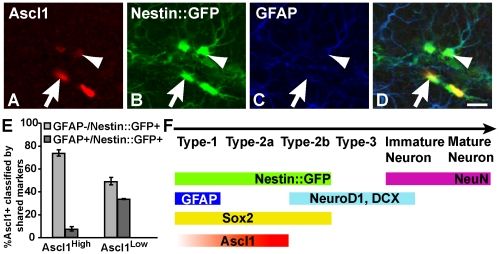
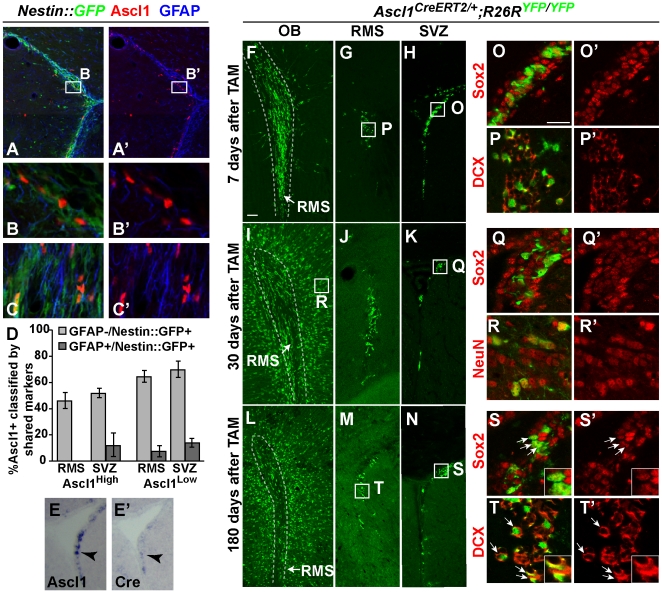
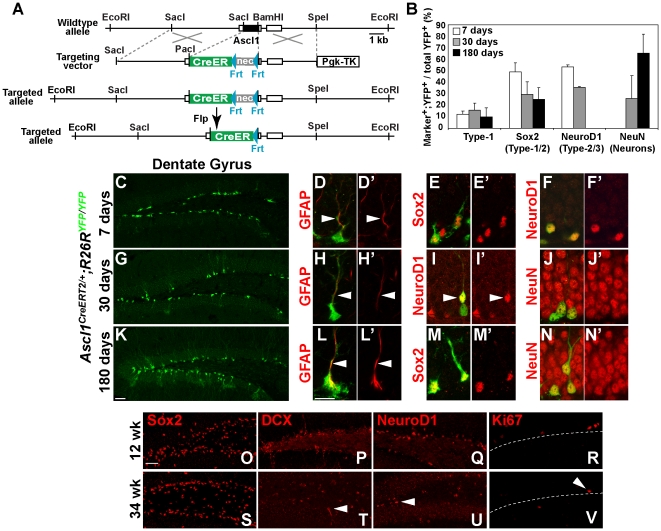
Ascl1 (Mash1) is a bHLH transcription factor essential for neural differentiation during embryogenesis but its role in adult neurogenesis is less clear. Here we show that in the adult brain Ascl1 is dynamically expressed during neurogenesis in the dentate gyrus subgranular zone (SGZ) and more rostral subventricular zone (SVZ). Specifically, we find Ascl1 levels low in SGZ Type-1 cells and SVZ B cells but increasing as the cells transition to intermediate progenitor stages. In vivo genetic lineage tracing with a tamoxifen (TAM) inducible Ascl1CreERT2 knock-in mouse strain shows that Ascl1 lineage cells continuously generate new neurons over extended periods of time. There is a regionally-specific difference in neuron generation, with mice given TAM at postnatal day 50 showing new dentate gyrus neurons through 30 days post-TAM, but showing new olfactory bulb neurons even 180 days post-TAM. These results show that Ascl1 is not restricted to transit amplifying populations but is also found in a subset of neural stem cells with long-term neurogenic potential in the adult brain.
Ascl1(Mash1)是胚胎发生过程中神经分化所必需的 bHLH 转录因子,但它在成年神经发生中的作用尚不清楚。在这里,我们发现在成年大脑中,Ascl1 在齿状回颗粒下区(SGZ)和更前端的侧脑室下区(SVZ)的神经发生过程中动态表达。具体来说,我们发现 SGZ 类型 1 细胞和 SVZ B 细胞中的 Ascl1 水平较低,但随着细胞向中间祖细胞阶段过渡而增加。用他莫昔芬(TAM)诱导的可诱导 Ascl1CreERT2 敲入小鼠品系进行体内遗传谱系追踪表明,Ascl1 谱系细胞在延长的时间内持续产生新的神经元。神经元生成存在区域特异性差异,在出生后第 50 天给予 TAM 的小鼠通过 30 天的 TAM 后出现新的齿状回神经元,但在 TAM 后 180 天仍出现新的嗅球神经元。这些结果表明,Ascl1 不仅局限于过渡扩增群体,而且还存在于具有长期神经发生潜力的成年大脑中的神经干细胞亚群中。