TNO-Metabolic Health Research, Leiden, The Netherlands.
PLoS One. 2011 Mar 31;6(3):e18432. doi: 10.1371/journal.pone.0018432.
Alternate day calorie restriction (CR) has been shown to be almost as beneficial as daily CR. The question arises whether this concept is also applicable to alternating dietary composition.
To seek evidence that alternating high cholesterol (HC)-cholesterol-free (CON) Western diet can effectively diminish hepatic and renal inflammation and cardiovascular risk factors as compared with daily HC-supplemented Western diet.
Four groups of ApoE*3Leiden mice, a humanized model for atherosclerosis, were subjected to different feeding treatments for 16 weeks. Mice were fed CON diet; CON diet with 1% w/w cholesterol (HC); alternate (ALT) diet regimen of CON (4 days) and HC (3 days); or CON diet supplemented with 0.43% (w/w) cholesterol (MC), with overall dietary cholesterol intake equal to ALT. Plasma was analyzed for cardiovascular risk factors, aorta for atherosclerotic lesion formation, and liver and kidney for inflammation.
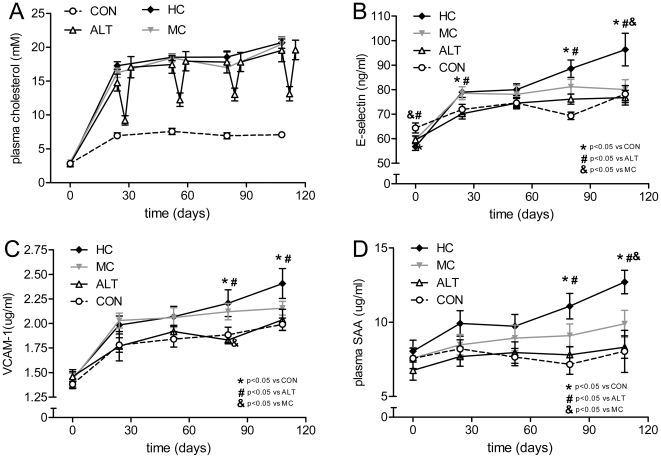
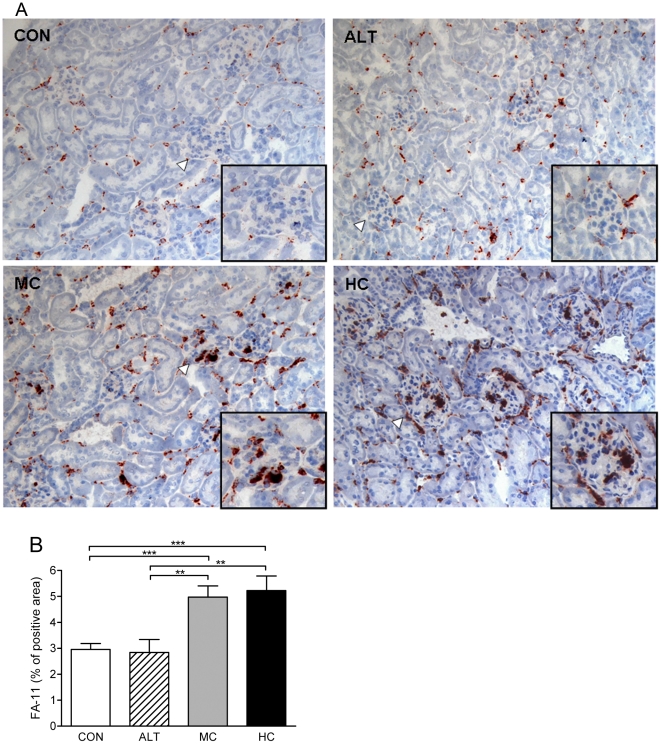
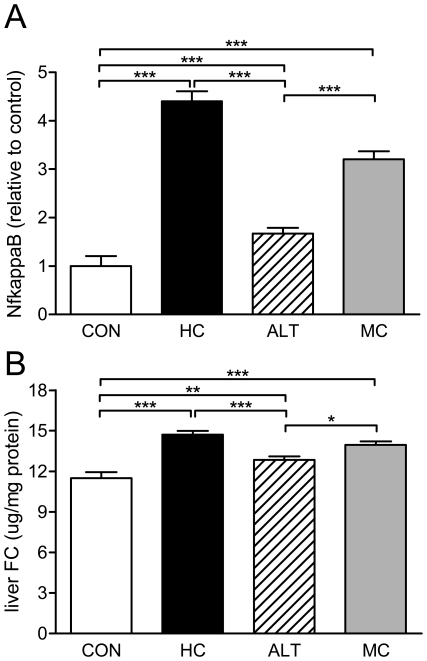
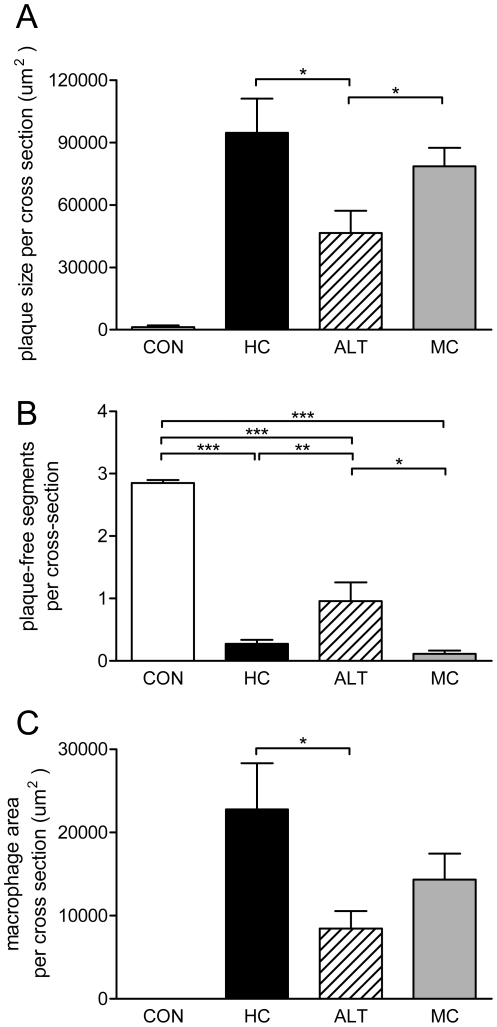
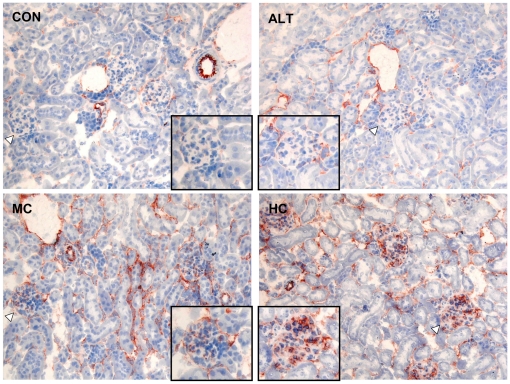
ALT diet but not MC was almost as effective as daily CON feeding in preventing disease development. Compared to HC, the ALT group showed 62% lower hepatic nuclear factor kappa B (NF-κB) activity (P<0.001), a reduction of the circulating inflammatory markers E-selectin (-20%; P<0.05), vascular cell adhesion molecule 1 (VCAM-1; -15%; P<0.05) and Serum Amyloid A (SAA; -31%; P<0.05), smaller atherosclerotic lesion sizes (-51%; 46497±10791 µm2 vs. 94664±16470 µm2; P<0.05) and diminished renal expression of specific inflammation and activation markers (VCAM-1, -27%; P<0.05; monocyte chemotactic protein-1 (MCP-1); -37%; P<0.01).
Alternate HC-CON feeding reproduced most of the beneficial effects of daily cholesterol-free diet, including strongly diminished hepatic, vascular and renal activation and inflammation; also atherosclerosis was reduced by half as compared to HC, albeit still higher compared to the CON group.
隔日热量限制(CR)已被证明几乎与每日 CR 一样有益。问题是,这一概念是否也适用于交替的饮食成分。
寻找证据表明,与每日补充胆固醇的西方饮食相比,交替高胆固醇(HC)-无胆固醇(CON)西方饮食可以有效减轻肝脏和肾脏炎症以及心血管危险因素。
4 组载脂蛋白 E*3Leiden 小鼠,一种动脉粥样硬化的人源化模型,接受不同的喂养处理 16 周。小鼠分别喂食 CON 饮食、含 1%w/w 胆固醇的 CON 饮食(HC)、CON(4 天)和 HC(3 天)交替饮食(ALT)、或补充 0.43%(w/w)胆固醇的 CON 饮食(MC),总体膳食胆固醇摄入量与 ALT 相同。分析血浆中的心血管危险因素、主动脉中的动脉粥样硬化病变形成以及肝脏和肾脏中的炎症。
ALT 饮食但不是 MC 饮食,与每日 CON 喂养一样,几乎可以有效地预防疾病的发展。与 HC 相比,ALT 组肝脏核因子 κB(NF-κB)活性降低 62%(P<0.001),循环炎症标志物 E-选择素降低 20%(P<0.05)、血管细胞黏附分子 1(VCAM-1)降低 15%(P<0.05)、血清淀粉样蛋白 A(SAA)降低 31%(P<0.05)、动脉粥样硬化病变大小减小 51%(46497±10791 µm2 比 94664±16470 µm2;P<0.05),肾脏特异性炎症和激活标志物的表达减少(VCAM-1 减少 27%,P<0.05;单核细胞趋化蛋白-1(MCP-1)减少 37%,P<0.01)。
交替 HC-CON 喂养再现了每日无胆固醇饮食的大部分有益作用,包括强烈减轻肝脏、血管和肾脏的激活和炎症;与 HC 相比,动脉粥样硬化减少了一半,但仍高于 CON 组。