Université Pierre et Marie Curie-Paris 6, UMR S945, Paris, France.
PLoS One. 2011 Mar 31;6(3):e18162. doi: 10.1371/journal.pone.0018162.
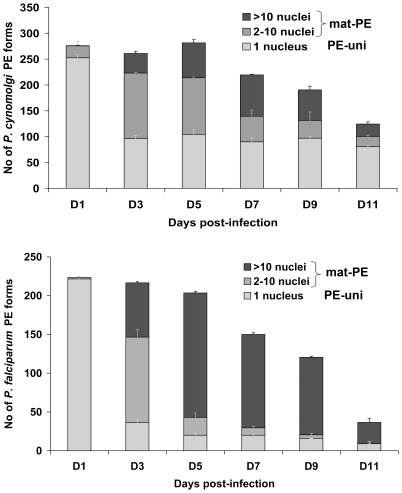
Amongst the Plasmodium species in humans, only P. vivax and P. ovale produce latent hepatic stages called hypnozoites, which are responsible for malaria episodes long after a mosquito bite. Relapses contribute to increased morbidity, and complicate malaria elimination programs. A single drug effective against hypnozoites, primaquine, is available, but its deployment is curtailed by its haemolytic potential in glucose-6-phosphate dehydrogenase deficient persons. Novel compounds are thus urgently needed to replace primaquine. Discovery of compounds active against hypnozoites is restricted to the in vivo P. cynomolgi-rhesus monkey model. Slow growing hepatic parasites reminiscent of hypnozoites had been noted in cultured P. vivax-infected hepatoma cells, but similar forms are also observed in vitro by other species including P. falciparum that do not produce hypnozoites.
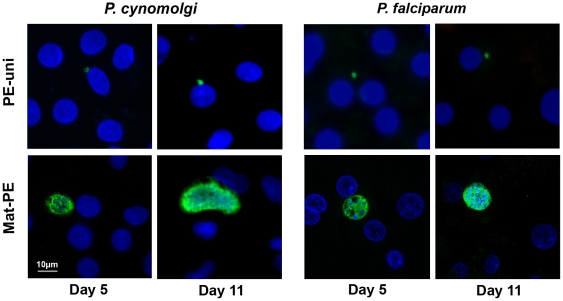
P. falciparum or P. cynomolgi sporozoites were used to infect human or Macaca fascicularis primary hepatocytes, respectively. The susceptibility of the slow and normally growing hepatic forms obtained in vitro to three antimalarial drugs, one active against hepatic forms including hypnozoites and two only against the growing forms, was measured.
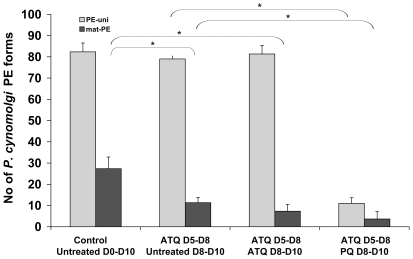
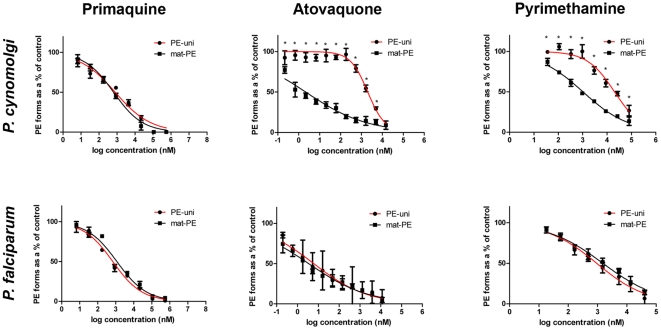
The non-dividing slow growing P. cynomolgi hepatic forms, observed in vitro in primary hepatocytes from the natural host Macaca fascicularis, can be distinguished from similar forms seen in P. falciparum-infected human primary hepatocytes by the differential action of selected anti-malarial drugs. Whereas atovaquone and pyrimethamine are active on all the dividing hepatic forms observed, the P. cynomolgi slow growing forms are highly resistant to treatment by these drugs, but remain susceptible to primaquine.
Resistance of the non-dividing P. cynomolgi forms to atovaquone and pyrimethamine, which do not prevent relapses, strongly suggests that these slow growing forms are hypnozoites. This represents a first step towards the development of a practical medium-throughput in vitro screening assay for novel hypnozoiticidal drugs.
在人类中的疟原虫属中,只有间日疟原虫和卵形疟原虫产生潜伏的肝期称为休眠子,这些休眠子是导致蚊子叮咬后长时间发生疟疾的原因。复发会导致发病率增加,并使疟疾消除计划复杂化。有一种有效的抗休眠子药物,即伯氨喹,但由于其在葡萄糖-6-磷酸脱氢酶缺乏者中的溶血作用,其应用受到限制。因此,迫切需要新型化合物来替代伯氨喹。对休眠子有活性的化合物的发现仅限于体内恒河猴疟原虫-恒河猴模型。在培养的间日疟原虫感染的肝癌细胞中已经注意到类似于休眠子的缓慢生长的肝期寄生虫,但在其他物种(包括不产生休眠子的恶性疟原虫)的体外也观察到类似的形式。
用恶性疟原虫或食蟹猴疟原虫孢子虫感染人或猕猴原代肝细胞。测量在体外获得的缓慢和正常生长的肝期形式对三种抗疟药物的敏感性,其中一种药物对包括休眠子在内的肝期形式有效,两种药物仅对生长形式有效。
在天然宿主猕猴的原代肝细胞中,在体外观察到的非分裂缓慢生长的食蟹猴肝期形式,可以通过选择的抗疟药物的差异作用与在恶性疟原虫感染的人原代肝细胞中观察到的类似形式区分开来。阿托伐醌和乙胺嘧啶对所有观察到的分裂肝期形式均有效,而食蟹猴缓慢生长的形式对这些药物高度耐药,但仍对伯氨喹敏感。
非分裂的食蟹猴形式对阿托伐醌和乙胺嘧啶的耐药性,这些药物不能预防复发,强烈表明这些缓慢生长的形式是休眠子。这是朝着开发新的休眠子杀伤药物实用高通量体外筛选测定法迈出的第一步。