Department of Surgery, Arrowhead Regional Medical Center, Colton, California, USA.
Scand J Trauma Resusc Emerg Med. 2011 Apr 13;19:24. doi: 10.1186/1757-7241-19-24.
Sodium acetate has been shown to cause hemodynamic instability when used as a hemodialysis buffer. The pattern of hemodynamic response to injury will be evaluated between those who received sodium acetate and those who did not.The primary purpose of the study is to analyze the effect of sodium acetate on hemodynamic parameters. Secondarily we looked at the effects on prevention and treatment of hyperchloremic metabolic acidosis.
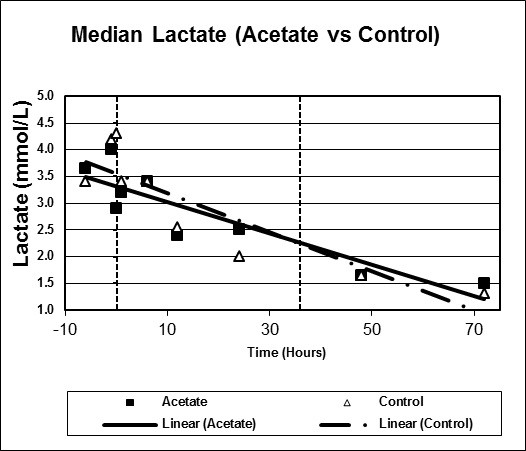
The study arm was comprised of patients who had received sodium acetate infusions in place of normal saline between March 2005 and December 2009. A control arm was created based on matching three pre-treatment variables: injury severity score (ISS), pH (+/- 0.03) and base deficit (+/- 3). A retrospective chart review was performed for patients in both arms. Blood pressure, arterial blood gas data and chemistry values were recorded for the time points of -6, -1, 0, 1, 6, 12, 24, 48, and 72 hours from start of sodium acetate infusion. Patients were excluded based on the following criteria: patients who were given sodium bicarbonate within 48 hours of starting sodium acetate, those given sodium acetate as a bolus, non-trauma patients, burn patients, patients who expired within 24 hours of arrival to the ICU, patients diagnosed with rhabdomyolysis and patients whose medical record could not be obtained.
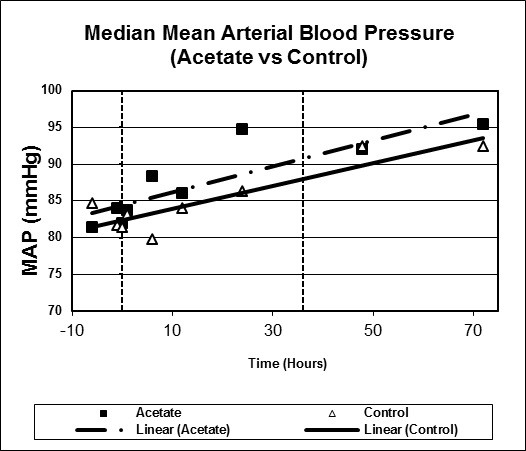
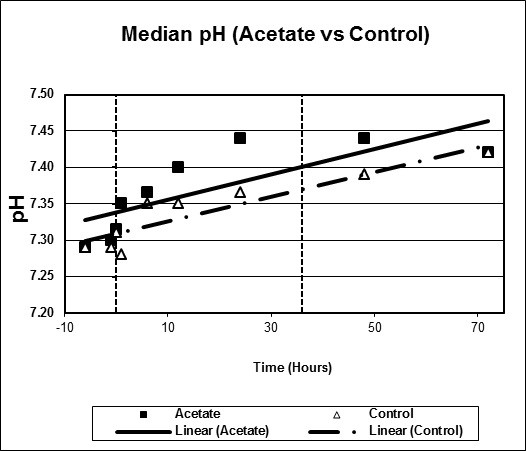
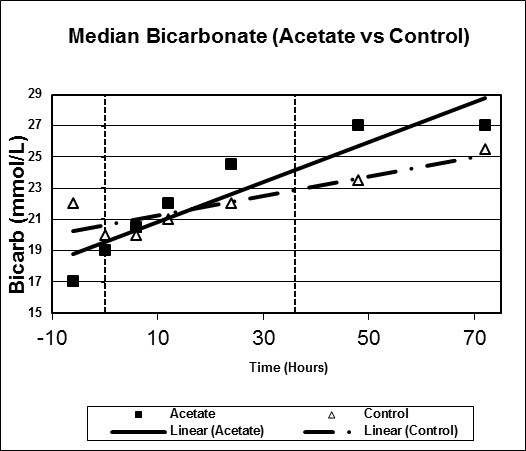
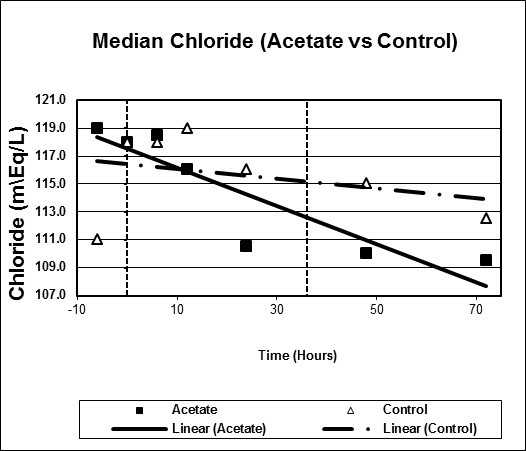
A total of 78 patients were included in the study, 39 in the study arm and 39 in the control arm. There were no statistically significant drops in blood pressure within either group. The median pH between the two groups at the start of infusion was equal. Both groups trended towards normal pH with the study arm improving faster than the control arm. The median serum bicarbonate at start of sodium acetate infusion was 19 mmol/L and 20 mmol/L at time zero for the study and control arms respectively with both trending upward during the study period. Chloride trended up initially in both groups but the study arm began to correct sooner at 24 hours compared to 48 hours for the control arm.
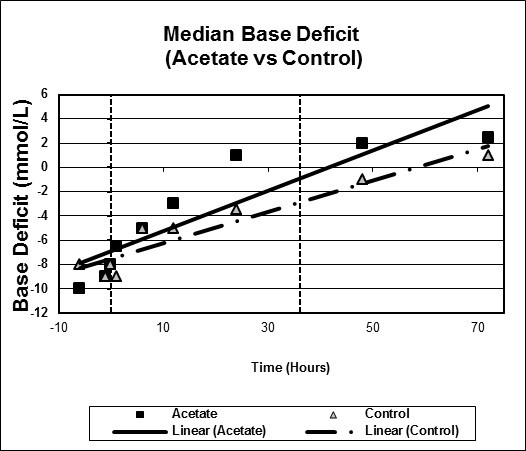
We analyzed the use of sodium acetate as an alternative to normal saline or lactated ringers during resuscitation of critically ill trauma patients at a single center. Our data shows that the hemodynamic profile remained favorable, without evidence of instability at any point during the study period. Normalization of hyperchloremia and metabolic acidosis occurred faster in the patients who received sodium acetate.
当用作血液透析缓冲液时,醋酸钠已被证明会导致血液动力学不稳定。将评估接受醋酸钠和未接受醋酸钠的患者之间对损伤的血液动力学反应模式。本研究的主要目的是分析醋酸钠对血液动力学参数的影响。其次,我们观察了其在预防和治疗高氯代谢性酸中毒方面的作用。
研究组由 2005 年 3 月至 2009 年 12 月期间接受醋酸钠输注替代生理盐水的患者组成。根据损伤严重程度评分(ISS)、pH 值(+/-0.03)和基础缺陷(+/-3)匹配三个预处理变量,创建了对照组。对两组患者进行了回顾性图表审查。从开始输注醋酸钠的-6、-1、0、1、6、12、24、48 和 72 小时记录血压、动脉血气数据和化学值。根据以下标准排除患者:在开始使用醋酸钠后 48 小时内给予碳酸氢钠的患者、给予醋酸钠作为推注的患者、非创伤患者、烧伤患者、入住 ICU 后 24 小时内死亡的患者、诊断为横纹肌溶解症的患者和无法获取病历的患者。
共有 78 例患者纳入研究,研究组 39 例,对照组 39 例。两组患者血压均无明显下降。两组输注开始时的中位 pH 值相等。两组的 pH 值均呈正态趋势,研究组的 pH 值改善速度快于对照组。醋酸钠输注开始时两组血清碳酸氢盐的中位数分别为 19mmol/L 和 20mmol/L,研究组和对照组在研究期间均呈上升趋势。氯最初在两组均呈上升趋势,但研究组在 24 小时时开始纠正,而对照组在 48 小时时才开始纠正。
我们分析了在单中心对危重症创伤患者进行复苏时使用醋酸钠替代生理盐水或乳酸林格氏液的情况。我们的数据表明,在整个研究期间,血液动力学特征保持良好,没有不稳定的证据。接受醋酸钠的患者更快地纠正高氯血症和代谢性酸中毒。