Center of Research on Psychology in Somatic diseases [CoRPS], Department of Medical Psychology and Neuropsychology, Tilburg University, Tilburg, the Netherlands.
BMC Pediatr. 2011 Apr 14;11:28. doi: 10.1186/1471-2431-11-28.
In young children with type 1 diabetes mellitus (T1DM) parents have full responsibility for the diabetes-management of their child (e.g. blood glucose monitoring, and administering insulin). Behavioral tasks in childhood, such as developing autonomy, and oppositional behavior (e.g. refusing food) may interfere with the diabetes-management to achieve an optimal blood glucose control. Furthermore, higher blood glucose levels are related to more behavioral problems. So parents might need to negotiate with their child on the diabetes-management to avoid this direct negative effect. This interference, the negotiations, and the parent's responsibility for diabetes may negatively affect the quality of parent-child interaction. Nevertheless, there is little knowledge about the quality of interaction between parents and young children with T1DM, and the possible impact this may have on glycemic control and psychosocial functioning of the child. While widely used global parent-child interaction observational methods are available, there is a need for an observational tool specifically tailored to the interaction patterns of parents and children with T1DM. The main aim of this study is to construct a disease-specific observational method to assess diabetes-specific parent-child interaction. Additional aim is to explore whether the quality of parent-child interactions is associated with the glycemic control, and psychosocial functioning (resilience, behavioral problems, and quality of life).
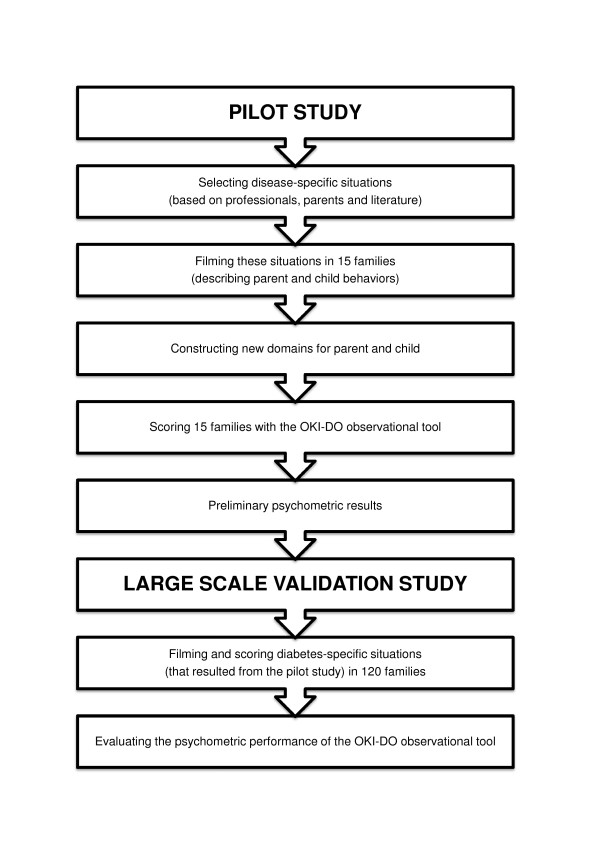
METHODS/DESIGN: First, we will examine which situations are most suitable for observing diabetes-specific interactions. Then, these situations will be video-taped in a pilot study (N = 15). Observed behaviors are described into rating scales, with each scale describing characteristics of parent-child interactional behaviors. Next, we apply the observational tool on a larger scale for further evaluation of the instrument (N = 120). The parents are asked twice (with two years in between) to fill out questionnaires about psychosocial functioning of their child with T1DM. Furthermore, glycemic control (HbA1c) will be obtained from their medical records.
A disease-specific observational tool will enable the detailed assessment of the quality of diabetes-specific parent-child interactions. The availability of such a tool will facilitate future (intervention) studies that will yield more knowledge about impact of parent-child interactions on psychosocial functioning, and glycemic control of children with T1DM.
在患有 1 型糖尿病(T1DM)的幼儿中,父母对孩子的糖尿病管理负有全部责任(例如,血糖监测和胰岛素注射)。儿童时期的行为任务,例如发展自主性和对立行为(例如拒绝进食),可能会干扰糖尿病管理,以实现最佳血糖控制。此外,更高的血糖水平与更多的行为问题有关。因此,父母可能需要与孩子就糖尿病管理进行协商,以避免这种直接的负面影响。这种干扰、协商以及父母对糖尿病的责任可能会对亲子互动的质量产生负面影响。尽管如此,对于患有 T1DM 的父母与幼儿之间互动质量的了解甚少,也不清楚这可能对孩子的血糖控制和心理社会功能产生什么影响。虽然有广泛使用的全球亲子互动观察方法,但需要一种专门针对 T1DM 患儿亲子互动模式的观察工具。本研究的主要目的是构建一种疾病特异性观察方法来评估糖尿病特异性的亲子互动。另外的目的是探讨亲子互动的质量是否与血糖控制以及心理社会功能(适应力、行为问题和生活质量)相关。
方法/设计:首先,我们将研究哪些情况最适合观察糖尿病特异性的互动。然后,将在一项试点研究中(N=15)对这些情况进行录像。观察到的行为被描述为评分量表,每个量表描述亲子互动行为的特征。接下来,我们将在更大的范围内应用观察工具,以进一步评估该工具(N=120)。父母将在两次(相隔两年)时被要求填写有关 T1DM 患儿心理社会功能的问卷。此外,将从他们的医疗记录中获取血糖控制(HbA1c)数据。
疾病特异性观察工具将能够详细评估糖尿病特异性亲子互动的质量。这种工具的可用性将促进未来(干预)研究,从而更多地了解亲子互动对儿童 T1DM 的心理社会功能和血糖控制的影响。