Departments of Medicine/Cardiology, University of Utah, Salt Lake City, 84132, USA.
Circ Arrhythm Electrophysiol. 2011 Jun;4(3):279-86. doi: 10.1161/CIRCEP.110.960567. Epub 2011 Apr 14.
Ablation has become an important tool in treating atrial fibrillation and ventricular tachycardia, yet the recurrence rates remain high. It is well established that ablation lines can be discontinuous and that conduction through the gaps in ablation lines can be affected by tissue heating. In this study, we looked at the effect of tissue conductivity and propagation of electric wave fronts across ablation lines with gaps, using both simulations and an animal model.
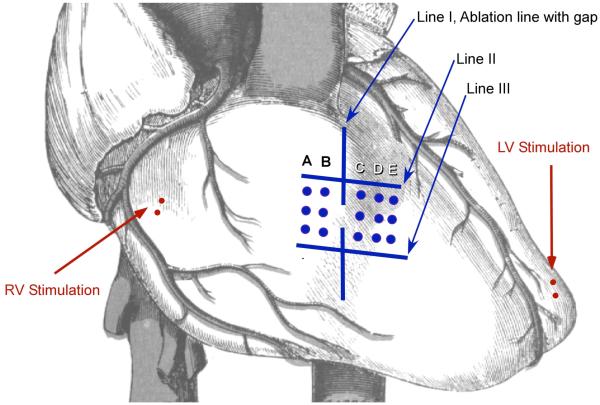
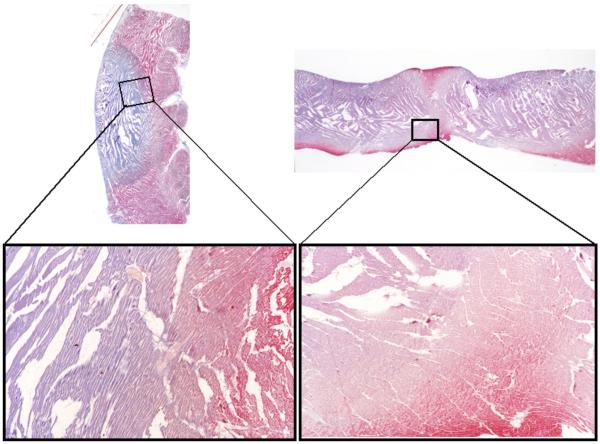
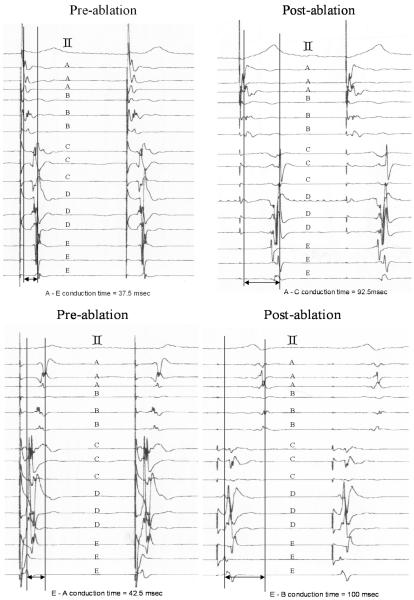
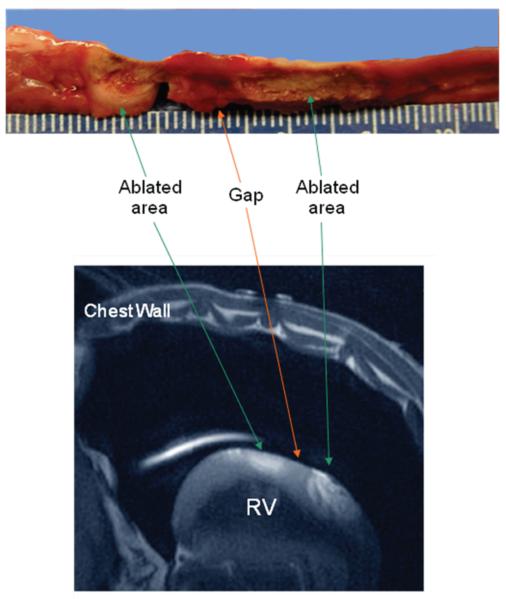
For the simulations, we implemented a 2-dimensional bidomain model of the cardiac syncytium, simulating ablation lines with gaps of varying lengths, conductivity, and orientation. For the animal model, transmural ablation lines with a gap were created in 7 mongrel dogs. The gap length was progressively decreased until there was conduction block. The ablation line with a gap was then imaged using MRI and was correlated with histology. With normal conductivity in the gap and the ablation line oriented parallel to the fiber direction, the simulation predicted that the maximum gap length that exhibited conduction block was 1.4 mm. As the conductivity was decreased, the maximum gap length with conduction block increased substantially, that is, with a conductivity of 67% of normal, the maximum gap length with conduction block increased to 4 mm. In the canine studies, the maximum gap length that displayed conduction block acutely as measured by gross pathology correlated well (R(2) of 0.81) with that measured by MRI.
Conduction block can occur across discontinuous ablation lines. Moreover, with recovery of conductivity over time, ablation lines with large gaps exhibiting acute conduction block may recover propagation in the gap over time, allowing recurrences of arrhythmias. The ability to see gaps acutely using MRI will allow for targeting these sites for ablation.
消融术已成为治疗心房颤动和室性心动过速的重要手段,但复发率仍然很高。众所周知,消融线可能不连续,并且消融线间隙中的传导可能会受到组织加热的影响。在这项研究中,我们使用模拟和动物模型研究了组织电导率和电脉冲波前在有间隙的消融线中的传播。
对于模拟,我们实现了心脏合体的二维双域模型,模拟了具有不同长度、电导率和方向的消融线间隙。对于动物模型,在 7 只杂种犬中创建了具有间隙的透壁消融线。逐渐减小间隙长度,直到出现传导阻滞。然后使用 MRI 对带有间隙的消融线进行成像,并与组织学相关联。在间隙和消融线的电导率正常且与纤维方向平行的情况下,模拟预测表现出传导阻滞的最大间隙长度为 1.4mm。随着电导率的降低,表现出传导阻滞的最大间隙长度显著增加,也就是说,当电导率降低到正常的 67%时,表现出传导阻滞的最大间隙长度增加到 4mm。在犬的研究中,通过大体病理学急性测量显示传导阻滞的最大间隙长度与通过 MRI 测量的结果高度相关(R²为 0.81)。
不连续的消融线之间可能发生传导阻滞。此外,随着电导率随时间的恢复,在具有大间隙的急性传导阻滞的消融线中,可能会随着时间的推移在间隙中恢复传播,从而导致心律失常的复发。使用 MRI 急性观察到间隙的能力将允许针对这些部位进行消融。