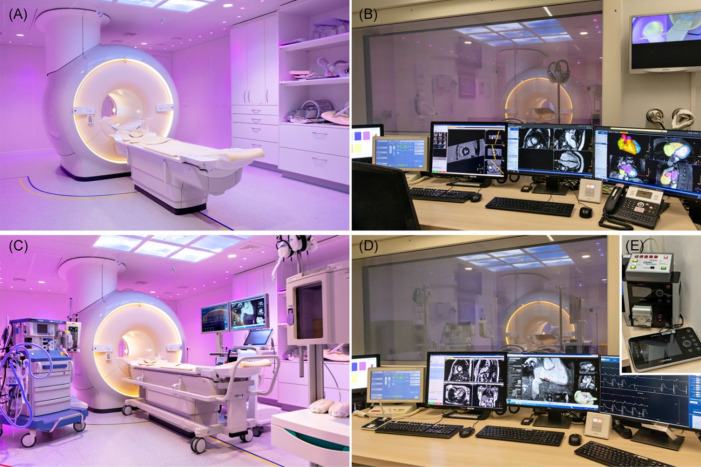
Tampakis Konstantinos, Pastromas Sokratis, Sykiotis Alexandros, Kampanarou Stamatina, Kourgiannidis Georgios, Pyrpiri Chrysa, Bousoula Maria, Rozakis Dimitrios, Andrikopoulos George
Department of Pacing & Electrophysiology, Henry Dunant Hospital Center, Athens 11526, Greece.
Department of Radiology, Henry Dunant Hospital Center, Athens 11526, Greece.
World J Cardiol. 2023 Sep 26;15(9):415-426. doi: 10.4330/wjc.v15.i9.415.
Cardiac magnetic resonance (CMR) imaging could enable major advantages when guiding in real-time cardiac electrophysiology procedures offering high-resolution anatomy, arrhythmia substrate, and ablation lesion visualization in the absence of ionizing radiation. Over the last decade, technologies and platforms for performing electrophysiology procedures in a CMR environment have been developed. However, performing procedures outside the conventional fluoroscopic laboratory posed technical, practical and safety concerns. The development of magnetic resonance imaging compatible ablation systems, the recording of high-quality electrograms despite significant electromagnetic interference and reliable methods for catheter visualization and lesion assessment are the main limiting factors. The first human reports, in order to establish a procedural workflow, have rationally focused on the relatively simple typical atrial flutter ablation and have shown that CMR-guided cavotricuspid isthmus ablation represents a valid alternative to conventional ablation. Potential expansion to other more complex arrhythmias, especially ventricular tachycardia and atrial fibrillation, would be of essential impact, taking into consideration the widespread use of substrate-based strategies. Importantly, all limitations need to be solved before application of CMR-guided ablation in a broad clinical setting.
心脏磁共振(CMR)成像在实时指导心脏电生理手术时具有诸多显著优势,能够提供高分辨率的解剖结构、心律失常基质以及消融灶可视化,且无需电离辐射。在过去十年中,已开发出在CMR环境中进行电生理手术的技术和平台。然而,在传统荧光透视实验室之外进行手术存在技术、实践和安全方面的问题。磁共振成像兼容的消融系统的开发、尽管存在显著电磁干扰仍能记录高质量的心电信号,以及用于导管可视化和病灶评估的可靠方法,是主要的限制因素。为建立手术流程,首批人体报告合理地聚焦于相对简单的典型心房扑动消融,并表明CMR引导下的腔静脉峡部消融是传统消融的有效替代方法。考虑到基于基质的策略的广泛应用,向其他更复杂的心律失常(尤其是室性心动过速和心房颤动)的潜在扩展将具有至关重要的影响。重要的是,在CMR引导的消融在广泛临床环境中应用之前,所有限制都需要得到解决。