Key Laboratory of Systems Biomedicine (Ministry of Education), Shanghai Center for Systems Biomedicine, Shanghai Jiao Tong University, Shanghai, China.
PLoS One. 2011 Apr 11;6(4):e18414. doi: 10.1371/journal.pone.0018414.
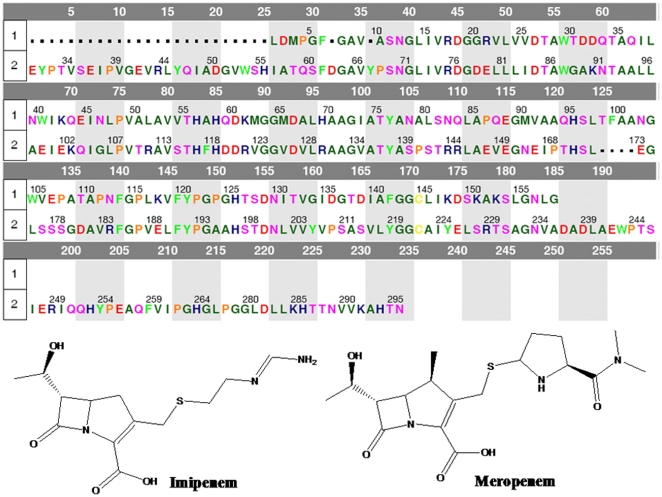
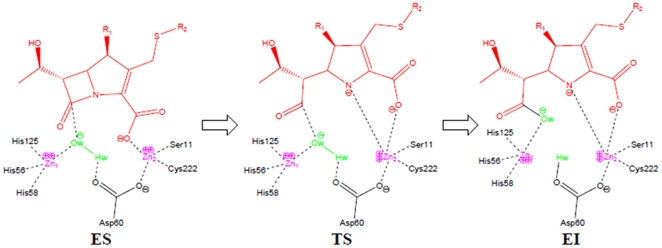
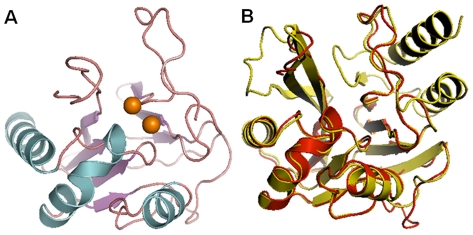
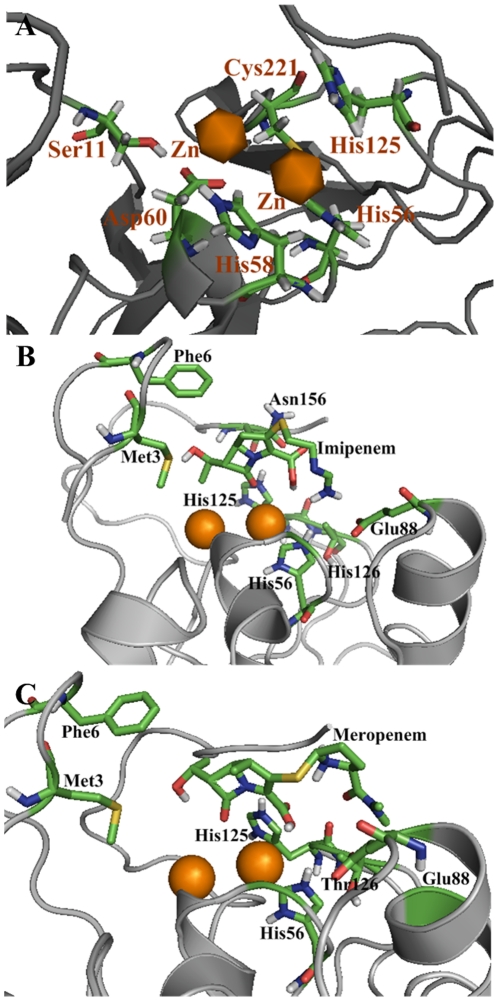
New Delhi metallo-beta-lactamase (NDM-1) is an enzyme that makes bacteria resistant to a broad range of beta-lactam antibiotic drugs. This is because it can inactivate most beta-lactam antibiotic drugs by hydrolyzing them. For in-depth understanding of the hydrolysis mechanism, the three-dimensional structure of NDM-1 was developed. With such a structural frame, two enzyme-ligand complexes were derived by respectively docking Imipenem and Meropenem (two typical beta-lactam antibiotic drugs) to the NDM-1 receptor. It was revealed from the NDM-1/Imipenem complex that the antibiotic drug was hydrolyzed while sitting in a binding pocket of NDM-1 formed by nine residues. And for the case of NDM-1/Meropenem complex, the antibiotic drug was hydrolyzed in a binding pocket formed by twelve residues. All these constituent residues of the two binding pockets were explicitly defined and graphically labeled. It is anticipated that the findings reported here may provide useful insights for developing new antibiotic drugs to overcome the resistance problem.
新德里金属β-内酰胺酶(NDM-1)是一种能够使细菌对多种β-内酰胺类抗生素药物产生耐药性的酶。这是因为它可以通过水解来使大多数β-内酰胺类抗生素药物失活。为了深入了解水解机制,开发了 NDM-1 的三维结构。有了这样的结构框架,通过分别对接亚胺培南和美罗培南(两种典型的β-内酰胺类抗生素药物)到 NDM-1 的受体,得到了两个酶-配体复合物。从 NDM-1/亚胺培南复合物中揭示了抗生素药物在 NDM-1 形成的由九个残基组成的结合口袋中水解。对于 NDM-1/美罗培南复合物的情况,抗生素药物在由十二个残基组成的结合口袋中水解。两个结合口袋的所有组成残基都被明确定义并图形标记。预计这里报道的发现可能为开发新的抗生素药物以克服耐药性问题提供有用的见解。