Guangxi Academy of Sciences, Nanning, Guangxi, China.
PLoS One. 2010 Feb 23;5(2):e9388. doi: 10.1371/journal.pone.0009388.
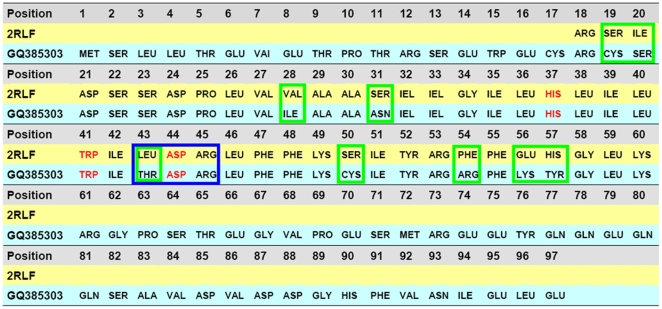
M2 proton channel of H1N1 influenza A virus is the target protein of anti-flu drugs amantadine and rimantadine. However, the two once powerful adamantane-based drugs lost their 90% bioactivity because of mutations of virus in recent twenty years. The NMR structure of the M2 channel protein determined by Schnell and Chou (Nature, 2008, 451, 591-595) may help people to solve the drug-resistant problem and develop more powerful new drugs against H1N1 influenza virus.
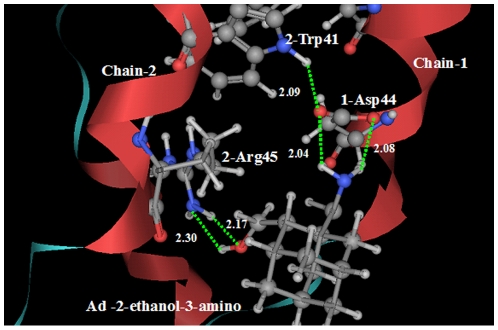
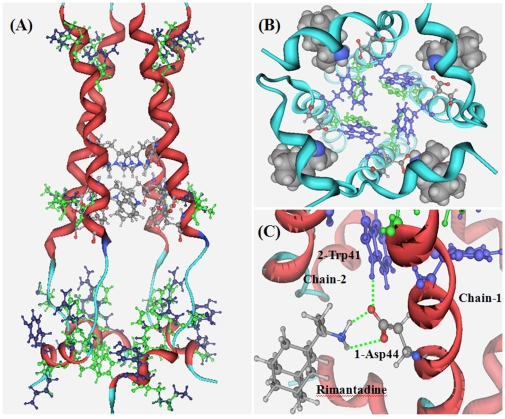
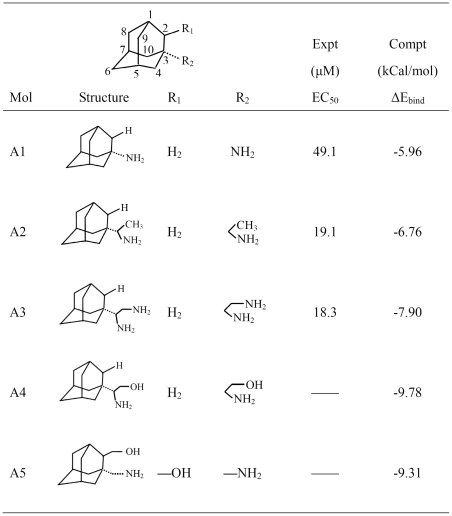
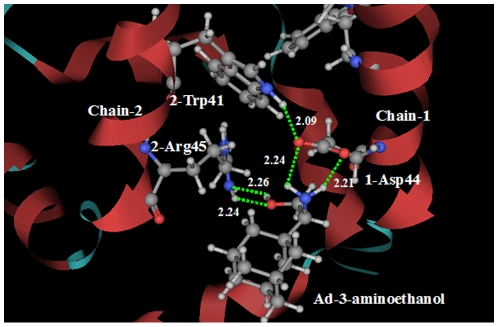
Docking calculation is performed to build the complex structure between receptor M2 proton channel and ligands, including existing drugs amantadine and rimantadine, and two newly designed inhibitors. The computer-aided drug design methods are used to calculate the binding free energies, with the computational biology techniques to analyze the interactions between M2 proton channel and adamantine-based inhibitors.
H1N1 流感病毒的 M2 质子通道是金刚烷胺和金刚乙胺等抗流感药物的靶标蛋白。然而,这两种曾经强大的金刚烷类药物在过去 20 年中由于病毒的突变,失去了 90%的生物活性。Schnell 和 Chou(自然,2008,451,591-595)确定的 M2 通道蛋白的 NMR 结构可能有助于人们解决耐药性问题,并开发更强大的针对 H1N1 流感病毒的新药。
对接计算构建了受体 M2 质子通道与配体(包括现有药物金刚烷胺和金刚乙胺以及两种新设计的抑制剂)之间的复合物结构。计算机辅助药物设计方法用于计算结合自由能,并利用计算生物学技术分析 M2 质子通道与金刚烷类抑制剂之间的相互作用。
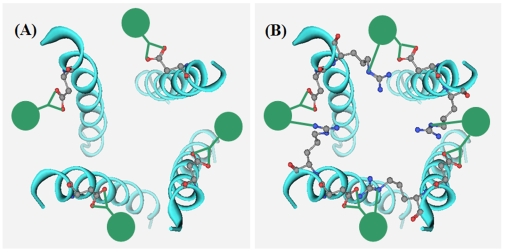
1)M2 质子通道的 NMR 结构为合理设计抗流感病毒药物提供了可靠的结构基础。2)M2 质子通道 NMR 结构揭示的通道门控机制和 M2 质子通道抑制机制为通道抑制剂设计提供了新的思路。3)基于 H1N1-M2 质子通道建模结构设计的新金刚烷类抑制剂具有两个药效团,通过通道外的两个药效团,像“桶箍”一样将 H1N1-M2 四聚体的两个相邻螺旋固定在一起。4)具有这种结合机制的抑制剂可能克服流感病毒对金刚烷类药物的耐药性问题。