Department of Mechanical Engineering, Massachusetts Institute of Technology, Cambridge, MA 02139, USA.
Cell. 2011 Apr 15;145(2):257-67. doi: 10.1016/j.cell.2011.03.036.
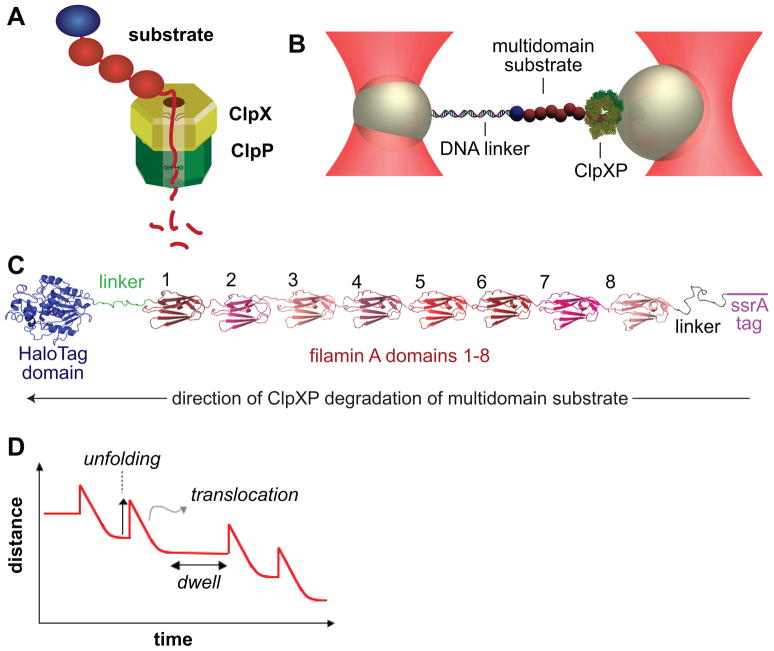
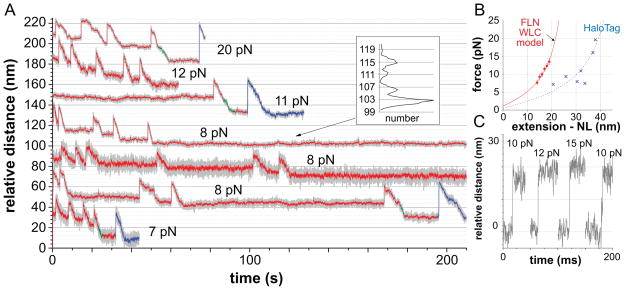
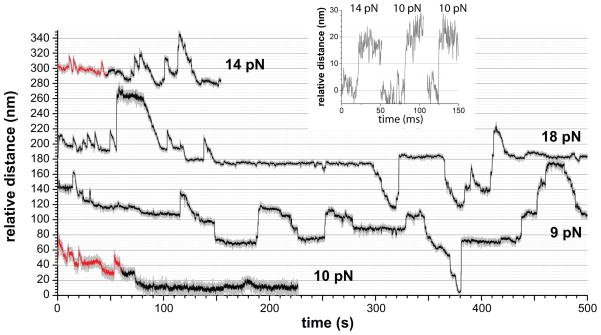
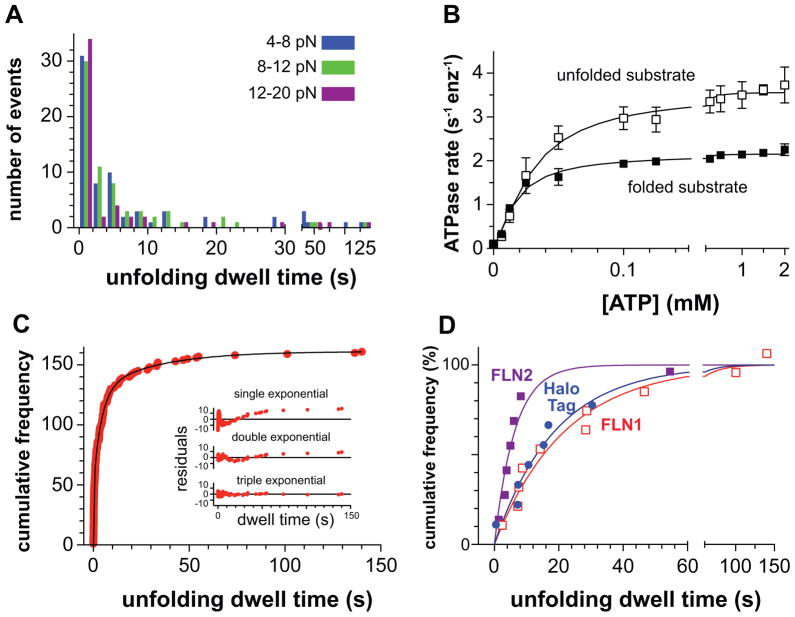
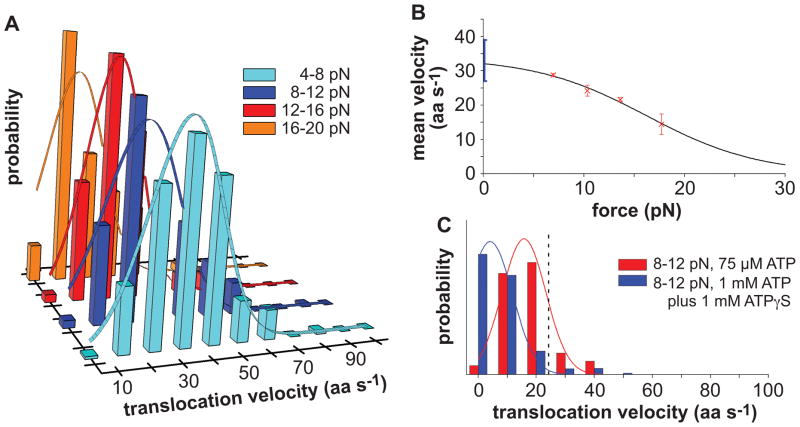
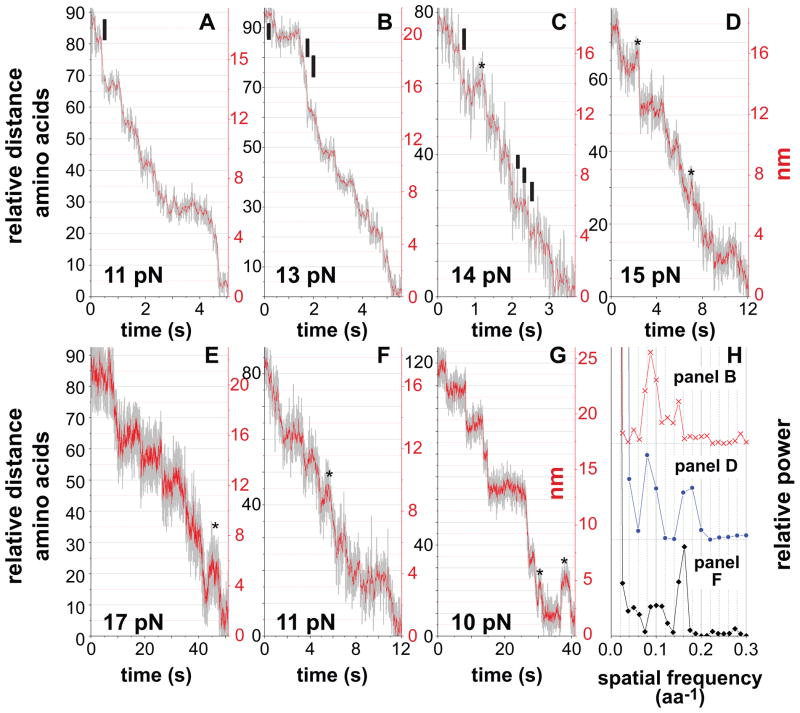
All cells employ ATP-powered proteases for protein-quality control and regulation. In the ClpXP protease, ClpX is a AAA+ machine that recognizes specific protein substrates, unfolds these molecules, and then translocates the denatured polypeptide through a central pore and into ClpP for degradation. Here, we use optical-trapping nanometry to probe the mechanics of enzymatic unfolding and translocation of single molecules of a multidomain substrate. Our experiments demonstrate the capacity of ClpXP and ClpX to perform mechanical work under load, reveal very fast and highly cooperative unfolding of individual substrate domains, suggest a translocation step size of 5-8 amino acids, and support a power-stroke model of denaturation in which successful enzyme-mediated unfolding of stable domains requires coincidence between mechanical pulling by the enzyme and a transient stochastic reduction in protein stability. We anticipate that single-molecule studies of the mechanical properties of other AAA+ proteolytic machines will reveal many shared features with ClpXP.
所有细胞都利用 ATP 驱动的蛋白酶来进行蛋白质质量控制和调节。在 ClpXP 蛋白酶中,ClpX 是一种 AAA+ 机器,能够识别特定的蛋白质底物,展开这些分子,然后将变性多肽穿过中央孔转移到 ClpP 中进行降解。在这里,我们使用光阱纳米技术来探测单个多域底物的酶促展开和易位的力学特性。我们的实验证明了 ClpXP 和 ClpX 在负载下进行机械工作的能力,揭示了单个底物结构域的非常快速和高度协同的展开,表明易位步长为 5-8 个氨基酸,并支持变性的动力冲程模型,其中成功的酶介导的稳定结构域展开需要酶的机械拉伸与蛋白质稳定性的瞬时随机降低之间的巧合。我们预计,对其他 AAA+ 蛋白水解机器的机械特性的单分子研究将揭示出许多与 ClpXP 共享的特征。