Laboratory of Experimental Carcinogenesis, Center for Cancer Research, National Cancer Institute, National Institute of Health, Bethesda, MD, USA.
Oncogene. 2011 Oct 6;30(40):4175-84. doi: 10.1038/onc.2011.126. Epub 2011 Apr 18.
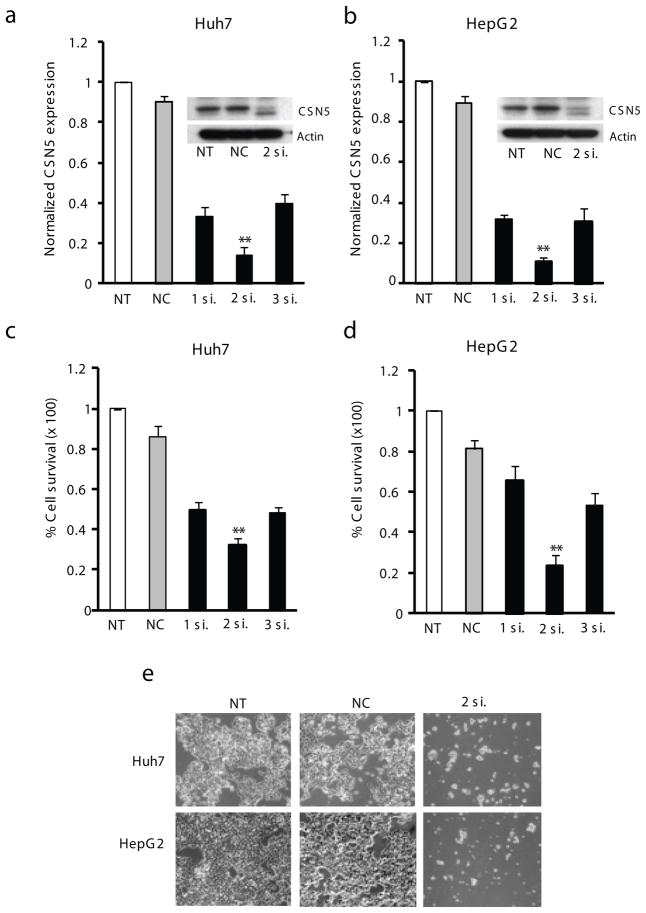
Development of targeted therapy for hepatocellular carcinoma (HCC) remains a major challenge. We have recently identified an elevated expression of the fifth subunit of COP9 signalosome (CSN5) in early HCC as compared with dysplastic stage. In the present study, we explored the possibility of CSN5 being a potential therapeutic target for HCC. Our results show that CSN5 knockdown by small-interfering (si) RNA caused a strong induction of apoptosis and inhibition of cell-cycle progression in HCC cells in vitro. The down-regulation of CSN5 was sufficient to interfere with CSN function as evidenced by the accumulation of neddylated Cullin 1 and changes in the protein levels of CSN-controlled substrates SKP2, p53, p27 and nuclear factor-κB, albeit to a different degree depending on the HCC cell line, which could account for the CSN5 knockdown phenotype. The transcriptomic analysis of CSN5 knockdown signature showed that the anti-proliferative effect was driven by a common subset of molecular alterations including down-regulation of cyclin-dependent kinase 6 (CDK6) and integrin β1 (ITGB1), which were functionally interconnected with key oncogenic regulators MYC and TGFβ1 involved in the control of proliferation, apoptotic cell death and HCC progression. Consistent with microarray analysis, western blotting revealed that CSN5 depletion increased phosphorylation of Smad 2/3, key mediators of TGFβ1 signaling, decreased the protein levels of ITGB1, CDK6 and cyclin D1 and caused reduced expression of anti-apoptotic Bcl-2, while elevating the levels of pro-apoptotic Bak. A chemically modified variant of CSN5 siRNA was then selected for in vivo application based on the growth inhibitory effect and minimal induction of unwanted immune response. Systemic delivery of the CSN5 3/8 variant by stable-nucleic-acid-lipid particles significantly suppressed the tumor growth in Huh7-luc+ orthotopic xenograft model. Taken together, these results indicate that CSN5 has a pivotal role in HCC pathogenesis and maybe an attractive molecular target for systemic HCC therapy.
肝细胞癌(HCC)的靶向治疗仍然是一个主要挑战。我们最近发现,与发育不良阶段相比,早期 HCC 中 COP9 信号体的第五亚基(CSN5)的表达升高。在本研究中,我们探讨了 CSN5 作为 HCC 潜在治疗靶点的可能性。我们的结果表明,CSN5 通过小干扰(si)RNA 敲低在体外导致 HCC 细胞强烈诱导细胞凋亡和细胞周期进程抑制。CSN5 的下调足以干扰 CSN 功能,这一点从 neddylated Cullin 1 的积累和 CSN 控制的底物 SKP2、p53、p27 和核因子-κB 的蛋白水平变化中得到证明,尽管根据 HCC 细胞系的不同程度不同,这可以解释 CSN5 敲低表型。CSN5 敲低特征的转录组分析表明,抗增殖作用是由一组共同的分子改变驱动的,包括细胞周期蛋白依赖性激酶 6(CDK6)和整合素β1(ITGB1)的下调,这些改变与参与增殖、细胞凋亡和 HCC 进展控制的关键致癌调节剂 MYC 和 TGFβ1 功能上相互连接。与微阵列分析一致,Western blot 显示 CSN5 耗竭增加了 TGFβ1 信号的关键介质 Smad 2/3 的磷酸化,降低了 ITGB1、CDK6 和 cyclin D1 的蛋白水平,并导致抗凋亡 Bcl-2 的表达降低,同时增加了促凋亡 Bak 的水平。然后根据生长抑制作用和最小诱导不必要免疫反应的情况,选择了 CSN5 siRNA 的化学修饰变体用于体内应用。通过稳定核酸脂质颗粒系统递送 CSN5 3/8 变体显著抑制了 Huh7-luc+原位异种移植模型中的肿瘤生长。总之,这些结果表明 CSN5 在 HCC 发病机制中具有关键作用,可能是全身 HCC 治疗的有吸引力的分子靶点。