Department of Research, Koo Foundation SYS Cancer Center, Taipei, Taiwan.
BMC Cancer. 2011 Apr 18;11:143. doi: 10.1186/1471-2407-11-143.
Optimizing treatment through microarray-based molecular subtyping is a promising method to address the problem of heterogeneity in breast cancer; however, current application is restricted to prediction of distant recurrence risk. This study investigated whether breast cancer molecular subtyping according to its global intrinsic biology could be used for treatment customization.
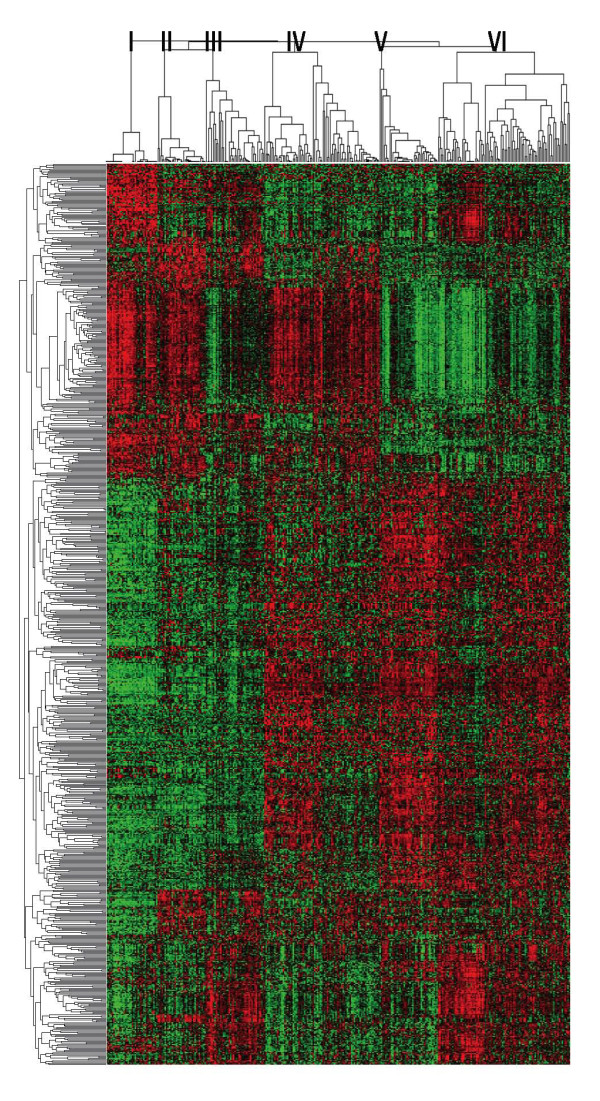
Gene expression profiling was conducted on fresh frozen breast cancer tissue collected from 327 patients in conjunction with thoroughly documented clinical data. A method of molecular subtyping based on 783 probe-sets was established and validated. Statistical analysis was performed to correlate molecular subtypes with survival outcome and adjuvant chemotherapy regimens. Heterogeneity of molecular subtypes within groups sharing the same distant recurrence risk predicted by genes of the Oncotype and MammaPrint predictors was studied.
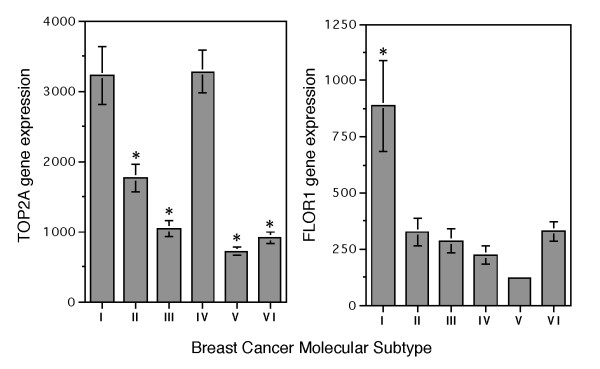
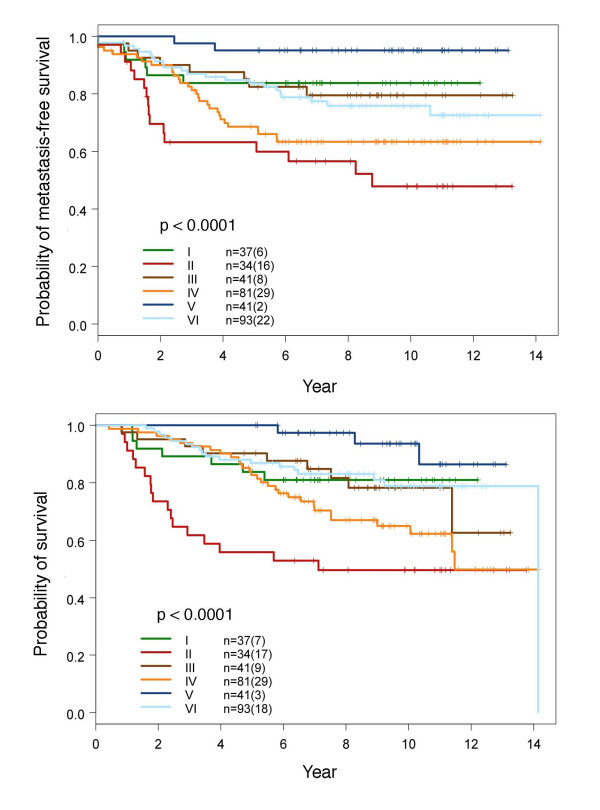
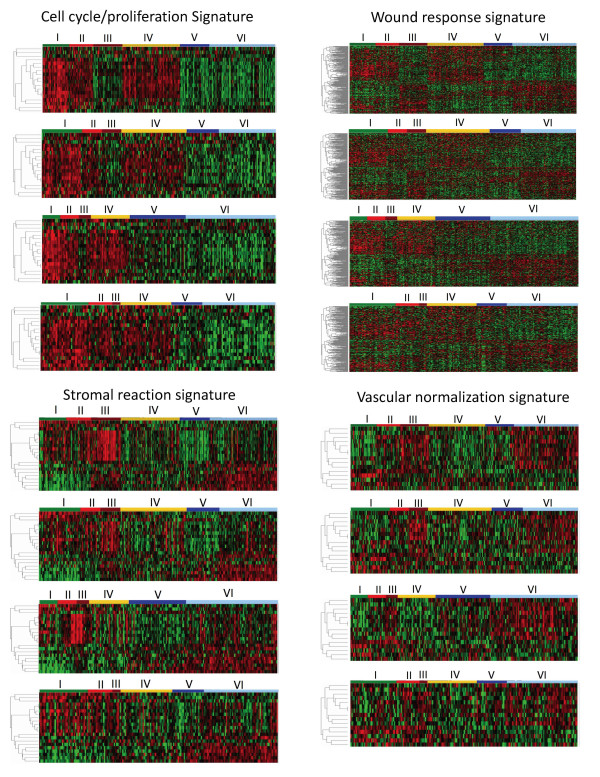
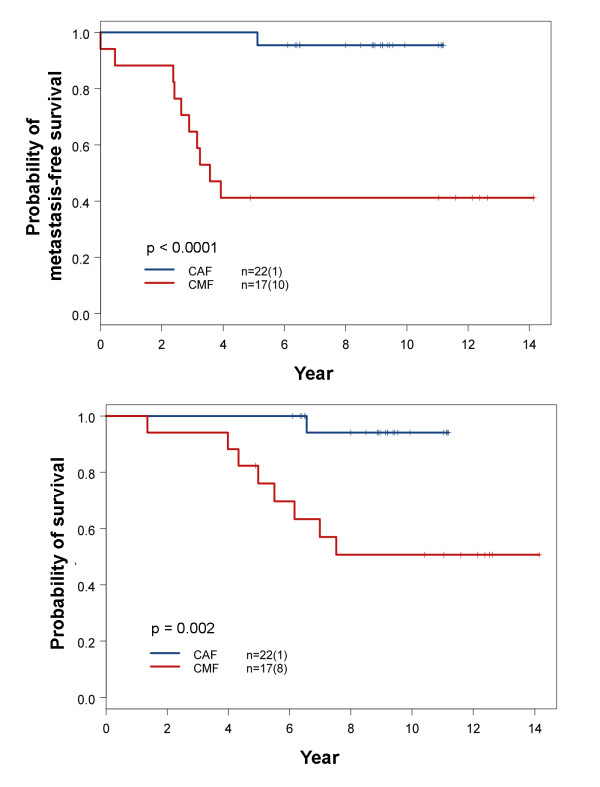
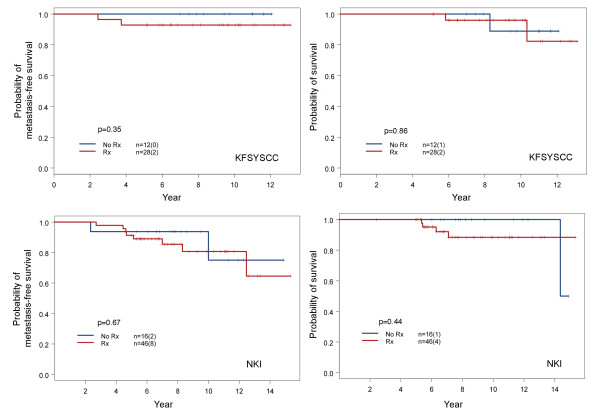
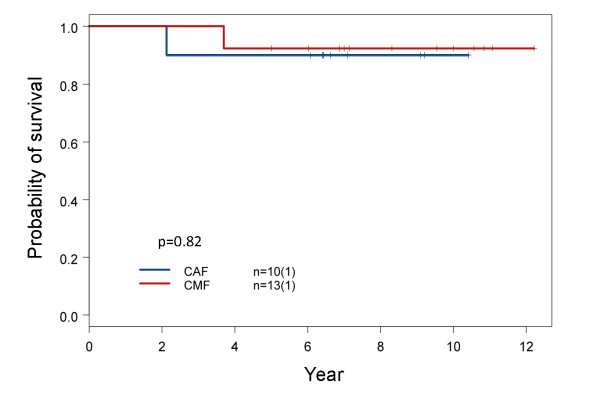
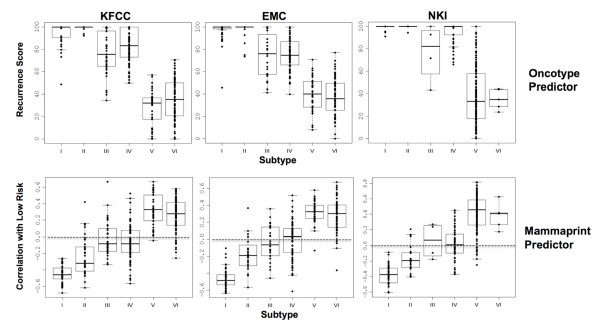
We identified six molecular subtypes of breast cancer demonstrating distinctive molecular and clinical characteristics. These six subtypes showed similarities and significant differences from the Perou-Sørlie intrinsic types. Subtype I breast cancer was in concordance with chemosensitive basal-like intrinsic type. Adjuvant chemotherapy of lower intensity with CMF yielded survival outcome similar to those of CAF in this subtype. Subtype IV breast cancer was positive for ER with a full-range expression of HER2, responding poorly to CMF; however, this subtype showed excellent survival when treated with CAF. Reduced expression of a gene associated with methotrexate sensitivity in subtype IV was the likely reason for poor response to methotrexate. All subtype V breast cancer was positive for ER and had excellent long-term survival with hormonal therapy alone following surgery and/or radiation therapy. Adjuvant chemotherapy did not provide any survival benefit in early stages of subtype V patients. Subtype V was consistent with a unique subset of luminal A intrinsic type. When molecular subtypes were correlated with recurrence risk predicted by genes of Oncotype and MammaPrint predictors, a significant degree of heterogeneity within the same risk group was noted. This heterogeneity was distributed over several subtypes, suggesting that patients in the same risk groups require different treatment approaches.
Our results indicate that the molecular subtypes established in this study can be utilized for customization of breast cancer treatment.
通过基于微阵列的分子亚型优化治疗是解决乳腺癌异质性问题的一种很有前途的方法;然而,目前的应用仅限于预测远处复发风险。本研究探讨了根据乳腺癌整体内在生物学进行分子分型是否可用于治疗定制。
对 327 例患者的新鲜冷冻乳腺癌组织进行基因表达谱分析,并结合详细记录的临床数据。建立并验证了一种基于 783 个探针集的分子分型方法。进行统计学分析,将分子亚型与生存结局和辅助化疗方案相关联。研究了在由 Oncotype 和 MammaPrint 预测器基因预测具有相同远处复发风险的同一组内分子亚型的异质性。
我们鉴定了 6 种乳腺癌分子亚型,具有独特的分子和临床特征。这 6 种亚型与 Perou-Sørlie 内在类型相似又存在显著差异。Ⅰ型乳腺癌与化疗敏感的基底样内在类型一致。在该亚型中,CMF 方案辅助化疗的强度较低,生存结局与 CAF 相似。IV 型乳腺癌 ER 阳性,HER2 呈全范围表达,对 CMF 反应不佳;然而,该亚型用 CAF 治疗时生存效果极好。IV 型中与甲氨蝶呤敏感性相关的基因表达降低可能是其对甲氨蝶呤反应不佳的原因。所有 V 型乳腺癌均为 ER 阳性,手术后和/或放疗后单独接受激素治疗具有良好的长期生存。早期 V 型患者的辅助化疗没有提供任何生存获益。V 型与独特的 luminal A 内在类型子集一致。当将分子亚型与 Oncotype 和 MammaPrint 预测器基因预测的复发风险相关联时,同一风险组内存在显著程度的异质性。这种异质性分布在几个亚型中,表明同一风险组的患者需要不同的治疗方法。
我们的研究结果表明,本研究建立的分子亚型可用于乳腺癌治疗的定制。