Oncogenomics Section, Pediatric Oncology Branch, National Cancer Institute, National Institute of Health, Gaithersburg, MD 20877, USA.
BMC Med Genomics. 2011 Apr 18;4:35. doi: 10.1186/1755-8794-4-35.
Neuroblastoma (NB) tumors are well known for their pronounced clinical and molecular heterogeneity. The global gene expression and DNA copy number alterations have been shown to have profound differences in tumors of low or high stage and those with or without MYCN amplification. RNA splicing is an important regulatory mechanism of gene expression, and differential RNA splicing may be associated with the clinical behavior of a tumor.
In this study, we used exon array profiling to investigate global alternative splicing pattern of 47 neuroblastoma samples in stage 1 and stage 4 with normal or amplified MYCN copy number (stage 1-, 4- and 4+). The ratio of exon-level expression to gene-level expression was used to detect alternative splicing events, while the gene-level expression was applied to characterize whole gene expression change.
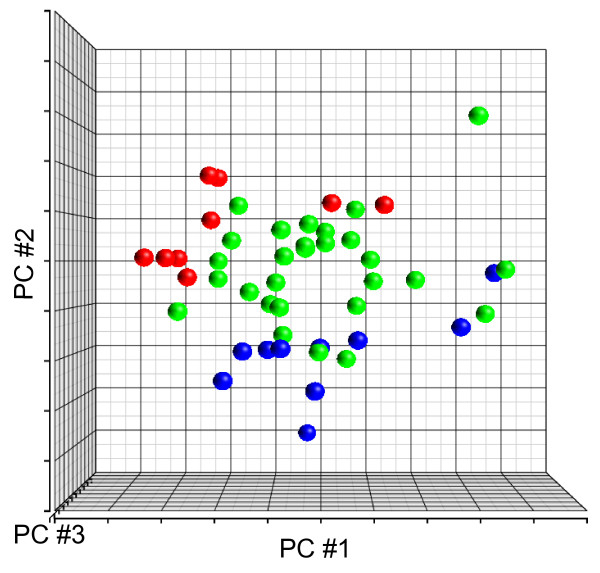
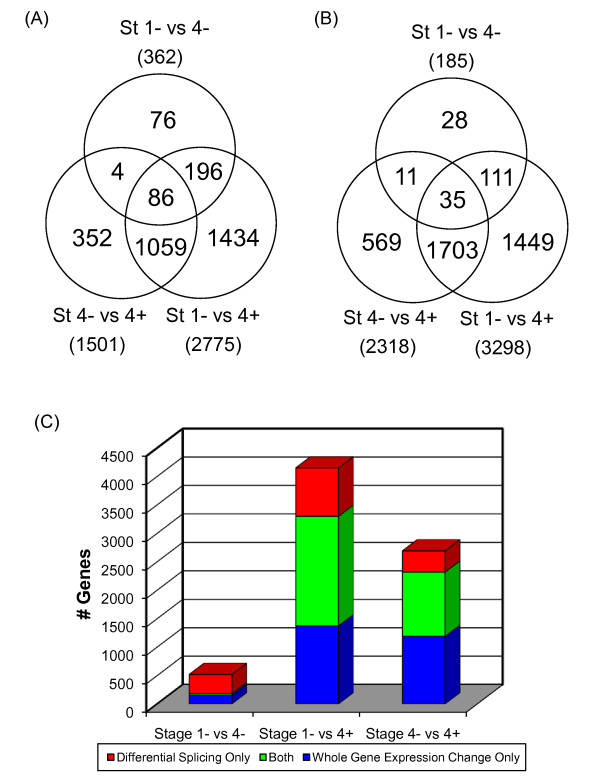
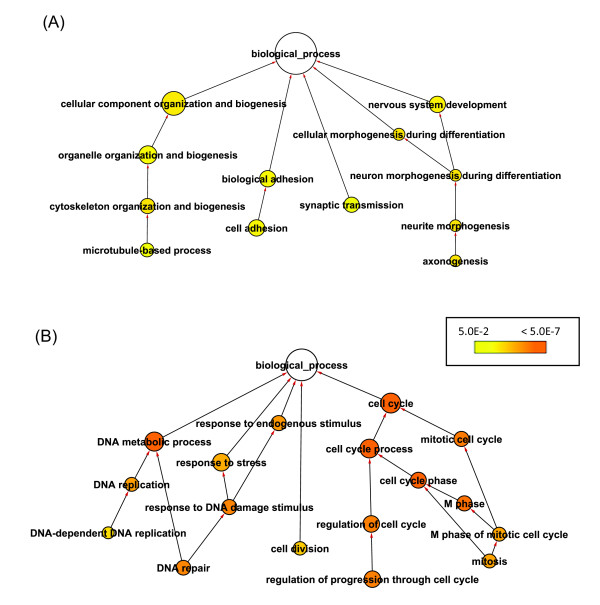
Principal component analysis (PCA) demonstrated distinct splicing pattern in three groups of samples. Pairwise comparison identified genes with splicing changes and/or whole gene expression changes in high stage tumors. In stage 4- compared with stage 1- tumors, alternatively spliced candidate genes had little overlap with genes showing whole gene expression changes, and most of them were involved in different biological processes. In contrast, a larger number of genes exhibited either exon-level splicing, gene-level expression or both changes in stage 4+ versus stage 1- tumors. Those biological processes involved in stage 4- tumors were disrupted to a greater extent by both splicing and transcription regulations in stage 4+ tumors.
Our results demonstrated a significant role of alternative splicing in high stage neuroblastoma, and suggested a MYCN-associated splicing regulation pathway in stage 4+ tumors. The identification of differentially spliced genes and pathways in neuroblastoma tumors of different stages and molecular subtypes may be important to the understanding of cancer biology and the discovery of diagnostic markers or therapeutic targets in neuroblastoma.
神经母细胞瘤(NB)肿瘤以其明显的临床和分子异质性而闻名。已表明,低分期或高分期、有无 MYCN 扩增的肿瘤之间的全局基因表达和 DNA 拷贝数改变存在显著差异。RNA 剪接是基因表达的重要调控机制,差异 RNA 剪接可能与肿瘤的临床行为有关。
在这项研究中,我们使用外显子数组分析来研究 47 例处于 1 期和 4 期且 MYCN 拷贝数正常或扩增(1-、4-和 4+)的神经母细胞瘤样本的全局选择性剪接模式。我们使用外显子水平表达与基因水平表达的比值来检测选择性剪接事件,而基因水平表达则用于描述全基因表达变化。
主成分分析(PCA)表明三组样本的剪接模式明显不同。两两比较确定了高分期肿瘤中具有剪接变化和/或全基因表达变化的基因。与 1-期肿瘤相比,4-期肿瘤中具有选择性剪接的候选基因与表现出全基因表达变化的基因几乎没有重叠,而且大多数基因参与不同的生物学过程。相比之下,在 4+期与 1-期肿瘤相比,更多的基因表现出外显子水平剪接、基因水平表达或两者的变化。在 4+期肿瘤中,参与 4-期肿瘤的生物学过程受到剪接和转录调控的更大程度的破坏。
我们的研究结果表明,选择性剪接在高分期神经母细胞瘤中具有重要作用,并提示 4+期肿瘤中存在与 MYCN 相关的剪接调控途径。鉴定不同分期和分子亚型神经母细胞瘤肿瘤中差异剪接的基因和途径可能对理解癌症生物学以及发现神经母细胞瘤的诊断标志物或治疗靶点具有重要意义。