EA2216 and IFR148, University Medical School, Université Européenne de Bretagne, F-9238 Brest, France.
Mol Cancer. 2011 Apr 19;10:42. doi: 10.1186/1476-4598-10-42.
The increasing availability of different monoclonal antibodies (mAbs) opens the way to more specific biologic therapy of cancer patients. However, despite the significant success of therapy in breast and ovarian carcinomas with anti-HER2 mAbs as well as in non-Hodkin B cell lymphomas with anti-CD20 mAbs, certain B cell malignancies such as B chronic lymphocytic leukaemia (B-CLL) respond poorly to anti-CD20 mAb, due to the low surface expression of this molecule. Thus, new mAbs adapted to each types of tumour will help to develop personalised mAb treatment. To this aim, we analyse the biological and therapeutic properties of three mAbs directed against the CD5, CD71 or HLA-DR molecules highly expressed on B-CLL cells.
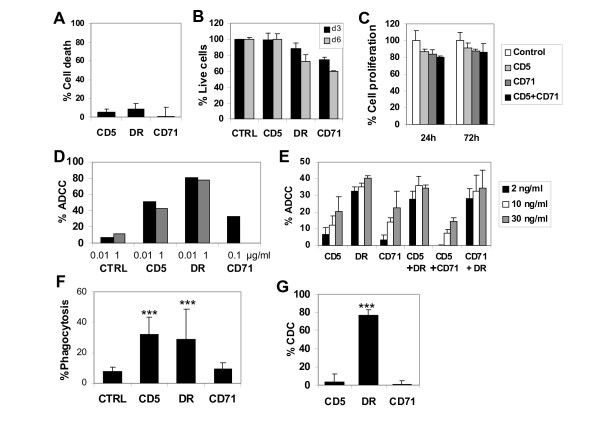
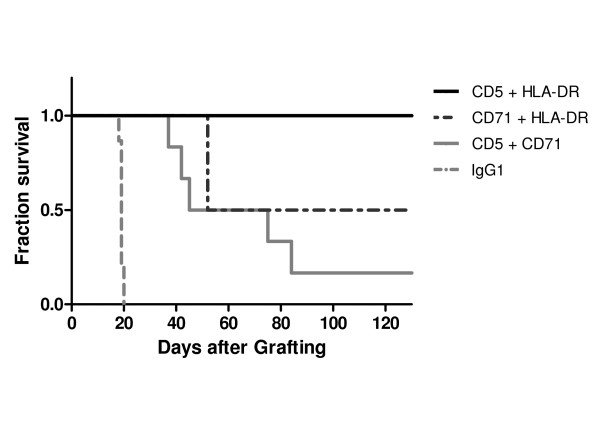
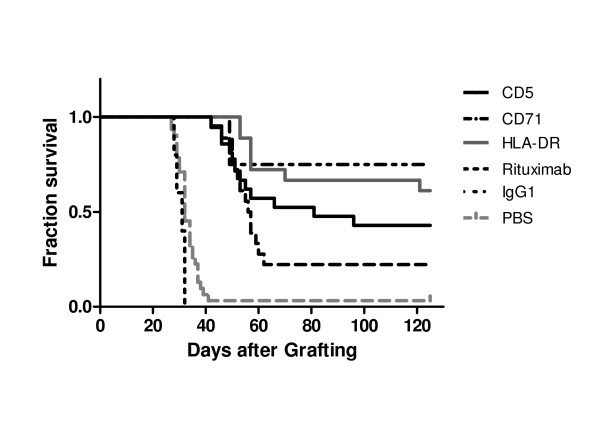
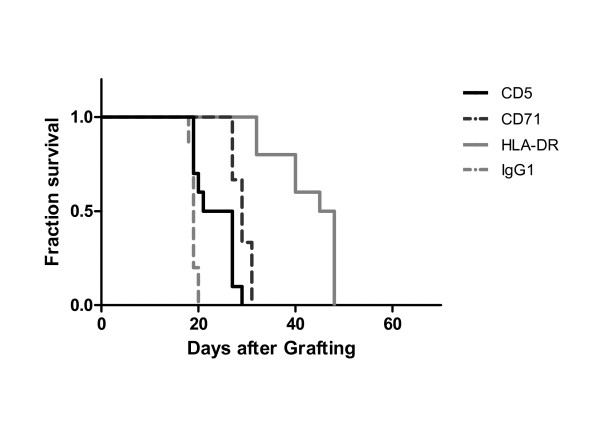
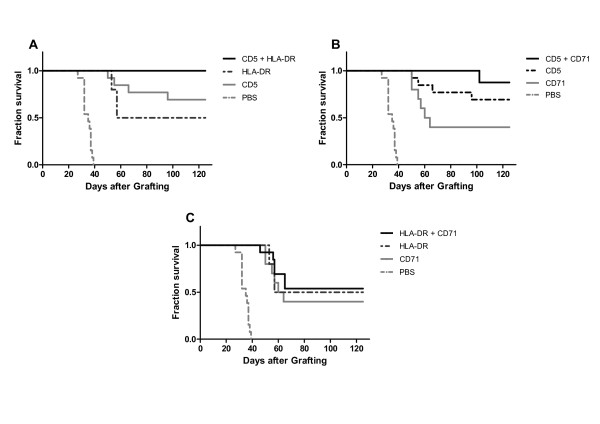
The three mAbs, after purification and radiolabelling demonstrated high and specific binding capacity to various human leukaemia target cells. Further in vitro analysis showed that mAb anti-CD5 induced neither growth inhibition nor apoptosis, mAb anti-CD71 induced proliferation inhibition with no early sign of cell death and mAb anti-HLA-DR induced specific cell aggregation, but without evidence of apoptosis. All three mAbs induced various degrees of ADCC by NK cells, as well as phagocytosis by macrophages. Only the anti-HLA-DR mAb induced complement mediated lysis. Coincubation of different pairs of mAbs did not significantly modify the in vitro results. In contrast with these discrete and heterogeneous in vitro effects, in vivo the three mAbs demonstrated marked anti-tumour efficacy and prolongation of mice survival in two models of SCID mice, grafted either intraperitoneally or intravenously with the CD5 transfected JOK1-5.3 cells. This cell line was derived from a human hairy cell leukaemia, a type of malignancy known to have very similar biological properties as the B-CLL, whose cells constitutively express CD5. Interestingly, the combined injection of anti-CD5 with anti-HLA-DR or with anti-CD71 led to longer mouse survival, as compared to single mAb injection, up to complete inhibition of tumour growth in 100% mice treated with both anti-HLA-DR and anti-CD5.
Altogether these data suggest that the combined use of two mAbs, such as anti-HLA-DR and anti-CD5, may significantly enhance their therapeutic potential.
越来越多的单克隆抗体(mAbs)的出现为癌症患者的生物治疗开辟了更具针对性的道路。然而,尽管抗 HER2 mAbs 在乳腺癌和卵巢癌以及抗 CD20 mAbs 在非霍奇金 B 细胞淋巴瘤中取得了显著的治疗成功,但某些 B 细胞恶性肿瘤,如 B 慢性淋巴细胞白血病(B-CLL),由于该分子的低表面表达,对抗 CD20 mAb 的反应不佳。因此,适应每种类型肿瘤的新型 mAb 将有助于开发个性化的 mAb 治疗。为此,我们分析了三种针对 B-CLL 细胞高表达的 CD5、CD71 或 HLA-DR 分子的 mAb 的生物学和治疗特性。
三种 mAb 在纯化和放射性标记后,表现出对各种人类白血病靶细胞的高特异性结合能力。进一步的体外分析表明,mAb 抗 CD5 既不诱导生长抑制也不诱导细胞凋亡,mAb 抗 CD71 诱导增殖抑制且早期无细胞死亡迹象,mAb 抗 HLA-DR 诱导特异性细胞聚集,但无凋亡证据。三种 mAb 均能诱导 NK 细胞的不同程度的 ADCC,以及巨噬细胞的吞噬作用。只有抗 HLA-DR mAb 诱导补体介导的溶解。不同 mAb 配对的共孵育并未显著改变体外结果。与这些离散和异质的体外效应相反,在体内,三种 mAb 在两种 SCID 小鼠模型中均表现出显著的抗肿瘤疗效和延长小鼠存活时间,这些模型分别用转染 CD5 的 JOK1-5.3 细胞经腹腔或静脉内移植。该细胞系源自人类毛细胞白血病,一种与 B-CLL 具有非常相似生物学特性的恶性肿瘤,其细胞持续表达 CD5。有趣的是,与单独注射 mAb 相比,联合注射抗 CD5 与抗 HLA-DR 或抗 CD71 可导致小鼠存活时间延长,100%用抗 HLA-DR 和抗 CD5 治疗的小鼠中完全抑制肿瘤生长。
综上所述,这些数据表明,联合使用两种 mAb,如抗 HLA-DR 和抗 CD5,可能显著增强其治疗潜力。