Animal Breeding and Genomics Centre, Wageningen UR Livestock Research, Lelystad, The Netherlands.
BMC Genomics. 2011 Apr 19;12:200. doi: 10.1186/1471-2164-12-200.
The decline noticed in several fertility traits of dairy cattle over the past few decades is of major concern. Understanding of the genomic factors underlying fertility, which could have potential applications to improve fertility, is very limited. Here, we aimed to identify and study those genes that associated with a key fertility trait namely estrous behavior, among genes expressed in four bovine brain areas (hippocampus, amygdala, dorsal hypothalamus and ventral hypothalamus), either at the start of estrous cycle, or at mid cycle, or regardless of the phase of cycle.
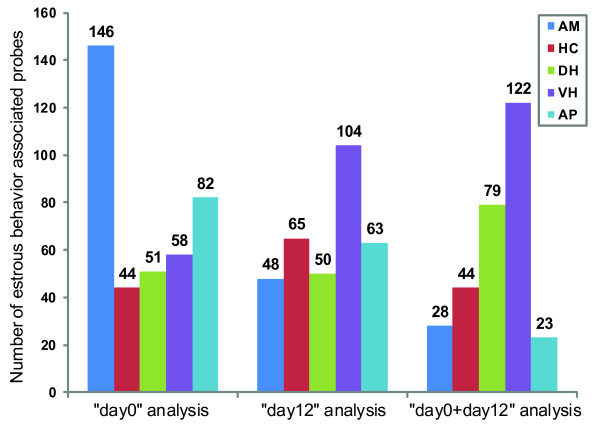
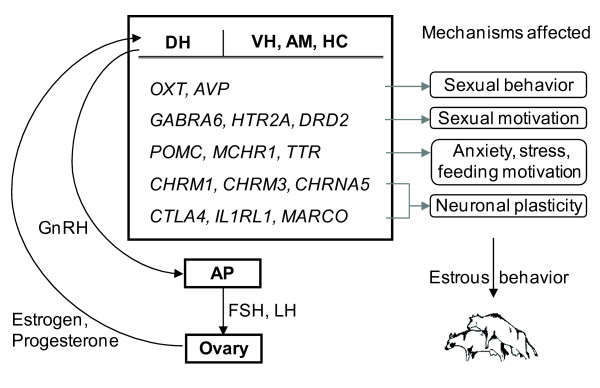
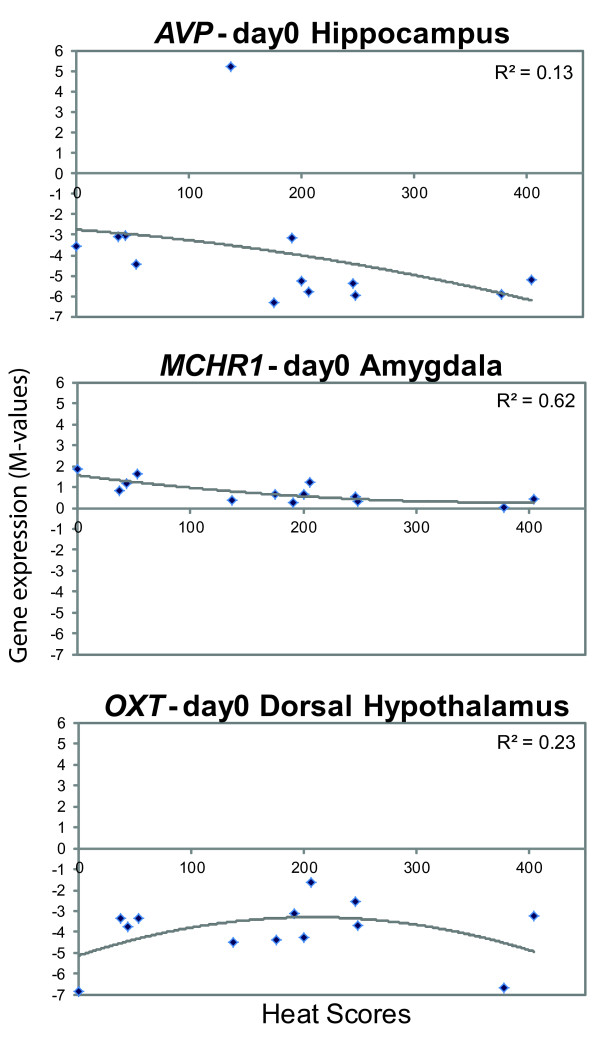
An average heat score was calculated for each of 28 primiparous cows in which estrous behavior was recorded for at least two consecutive estrous cycles starting from 30 days post-partum. Gene expression was then measured in brain tissue samples collected from these cows, 14 of which were sacrificed at the start of estrus and 14 around mid cycle. For each brain area, gene expression was modeled as a function of the orthogonally transformed average heat score values using a Bayesian hierarchical mixed model. Genes whose expression patterns showed significant linear or quadratic relationships with heat scores were identified. These included genes expected to be related to estrous behavior as they influence states like socio-sexual behavior, anxiety, stress and feeding motivation (OXT, AVP, POMC, MCHR1), but also genes whose association with estrous behavior is novel and warrants further investigation.
Several genes were identified whose expression levels in the bovine brain associated with the level of expression of estrous behavior. The genes OXT and AVP play major roles in regulating estrous behavior in dairy cows. Genes related to neurotransmission and neuronal plasticity are also involved in estrous regulation, with several genes and processes expressed in mid-cycle probably contributing to proper expression of estrous behavior in the next estrus. Studying these genes and the processes they control improves our understanding of the genomic regulation of estrous behavior expression.
在过去几十年中,奶牛的几个生育特征出现下降,这引起了人们的极大关注。尽管人们对与生育有关的基因组因素有一定的了解,这些因素可能具有改善生育能力的应用潜力,但目前的了解非常有限。在这里,我们旨在识别和研究那些与关键生育特征(即发情行为)相关的基因,这些基因在四个牛脑区(海马体、杏仁核、背侧下丘脑和腹侧下丘脑)中表达,这些基因要么在发情周期开始时表达,要么在周期中期表达,要么与周期阶段无关。
为了评估发情行为,我们为至少连续两个发情周期的 28 头初产奶牛计算了平均发情评分。从产后 30 天开始,对这些奶牛的发情行为进行了记录。然后,在这些奶牛的脑组织样本中测量了基因表达情况,其中 14 头在发情开始时被处死,14 头在发情中期左右被处死。对于每个脑区,我们使用贝叶斯层次混合模型将基因表达建模为正交变换后的平均发情评分值的函数。鉴定出了那些表达模式与发情评分呈显著线性或二次关系的基因。这些基因包括预期与发情行为相关的基因,因为它们会影响社会性行为、焦虑、压力和进食动机等状态(OXT、AVP、POMC、MCHR1),还包括那些与发情行为相关的新型基因,值得进一步研究。
鉴定出了一些基因,这些基因在牛脑中的表达水平与发情行为的表达水平相关。OXT 和 AVP 基因在调节奶牛发情行为中起着重要作用。与神经传递和神经元可塑性相关的基因也参与了发情调控,几个在发情中期表达的基因和过程可能有助于在下一个发情周期中正确表达发情行为。研究这些基因及其控制的过程可以提高我们对发情行为表达的基因组调控的理解。