Department of Endocrinology, The First Affiliated Hospital of Xi'an Jiaotong University College of Medicine, Xi'an 710061, the People's Republic of China.
BMC Cancer. 2011 Apr 20;11:147. doi: 10.1186/1471-2407-11-147.
Lung cancer is the leading cause of cancer-related death worldwide. Genetic and epigenetic alterations have been identified frequently in lung cancer, such as promoter methylation, gene mutations and genomic amplification. However, the interaction between genetic and epigenetic events and their significance in lung tumorigenesis remains poorly understood.
We determined the promoter methylation of 6 genes and PIK3CA amplification using quantitative methylation-specific PCR (Q-MSP) and real-time quantitative PCR, respectively, and explore the association of promoter methylation with PIK3CA amplification in a large cohort of clinically well-characterized non-small cell lung cancer (NSCLC).
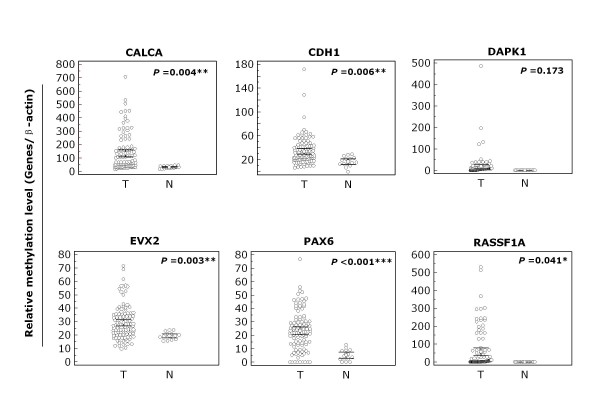
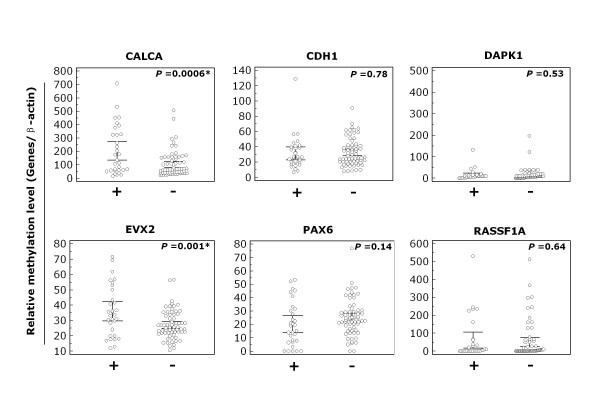
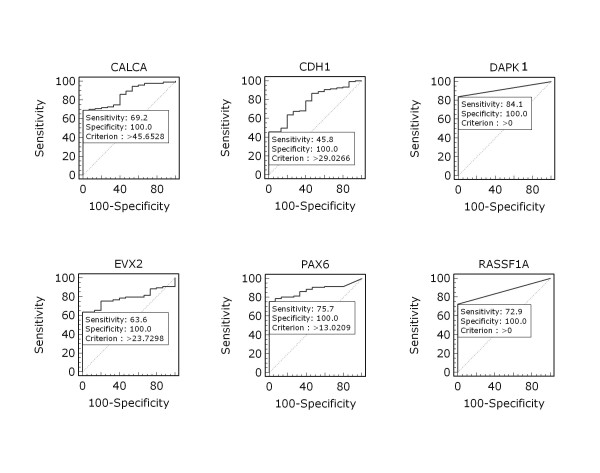
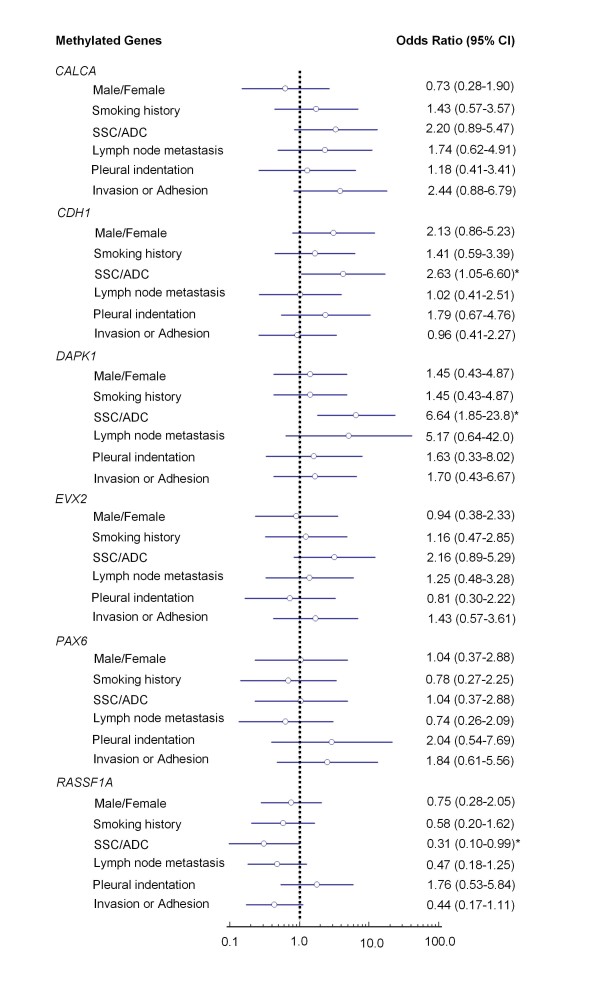
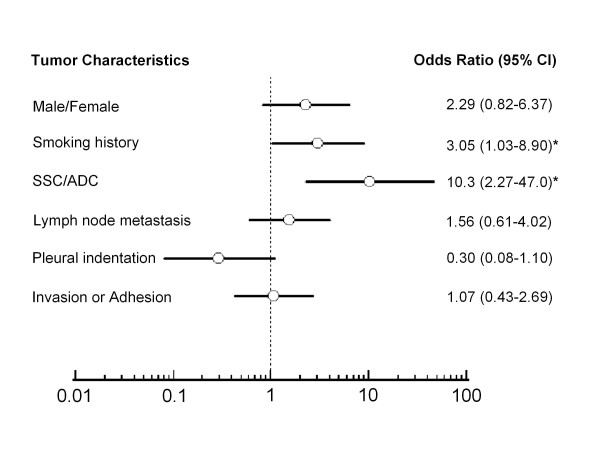
Highly frequent promoter methylation was observed in NSCLC. With 100% diagnostic specificity, excellent sensitivity, ranging from 45.8 to 84.1%, was found for each of the 6 genes. The promoter methylation was associated with histologic type. Methylation of CALCA, CDH1, DAPK1, and EVX2 was more common in squamous cell carcinomas (SCC) compared to adenocarcinomas (ADC). Conversely, there was a trend toward a higher frequency of RASSF1A methylation in ADC than SCC. In addition, PIK3CA amplification was frequently found in NSCLC, and was associated with certain clinicopathologic features, such as smoking history, histologic type and pleural indentation. Importantly, aberrant promoter methylation of certain genes was significantly associated with PIK3CA amplification.
Our data showed highly frequent promoter methylation and PIK3CA amplification in Chinese NSCLC population, and first demonstrated the associations of gene methylation with PIK3CA amplification, suggesting that these epigenetic events may be a consequence of overactivation of PI3K/Akt pathway.
肺癌是全球癌症相关死亡的主要原因。在肺癌中经常发现遗传和表观遗传改变,例如启动子甲基化、基因突变和基因组扩增。然而,遗传和表观遗传事件之间的相互作用及其在肺癌发生中的意义仍知之甚少。
我们使用定量甲基化特异性 PCR(Q-MSP)和实时定量 PCR 分别确定了 6 个基因的启动子甲基化和 PIK3CA 扩增,并在一个大型临床特征明确的非小细胞肺癌(NSCLC)队列中探讨了启动子甲基化与 PIK3CA 扩增之间的关联。
在 NSCLC 中观察到高度频繁的启动子甲基化。对于每个 6 个基因,具有 100%诊断特异性、45.8%至 84.1%的优异灵敏度。启动子甲基化与组织学类型有关。CALCA、CDH1、DAPK1 和 EVX2 的启动子甲基化在鳞状细胞癌(SCC)中比腺癌(ADC)更为常见。相反,RASSF1A 甲基化在 ADC 中比 SCC 中更为常见。此外,PIK3CA 扩增在 NSCLC 中经常发现,与某些临床病理特征相关,如吸烟史、组织学类型和胸膜凹陷。重要的是,某些基因的异常启动子甲基化与 PIK3CA 扩增显著相关。
我们的数据显示中国 NSCLC 人群中存在高度频繁的启动子甲基化和 PIK3CA 扩增,并首次证明了基因甲基化与 PIK3CA 扩增之间的关联,表明这些表观遗传事件可能是 PI3K/Akt 通路过度激活的结果。