Ott J C
Erasmus University Rotterdam, Rotterdam, The Netherlands.
Soc Indic Res. 2011 May;102(1):3-22. doi: 10.1007/s11205-010-9719-z. Epub 2010 Oct 26.
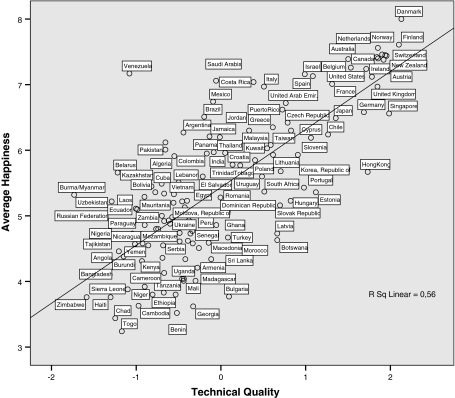
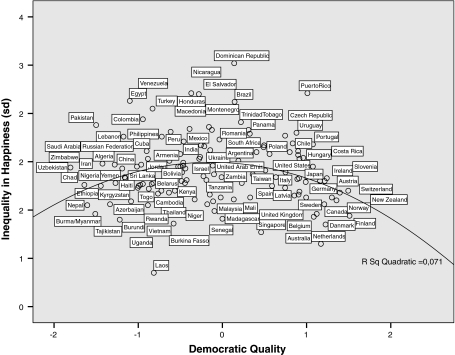
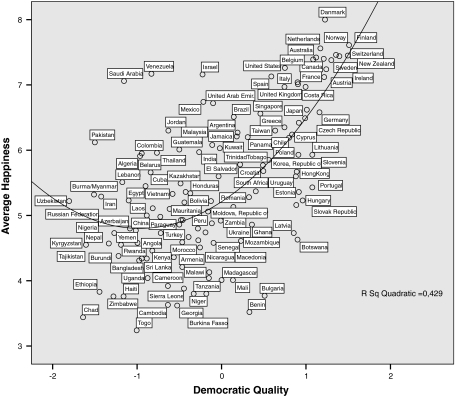
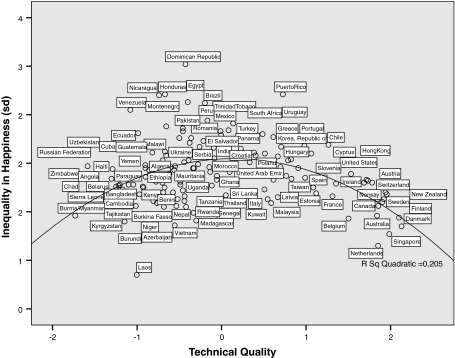
There are substantial differences in happiness in nations. Average happiness on scale 0-10 ranges in 2006 from 3.24 in Togo to 8.00 in Denmark and the inequality of happiness, as measured by the standard deviation, ranges from 0.85 in Laos to 3.02 in the Dominican Republic. Much of these differences are due to quality of governance and in particular to 'technical' quality. Once a minimum level is reached, rising technical quality boosts average happiness proportionally. Good governance does not only produce a higher level of happiness, but also lowers inequality of happiness among citizens. The relation between good governance and inequality of happiness is not linear, but follows a bell shaped pattern, inequality of happiness being highest in nations where the quality of government is at a medium level. The relation between the size of government and average happiness depends heavily on the quality of government; good-big government adds to happiness but bad-big government does not. Possible explanations of these findings are discussed.
不同国家的幸福程度存在显著差异。在0至10的幸福量表上,2006年各国的平均幸福度从多哥的3.24到丹麦的8.00不等,而幸福度的不平等程度(以标准差衡量)则从老挝的0.85到多米尼加共和国的3.02不等。这些差异很大程度上归因于治理质量,尤其是“技术”质量。一旦达到最低水平,不断提高的技术质量会按比例提升平均幸福度。良好的治理不仅能带来更高的幸福水平,还能降低公民之间幸福度的不平等。良好治理与幸福度不平等之间的关系并非线性,而是呈钟形模式,在政府质量处于中等水平的国家,幸福度不平等程度最高。政府规模与平均幸福度之间的关系在很大程度上取决于政府质量;优质的大政府能增加幸福度,但劣质的大政府则不然。文中讨论了这些研究结果可能的解释。