Kim Kyu Seop, Park Hyung Seo, Jung Il Soon, Park Jae-Hyeong, Ahn Kye Taek, Jin Seon-Ah, Park Yong Kyu, Kim Jun Hyung, Lee Jae-Hwan, Choi Si Wan, Jeong Jin-Ok, Seong In-Whan
Division of Cardiology, Department of Internal Medicine, School of Medicine, Chungnam National University, Chungnam National University Hospital, Daejeon Cardiocerebrovascular Center, Daejeon, Korea.
J Cardiovasc Ultrasound. 2011 Mar;19(1):21-5. doi: 10.4250/jcu.2011.19.1.21. Epub 2011 Mar 31.
Smoking is one of well known environmental factors causing endothelial dysfunction and plays important role in the atherosclerosis. We investigated the effect of cilostazol could improve the endothelial dysfunction in smokers with the measurement of flow-mediated dilatation (FMD).
We enrolled 10 normal healthy male persons and 20 male smokers without any known cardiovascular diseases. After measurement of baseline FMD, the participants were medicated with oral cilostazol 100 mg bid for two weeks. We checked the follow up FMD after two weeks and compared these values between two groups.
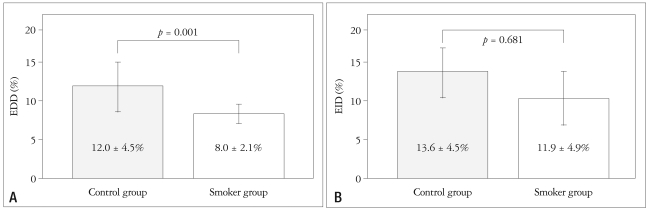
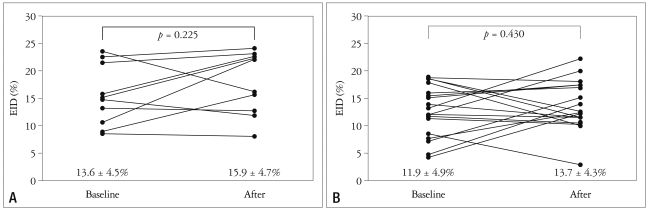
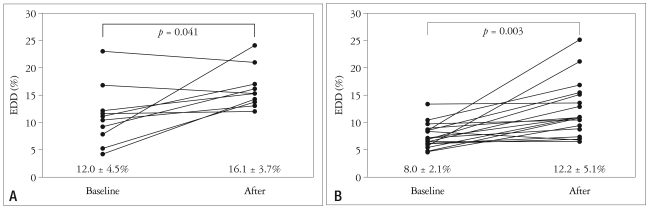
There was no statistical difference of baseline characteristics including age, body mass index, serum cholesterol profiles, serum glucose and high sensitive C-reactive protein between two groups. However, the control group showed significantly higher baseline endothelium-dependent dilatation (EDD) after reactive hyperemia (12.0 ± 4.5% in the control group vs. 8.0 ± 2.1% in the smoker group, p = 0.001). However, endothelium-independent dilatation (EID) after sublingual administration of nitroglycerin was similar between the two groups (13.6 ± 4.5% in the control group vs. 11.9 ± 4.9% in the smoker group, p = 0.681). Two of the smoker group were dropped out due to severe headache. After two weeks of cilostazol therapy, follow-up EDD were significantly increased in two groups (12.0 ± 4.5% to 16.1 ± 3.7%, p = 0.034 in the control group and 8.0 ± 2.1% to 12.2 ± 5.1%, p = 0.003 in the smoker group, respectively). However, follow up EID value was not significantly increased compared with baseline value in both groups (13.6 ± 4.5% to 16.1 ± 3.7%, p = 0.182 in the control group and 11.9 ± 4.9% to 13.7 ± 4.3%, p = 0.430 in the smoker group, respectively).
Oral cilostazol treatment significantly increased the vasodilatory response to reactive hyperemia in two groups. It can be used to improve endothelial function in the patients with endothelial dysfunction caused by cigarette smoking.
吸烟是导致内皮功能障碍的知名环境因素之一,在动脉粥样硬化中起重要作用。我们通过测量血流介导的血管舒张功能(FMD)来研究西洛他唑改善吸烟者内皮功能障碍的效果。
我们招募了10名正常健康男性和20名无任何已知心血管疾病的男性吸烟者。在测量基线FMD后,参与者口服西洛他唑100毫克,每日两次,持续两周。两周后我们检查随访FMD,并比较两组之间的值。
两组之间的基线特征,包括年龄、体重指数、血清胆固醇谱、血糖和高敏C反应蛋白,均无统计学差异。然而,对照组在反应性充血后显示出显著更高的基线内皮依赖性舒张功能(EDD)(对照组为12.0±4.5%,吸烟者组为8.0±2.1%,p = 0.001)。然而,两组在舌下含服硝酸甘油后的非内皮依赖性舒张功能(EID)相似(对照组为13.6±4.5%,吸烟者组为11.9±4.9%,p = 0.681)。吸烟者组中有两人因严重头痛退出。西洛他唑治疗两周后,两组的随访EDD均显著增加(对照组从12.0±4.5%增至16.1±3.7%,p = 0.034;吸烟者组从8.0±2.1%增至12.2±5.1%,p = 0.003)。然而,两组随访的EID值与基线值相比均未显著增加(对照组从13.6±4.5%增至16.1±3.7%,p = 0.182;吸烟者组从11.9±4.9%增至13.7±4.3%,p = 0.430)。
口服西洛他唑治疗显著增加了两组对反应性充血的血管舒张反应。它可用于改善因吸烟引起内皮功能障碍患者的内皮功能。