Department of Orthopaedic Surgery, VU University Medical Center, 1007 MB Amsterdam, the Netherlands.
BMC Cancer. 2011 Apr 29;11:156. doi: 10.1186/1471-2407-11-156.
The use of radiotherapy in osteosarcoma (OS) is controversial due to its radioresistance. OS patients currently treated with radiotherapy generally are inoperable, have painful skeletal metastases, refuse surgery or have undergone an intralesional resection of the primary tumor. After irradiation-induced DNA damage, OS cells sustain a prolonged G(2) cell cycle checkpoint arrest allowing DNA repair and evasion of cell death. Inhibition of WEE1 kinase leads to abrogation of the G(2) arrest and could sensitize OS cells to irradiation induced cell death.
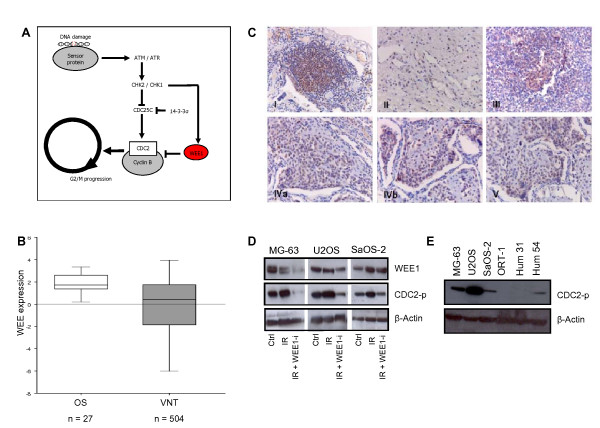
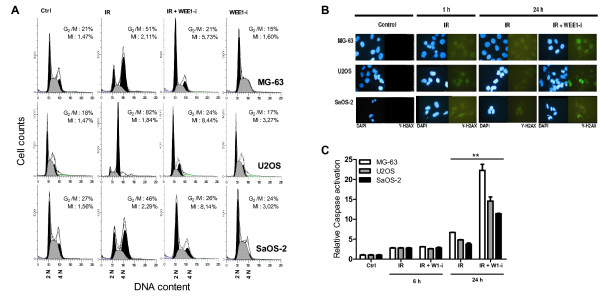
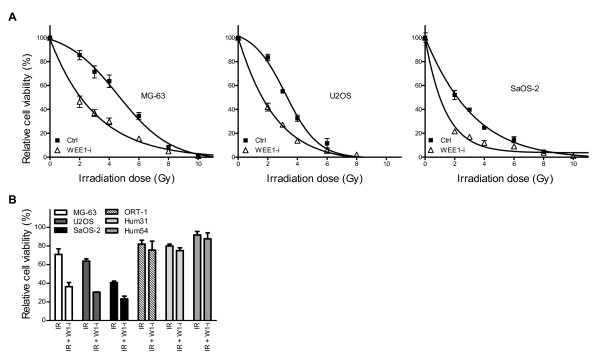
WEE1 expression in OS was investigated by gene-expression data analysis and immunohistochemistry of tumor samples. WEE1 expression in OS cell lines and human osteoblasts was investigated by Western blot. The effect of WEE1 inhibition on the radiosensitivity of OS cells was assessed by cell viability and caspase activation analyses after combination treatment. The presence of DNA damage was visualized using immunofluorescence microscopy. Cell cycle effects were investigated by flow cytometry and WEE1 kinase regulation was analyzed by Western blot.
WEE1 expression is found in the majority of tested OS tissue samples. Small molecule drug PD0166285 inhibits WEE1 kinase activity. In the presence of WEE1-inhibitor, irradiated cells fail to repair their damaged DNA, and show higher levels of caspase activation. The inhibition of WEE1 effectively abrogates the irradiation-induced G(2) arrest in OS cells, forcing the cells into premature, catastrophic mitosis, thus enhancing cell death after irradiation treatment.
We show that PD0166285, a small molecule WEE1 kinase inhibitor, can abrogate the G(2) checkpoint in OS cells, pushing them into mitotic catastrophe and thus sensitizing OS cells to irradiation-induced cell death. This suggests that WEE1 inhibition may be a promising strategy to enhance the radiotherapy effect in patients with OS.
由于放射抵抗性,骨肉瘤(OS)中放疗的应用存在争议。目前接受放疗的 OS 患者通常是不可手术的,有疼痛性骨骼转移,拒绝手术或已行肿瘤内切除术切除原发肿瘤。照射诱导 DNA 损伤后,OS 细胞维持长时间的 G2 细胞周期检查点阻滞,允许 DNA 修复并逃避细胞死亡。WEE1 激酶的抑制导致 G2 阻滞的中断,并可能使 OS 细胞对辐射诱导的细胞死亡敏感。
通过肿瘤样本的基因表达数据分析和免疫组织化学研究 OS 中的 WEE1 表达。通过 Western blot 研究 OS 细胞系和人成骨细胞中的 WEE1 表达。通过组合处理后细胞活力和半胱天冬酶激活分析评估 WEE1 抑制对 OS 细胞放射敏感性的影响。使用免疫荧光显微镜观察 DNA 损伤的存在。通过流式细胞术研究细胞周期效应,并通过 Western blot 分析 WEE1 激酶的调节。
WEE1 表达存在于大多数测试的 OS 组织样本中。小分子药物 PD0166285 抑制 WEE1 激酶活性。在 WEE1 抑制剂存在的情况下,受照射的细胞无法修复受损的 DNA,并显示出更高水平的半胱天冬酶激活。WEE1 的抑制有效地消除了 OS 细胞中照射诱导的 G2 阻滞,迫使细胞进入过早的、灾难性的有丝分裂,从而增强照射治疗后的细胞死亡。
我们表明,小分子 WEE1 激酶抑制剂 PD0166285 可消除 OS 细胞中的 G2 检查点,将其推向有丝分裂灾难,从而使 OS 细胞对辐射诱导的细胞死亡敏感。这表明 WEE1 抑制可能是增强 OS 患者放疗效果的有前途的策略。