Rothenhäusler B, Dornmair K, McConnell H M
Stauffer Laboratory of Physical Chemistry, Stanford University, CA 94305.
Proc Natl Acad Sci U S A. 1990 Jan;87(1):352-4. doi: 10.1073/pnas.87.1.352.
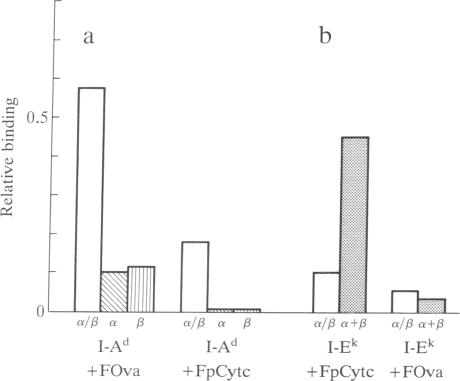
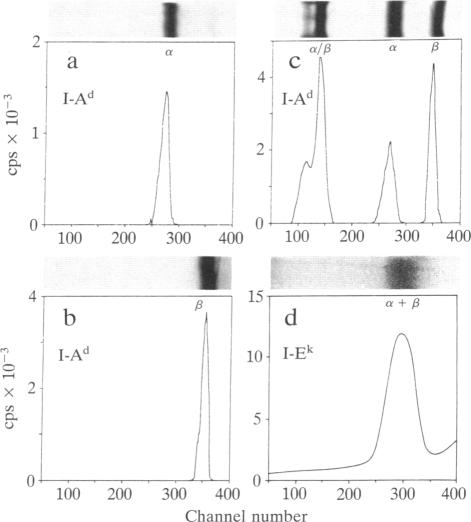
Class II molecules of the major histocompatibility complex bind antigenic peptides and present them to T-helper cells. Class II molecules are heterodimers consisting of one alpha and one beta chain. Here we report that each isolated alpha and beta chain binds antigenic peptides and that this binding is specific. The specificity of peptide binding was investigated by employing the murine major histocompatibility complex haplotypes I-Ad and I-Ek and fluorescence-labeled peptides of chicken ovalbumin and pigeon cytochrome c, respectively, which are known to be specific for these haplotypes. The major histocompatibility complex molecules were incubated with these peptides and subjected to SDS/PAGE under nondenaturing conditions. The gels were then scanned for the fluorescent peptides and, after silver staining, for proteins. We found that the fluorescence-labeled peptide fragment of ovalbumin bound preferentially to the isolated alpha and beta chains of I-Ad, whereas the fluorescence-labeled peptide fragment of pigeon cytochrome c bound preferentially to the isolated alpha and beta chains of I-Ek. The alpha and beta chains of each haplotype bound their specific peptides about equally well, suggesting comparable affinities. Our results indicate that in vivo the kinetic pathway for the formation of antigenic peptide complexes with the alpha/beta heterodimers may involve the initial formation of complexes of the alpha and/or beta chains with the specific antigenic peptides.
主要组织相容性复合体的II类分子结合抗原肽并将其呈递给辅助性T细胞。II类分子是由一条α链和一条β链组成的异二聚体。我们在此报告,每条分离的α链和β链都能结合抗原肽,且这种结合具有特异性。通过分别使用小鼠主要组织相容性复合体单倍型I-Ad和I-Ek以及鸡卵清蛋白和鸽细胞色素c的荧光标记肽来研究肽结合的特异性,已知这些肽对这些单倍型具有特异性。将主要组织相容性复合体分子与这些肽一起孵育,并在非变性条件下进行SDS/PAGE。然后对凝胶进行扫描以检测荧光肽,并在银染后检测蛋白质。我们发现,卵清蛋白的荧光标记肽片段优先结合I-Ad的分离α链和β链,而鸽细胞色素c的荧光标记肽片段优先结合I-Ek的分离α链和β链。每个单倍型的α链和β链结合其特异性肽的能力大致相同,表明亲和力相当。我们的结果表明,在体内,抗原肽与α/β异二聚体形成复合物的动力学途径可能涉及α链和/或β链与特异性抗原肽复合物的初始形成。