Maier Philip, Heizmann Ulrike, Böhringer Daniel, Kern Yvonne, Reinhard Thomas
University Eye Hospital, Freiburg, Germany.
Mol Vis. 2011 Apr 25;17:1016-23.
Cytokine patterns determined in the aqueous humor before penetrating keratoplasty (PK) may enable us to predict immune reactions (IR). We therefore analyzed 6 cytokines in the aqueous humor of patients before PK. By prospective clinical follow-up, we tested whether patients who developed an IR would present different preoperative cytokine patterns compared to patients without IR.
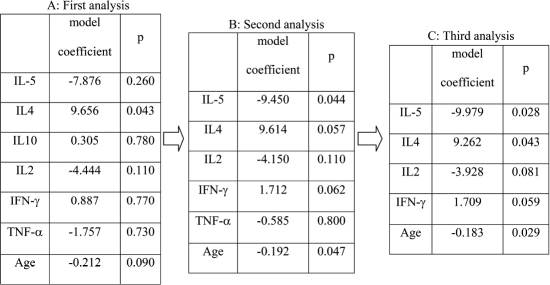
We analyzed 18 samples of aqueous humor from 18 patients undergoing PK. The following cytokines were analyzed by cytometric bead array: interleukin 2 (IL-2), interleukin 4 (IL-4), interleukin 5 (IL-5), interleukin 10 (IL-10), tumor-necrosis-factor α (TNF-α), and interferon γ (INF-γ). Seven patients presented with signs of IR during follow up. We performed Cox proportional hazards analysis to determine significant predictors for IR. We iteratively eliminated all co-variates with p values over 0.1 from the survival model (backward selection).
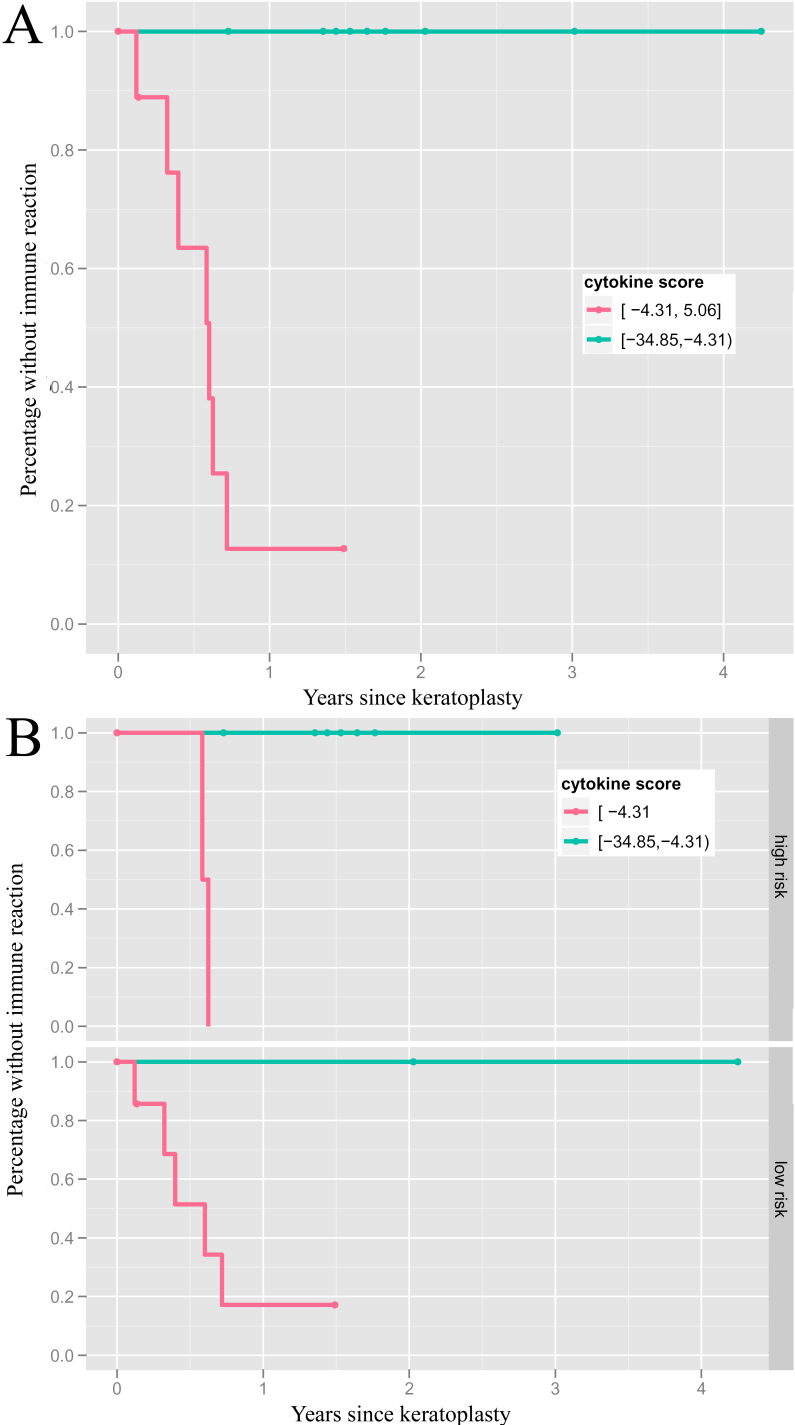
Our final Cox model included the hazardous factors IL-4 (p=0.043) and INF-γ (p=0.059), protective factors IL-2 (p=0.081), IL-5 (p=0.028), and age at time of surgery (p=0.029). We performed a linear discriminant analysis based on these coefficients. The resulting function was: (-9.979IL5) + (9.262IL4) + (-3.928IL2) + (1.709IFN-γ) + (-0.183*age). A median of -4.97 separated patients with and without IR with no classification error.
We demonstrate that cytokine levels in the aqueous humor can be predictive for IR. Our method allowed an almost 100% separation between patients with and without IR. This finding has the potential to improve the aftercare of PK fundamentally. However, our results need to be confirmed in a larger prospective cohort.
穿透性角膜移植术(PK)前房水中确定的细胞因子模式可能使我们能够预测免疫反应(IR)。因此,我们分析了PK患者前房水中的6种细胞因子。通过前瞻性临床随访,我们测试了发生IR的患者与未发生IR的患者术前细胞因子模式是否不同。
我们分析了18例接受PK患者的18份前房水样本。通过细胞计数珠阵列分析以下细胞因子:白细胞介素2(IL-2)、白细胞介素4(IL-4)、白细胞介素5(IL-5)、白细胞介素10(IL-10)、肿瘤坏死因子α(TNF-α)和干扰素γ(INF-γ)。7例患者在随访期间出现IR体征。我们进行了Cox比例风险分析以确定IR的显著预测因素。我们从生存模型(向后选择)中迭代消除了所有p值超过0.1的协变量。
我们最终的Cox模型包括危险因素IL-4(p = 0.043)和INF-γ(p = 0.059),保护因素IL-2(p = 0.081)、IL-5(p = 0.028)和手术时年龄(p = 0.029)。我们基于这些系数进行了线性判别分析。得到的函数为:(-9.979IL5)+(9.262IL4)+(-3.928IL2)+(1.709IFN-γ)+(-0.183*年龄)。中位数-4.97将有IR和无IR的患者分开,无分类错误。
我们证明前房水中的细胞因子水平可预测IR。我们的方法几乎能将有IR和无IR的患者100%区分开。这一发现有可能从根本上改善PK的术后护理。然而,我们的结果需要在更大的前瞻性队列中得到证实。