Department of Cardiology, Maastricht University Medical Center, PO Box 5800, 6202 AZ, Maastricht, the Netherlands,
Neth Heart J. 2011 May;19(5):214-22. doi: 10.1007/s12471-011-0095-3.
Antithrombotic management in atrial fibrillation (AF) is currently based on clinical characteristics, despite evidence of potential fine-tuning with transoesophageal echocardiography (TEE). This open, randomised, multicentre study addresses the hypothesis that a comprehensive strategy of TEE-based aspirin treatment in AF patients is feasible and safe.
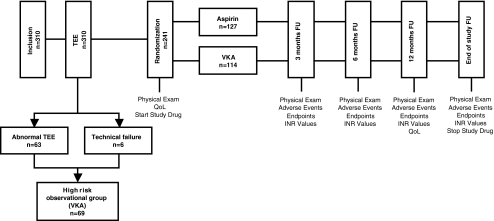
Between 2005 and 2009, ten large hospitals in the Netherlands enrolled AF patients with a moderate risk of stroke. Patients without thrombogenic TEE characteristics were randomised to aspirin or vitamin K antagonists (VKA). The primary objective is to show that TEE-based aspirin treatment is safe compared with VKA therapy. The secondary objective tests feasibility of TEE as a tool to detect echocardiographic features of high stroke risk. This report compares randomised to non-randomised patients and describes the feasibility of a TEE-based approach.
In total, 310 patients were included. Sixty-nine patients were not randomised because of non-visualisation (n = 6) or TEE risk factors (n = 63). Compared with non-randomised patients, randomised patients (n = 241) were younger (65 ± 11 vs. 69 ± 9 years, p = 0.004), had less coronary artery disease (9 vs. 20%, p = 0.018), previous TIA (1.7 vs. 7.2%, p = 0.029), AF during TEE (25 vs. 54%, p < 0.001), mitral incompetence (55 vs. 70%, p = 0.038), VKA use (69 vs. 82%, p = 0.032), had a lower mean CHADS(2) score (1.2 ± 0.6 vs. 1.6 ± 1.0, p = 0.004), and left ventricular ejection fraction (59 ± 8 vs. 56 ± 8%, p = 0.016).
This study shows that a TEE-based approach for fine-tuning stroke risk in AF patients with a moderate risk for stroke is feasible. Follow-up data will address the safety of this TEE-based approach.
尽管经食管超声心动图(TEE)有潜在的精细调整作用,但目前房颤(AF)的抗血栓治疗管理仍基于临床特征。这项开放、随机、多中心研究旨在验证以下假设,即针对房颤患者进行基于 TEE 的阿司匹林治疗的综合策略是可行且安全的。
2005 年至 2009 年期间,荷兰的十家大型医院招募了具有中度卒中风险的 AF 患者。无血栓形成 TEE 特征的患者被随机分配至阿司匹林或维生素 K 拮抗剂(VKA)治疗组。主要目的是证明与 VKA 治疗相比,基于 TEE 的阿司匹林治疗是安全的。次要目的是检测 TEE 作为一种检测高卒中风险超声心动图特征的工具的可行性。本报告比较了随机分组和非随机分组患者,并描述了基于 TEE 的方法的可行性。
共纳入 310 例患者。69 例患者因 TEE 无法可视化(n=6)或 TEE 相关风险因素(n=63)而未进行随机分组。与非随机分组患者相比,随机分组患者(n=241)年龄更小(65±11 岁 vs. 69±9 岁,p=0.004),冠心病更少(9% vs. 20%,p=0.018),有 TIA 病史者更少(1.7% vs. 7.2%,p=0.029),TEE 过程中发生房颤者更多(25% vs. 54%,p<0.001),二尖瓣关闭不全者更多(55% vs. 70%,p=0.038),VKA 使用率更低(69% vs. 82%,p=0.032),平均 CHADS2 评分更低(1.2±0.6 vs. 1.6±1.0,p=0.004),左心室射血分数更高(59±8% vs. 56±8%,p=0.016)。
本研究表明,针对具有中度卒中风险的 AF 患者,采用 TEE 进行卒中风险的精细调整是可行的。随访数据将评估这种基于 TEE 的方法的安全性。