Ryals Renee C, Boye Sanford L, Dinculescu Astra, Hauswirth William W, Boye Shannon E
Department of Ophthalmology, College of Medicine, University of Florida, Gainesville, FL 32610, USA.
Mol Vis. 2011 Apr 29;17:1090-102.
With the increasing number of retinal gene-based therapies and therapeutic constructs, in vitro bioassays characterizing vector transduction efficiency and quality are becoming increasingly important. Currently, in vitro assays quantifying vector transduction efficiency are performed predominantly for non-ocular tissues. A human retinal pigment epithelial cell line (ARPE19) and a mouse cone photoreceptor cell line, 661W, have been well characterized and are used for many retinal metabolism and biologic pathway studies. The purpose of this study is to quantify transduction efficiencies of a variety of self-complementary (sc) adeno-associated virus (AAV) vectors in these biologically relevant ocular cell lines using high-throughput fluorescence-activated cell sorting (FACS) analysis.
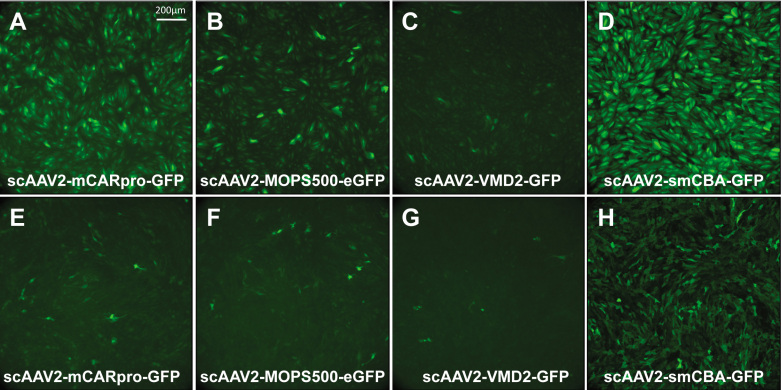
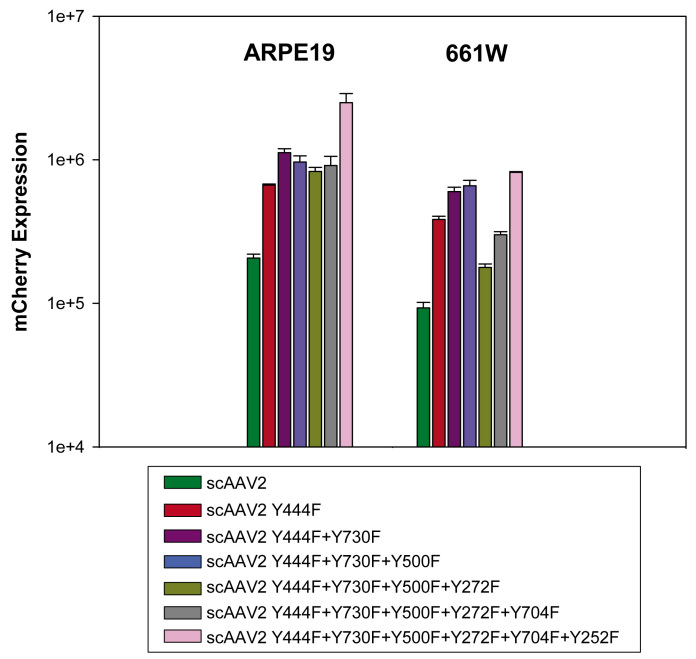
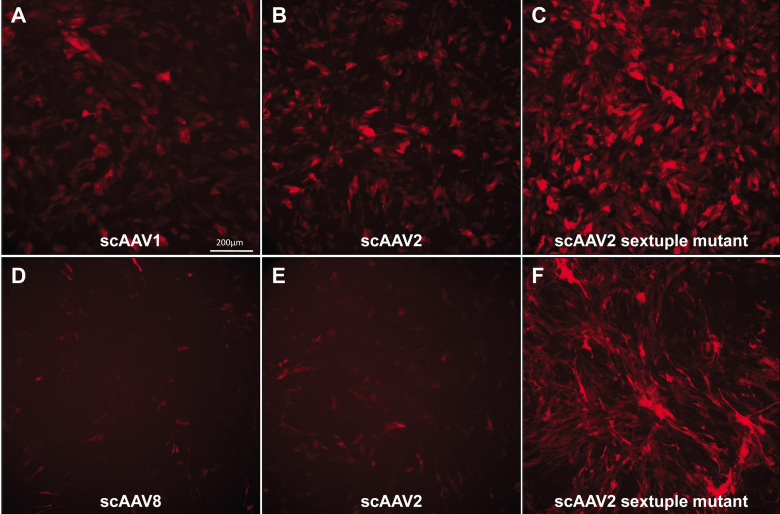
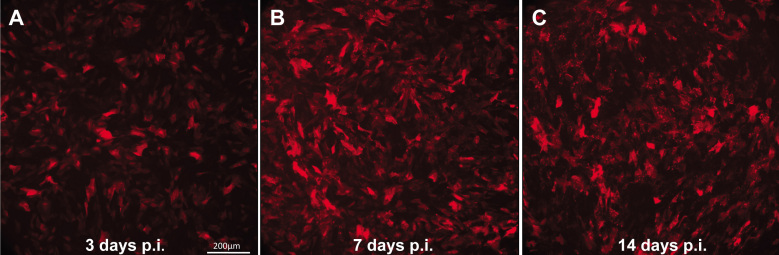
ARPE19 and 661W cells were infected with sc-smCBA-mCherry packaged in unmodified AAV capsids or capsids containing single/multiple tyrosine-phenylalanine (Y-F) mutations at multiplicity of infections (MOIs) ranging from 100 to 10,000. Three days post infection fluorescent images verified mCherry expression. Following microscopy, FACS analysis was performed to quantify the number of positive cells and the mean intensity of mCherry fluorescence, the product of which is reported as transduction efficiency for each vector. The scAAV vectors containing cone-specific (sc-mCARpro-green fluorescent protein [GFP]), rod-specific (sc-MOPS500-eGFP), retinal pigment epithelium (RPE)-specific (sc-VMD2-GFP), or ubiquitous (sc-smCBA-GFP) promoters were used to infect both cell lines at an MOI of 10,000. Three days post infection, cells were immunostained with an antibody raised against GFP and imaged. Finally, based on our in vitro results, we tested a prediction of transduction efficiency in vivo.
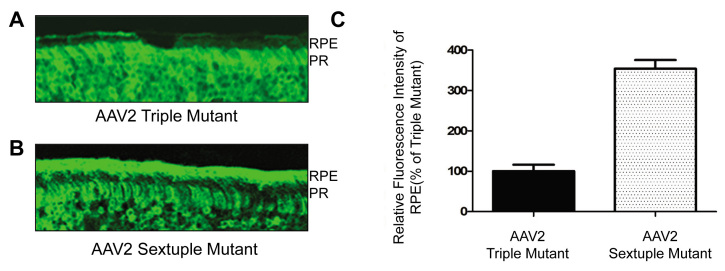
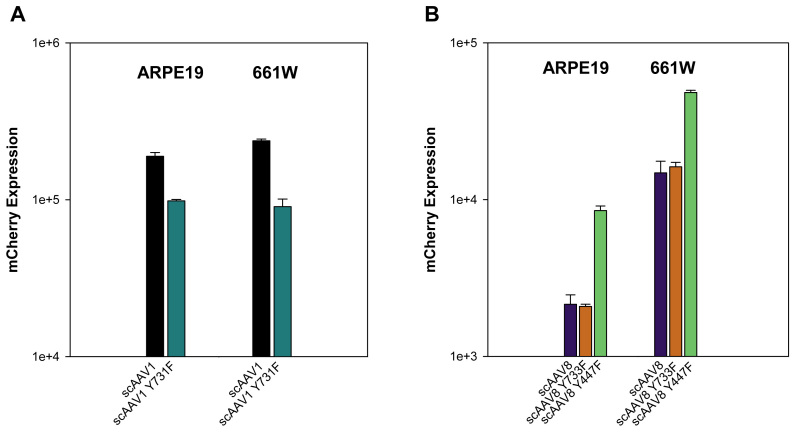
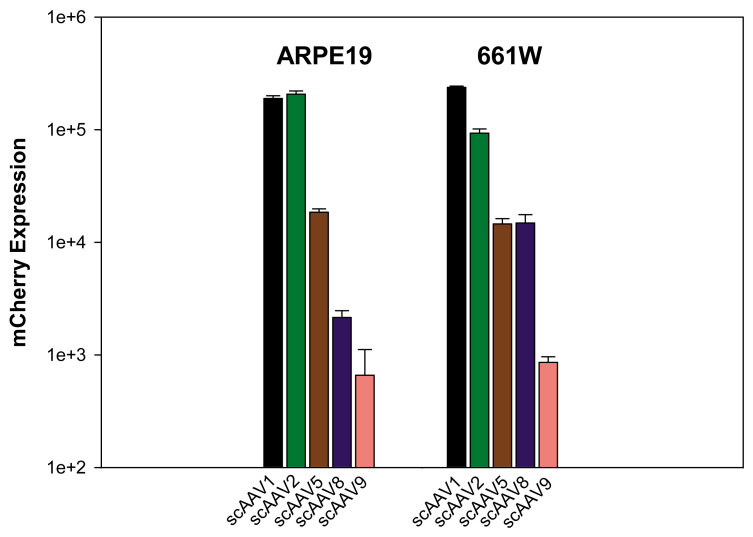
Expression from unmodified scAAV1, scAAV2, scAAV5, and scAAV8 vectors was detectable by FACS in both ARPE19 and 661W cells, with scAAV1 and scAAV2 being the most efficient in both cell lines. scAAV5 showed moderate efficiency in both ARPE19 and 661W cells. scAAV8 was moderately efficient in 661W cells and was by comparison less so in ARPE19 cells; however, transduction was still apparent. scAAV9 performed poorly in both cell types. With some exceptions, the Y-F capsid mutations generally increased the efficiency of scAAV vector transduction, with the increasing number of mutated residues improving efficiency. Results for single scAAV1 and scAAV8 capsid mutants were mixed. In some cases, efficiency improved; in others, it was unchanged or marginally reduced. Retinal-specific promoters were also active in both cell lines, with the 661W cells showing a pattern consistent with the in vivo activity of the respective promoters tested. The prediction based on in vitro data that AAV2 sextuple Y-F mutants would show higher transduction efficiency in RPE relative to AAV2 triple Y-F capsid mutants was validated by evaluating the transduction characteristics of the two mutant vectors in mouse retina.
Our results suggest that this rapid and quantifiable cell-based assay using two biologically relevant ocular cell lines will prove useful in screening and optimizing AAV vectors for application in retina-targeted gene therapies.
随着基于视网膜基因的疗法和治疗性构建体数量的增加,用于表征载体转导效率和质量的体外生物测定变得越来越重要。目前,主要针对非眼部组织进行量化载体转导效率的体外测定。一种人视网膜色素上皮细胞系(ARPE19)和一种小鼠视锥光感受器细胞系661W,已得到充分表征,并用于许多视网膜代谢和生物学途径研究。本研究的目的是使用高通量荧光激活细胞分选(FACS)分析来量化多种自互补(sc)腺相关病毒(AAV)载体在这些具有生物学相关性的眼部细胞系中的转导效率。
用包装在未修饰AAV衣壳或含有单个/多个酪氨酸-苯丙氨酸(Y-F)突变的衣壳中的sc-smCBA-mCherry以感染复数(MOI)为100至10,000感染ARPE19和661W细胞。感染后三天,荧光图像验证了mCherry的表达。显微镜检查后,进行FACS分析以量化阳性细胞数量和mCherry荧光的平均强度,其乘积作为每个载体的转导效率报告。使用含有视锥特异性(sc-mCARpro-绿色荧光蛋白[GFP])、视杆特异性(sc-MOPS500-eGFP)、视网膜色素上皮(RPE)特异性(sc-VMD2-GFP)或普遍存在(sc-smCBA-GFP)启动子的scAAV载体以MOI为10,000感染这两种细胞系。感染后三天,用针对GFP的抗体对细胞进行免疫染色并成像。最后,基于我们的体外结果,我们测试了体内转导效率的预测。
通过FACS在ARPE19和661W细胞中均检测到未修饰的scAAV1、scAAV2、scAAV5和scAAV8载体的表达,scAAV1和scAAV2在两种细胞系中效率最高。scAAV5在ARPE19和661W细胞中均显示出中等效率。scAAV8在661W细胞中效率中等,相比之下在ARPE19细胞中较低;然而,转导仍然明显。scAAV9在两种细胞类型中表现不佳。除了一些例外情况,Y-F衣壳突变通常提高了scAAV载体转导的效率,突变残基数量增加提高了效率。单个scAAV1和scAAV8衣壳突变体的结果不一。在某些情况下,效率提高;在其他情况下,效率不变或略有降低。视网膜特异性启动子在两种细胞系中也有活性,661W细胞显示出与所测试的各个启动子的体内活性一致的模式。通过评估两种突变载体在小鼠视网膜中的转导特性,验证了基于体外数据的预测,即AAV2六重Y-F突变体相对于AAV2三重Y-F衣壳突变体在RPE中显示出更高的转导效率。
我们的结果表明,这种使用两种具有生物学相关性的眼部细胞系的快速且可量化的基于细胞的测定方法,将被证明在筛选和优化用于视网膜靶向基因治疗的AAV载体方面是有用的。