Department of Ophthalmology, University of Missouri-Columbia School of Medicine, Columbia, Missouri, United States of America.
PLoS One. 2011 Apr 28;6(4):e19291. doi: 10.1371/journal.pone.0019291.
The eye lens is composed of fiber cells that are filled with α-, β- and γ-crystallins. The primary function of crystallins is to maintain the clarity of the lens through ordered interactions as well as through the chaperone-like function of α-crystallin. With aging, the chaperone function of α-crystallin decreases, with the concomitant accumulation of water-insoluble, light-scattering oligomers and crystallin-derived peptides. The role of crystallin-derived peptides in age-related lens protein aggregation and insolubilization is not understood.
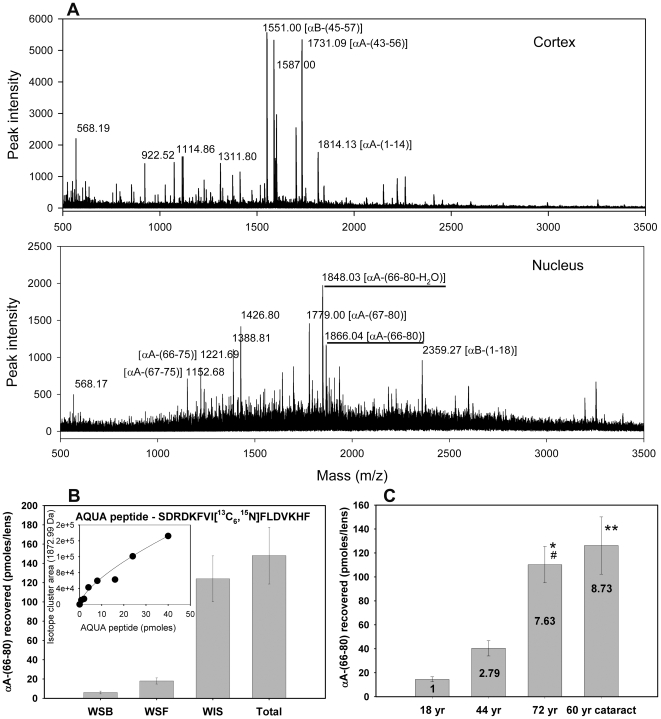
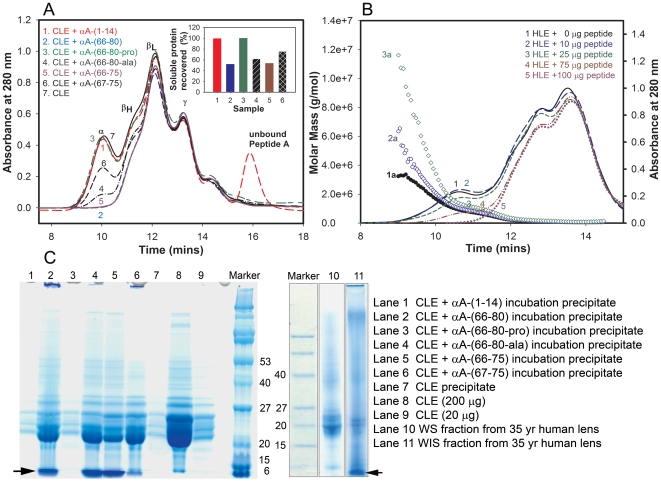
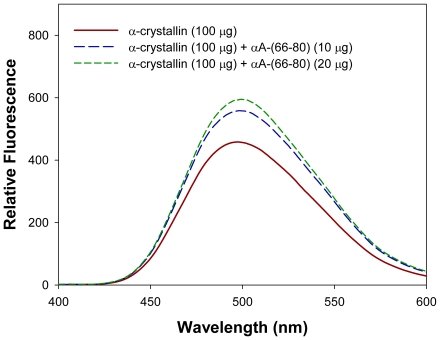
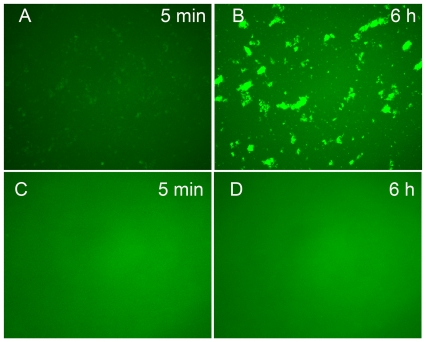
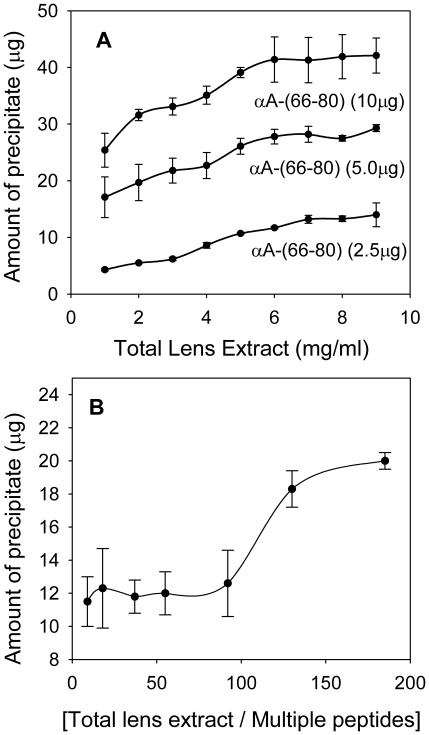
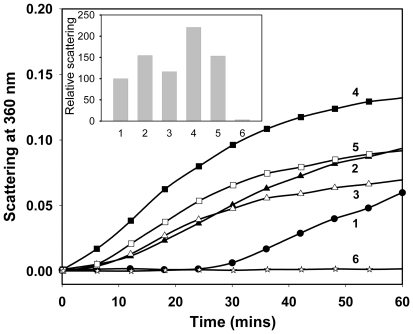
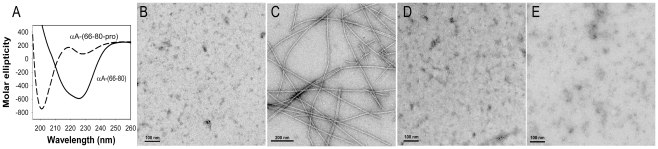
METHODOLOGY/PRINCIPAL FINDINGS: We found that αA-crystallin-derived peptide, (66)SDRDKFVIFLDVKHF(80), which accumulates in the aging lens, can inhibit the chaperone activity of α-crystallin and cause aggregation and precipitation of lens crystallins. Age-related change in the concentration of αA-(66-80) peptide was estimated by mass spectrometry. The interaction of the peptide with native crystallin was studied by multi-angle light scattering and fluorescence methods. High molar ratios of peptide-to-crystallin were favourable for aggregation and precipitation. Time-lapse recordings showed that, in the presence of αA-(66-80) peptide, α-crystallin aggregates and functions as a nucleus for protein aggregation, attracting aggregation of additional α-, β- and γ-crystallins. Additionally, the αA-(66-80) peptide shares the principal properties of amyloid peptides, such as β-sheet structure and fibril formation.
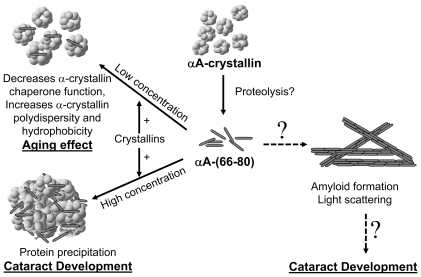
CONCLUSIONS/SIGNIFICANCE: These results suggest that crystallin-derived peptides such as αA-(66-80), generated in vivo, can induce age-related lens changes by disrupting the structure and organization of crystallins, leading to their insolubilization. The accumulation of such peptides in aging lenses may explain a novel mechanism for age-related crystallin aggregation and cataractogenesis.
眼睛晶状体由充满 α-、β-和 γ-晶体蛋白的纤维细胞组成。晶体蛋白的主要功能是通过有序相互作用以及 α-晶体蛋白的伴侣样功能来保持晶状体的透明度。随着年龄的增长,α-晶体蛋白的伴侣功能下降,同时伴有不溶性、光散射低聚物和晶体衍生肽的积累。晶体衍生肽在与年龄相关的晶状体蛋白聚集和不溶中的作用尚不清楚。
方法/主要发现:我们发现,在衰老的晶状体中积累的αA-晶体蛋白衍生肽 (66)SDRDKFVIFLDVKHF(80) 可以抑制α-晶体蛋白的伴侣活性,并导致晶状体晶体蛋白的聚集和沉淀。通过质谱法估计了与年龄相关的αA-(66-80)肽浓度变化。通过多角度光散射和荧光方法研究了肽与天然晶体蛋白的相互作用。肽与晶体蛋白的高摩尔比有利于聚集和沉淀。时程记录显示,在存在αA-(66-80)肽的情况下,α-晶体蛋白聚集并作为蛋白质聚集的核,吸引额外的α-、β-和γ-晶体蛋白的聚集。此外,αA-(66-80)肽具有淀粉样肽的主要特性,如β-折叠结构和纤维形成。
结论/意义:这些结果表明,体内产生的晶体衍生肽,如αA-(66-80),通过破坏晶体蛋白的结构和组织,导致其不溶,从而引起与年龄相关的晶状体变化。这些肽在衰老晶状体中的积累可能解释了与年龄相关的晶体蛋白聚集和白内障形成的一种新机制。