Toronto General Research Institute, University Health Network, Toronto, Ontario, Canada.
Diabetes. 2011 Jul;60(7):1901-6. doi: 10.2337/db11-0120. Epub 2011 May 11.
Circulating glucose inhibits glucose production in normal rodents and humans, but this glucose effectiveness is disrupted in diabetes due partly to sustained hyperglycemia. We hypothesize that hyperglycemia in diabetes impairs hypothalamic glucose sensing to lower glucose production, and changes of glucose transporter-1 (GLUT1) in the hypothalamic glial cells are responsible for the deleterious effects of hyperglycemia in vivo.
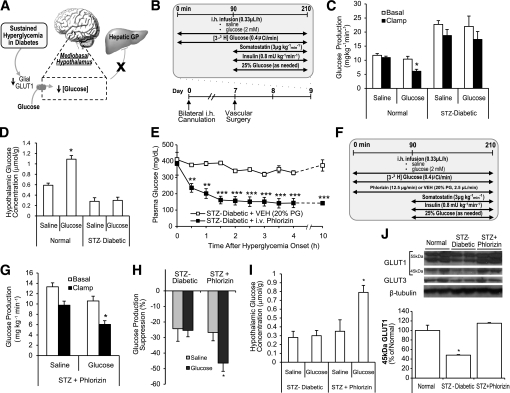
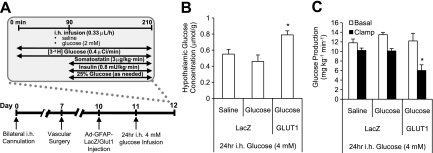
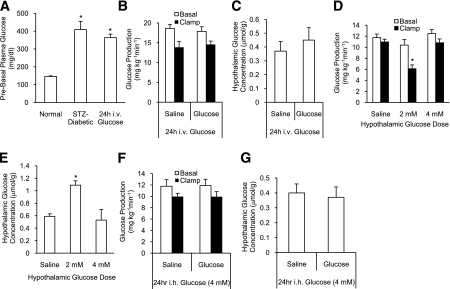
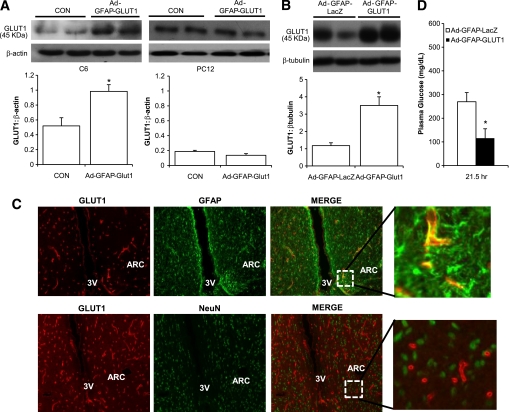
We tested hypothalamic glucose effectiveness to increase hypothalamic glucose concentration and lower glucose production in rats induced with streptozotocin (STZ) uncontrolled diabetes, STZ and phlorizin, and whole-body and hypothalamic sustained hyperglycemia. We next assessed the content of glial GLUT1 in the hypothalamus, generated an adenovirus expressing GLUT1 driven by a glial fibrillary acidic protein (GFAP) promoter (Ad-GFAP-GLUT1), and injected Ad-GFAP-GLUT1 into the hypothalamus of rats induced with hyperglycemia. Pancreatic euglycemic clamp and tracer-dilution methodologies were used to assess changes in glucose kinetics in vivo.
Sustained hyperglycemia, as seen in the early onset of STZ-induced diabetes, disrupted hypothalamic glucose sensing to increase hypothalamic glucose concentration and lower glucose production in association with reduced GLUT1 levels in the hypothalamic glial cells of rats in vivo. Overexpression of hypothalamic glial GLUT1 in STZ-induced rats with reduced GLUT1 acutely normalized plasma glucose levels and in rats with selectively induced hypothalamic hyperglycemia restored hypothalamic glucose effectiveness.
Sustained hyperglycemia impairs hypothalamic glucose sensing to lower glucose production through changes in hypothalamic glial GLUT1, and these data highlight the critical role of hypothalamic glial GLUT1 in mediating glucose sensing to regulate glucose production.
循环葡萄糖可抑制正常啮齿动物和人类的葡萄糖生成,但由于持续的高血糖,这种葡萄糖效应在糖尿病中被破坏。我们假设糖尿病中的高血糖会损害下丘脑的葡萄糖感应,从而降低葡萄糖生成,并且下丘脑神经胶质细胞中的葡萄糖转运蛋白-1 (GLUT1) 的变化是高血糖在体内产生有害影响的原因。
我们测试了用链脲佐菌素 (STZ) 诱导的未控制糖尿病、STZ 和根皮苷以及全身和下丘脑持续高血糖的大鼠,以检测下丘脑葡萄糖效应来增加下丘脑葡萄糖浓度并降低葡萄糖生成。接下来,我们评估了下丘脑神经胶质 GLUT1 的含量,生成了一种由神经胶质纤维酸性蛋白 (GFAP) 启动子驱动 GLUT1 表达的腺病毒 (Ad-GFAP-GLUT1),并将 Ad-GFAP-GLUT1 注射到高血糖诱导的大鼠的下丘脑。使用胰腺正葡萄糖钳夹和示踪剂稀释技术评估体内葡萄糖动力学的变化。
正如 STZ 诱导的糖尿病早期所看到的那样,持续的高血糖破坏了下丘脑的葡萄糖感应,导致大鼠下丘脑葡萄糖浓度升高和葡萄糖生成降低,同时下丘脑神经胶质细胞中的 GLUT1 水平降低。在 GLUT1 减少的 STZ 诱导的大鼠中过表达下丘脑神经胶质 GLUT1 可使血浆葡萄糖水平迅速正常化,而在选择性诱导的下丘脑高血糖大鼠中恢复下丘脑葡萄糖效应。
持续的高血糖通过改变下丘脑神经胶质 GLUT1 来损害下丘脑的葡萄糖感应,从而降低葡萄糖生成,这些数据突出了下丘脑神经胶质 GLUT1 在介导葡萄糖感应以调节葡萄糖生成中的关键作用。