Beck M A, Chapman N M, McManus B M, Mullican J C, Tracy S
Department of Pathology and Microbiology, University of Nebraska Medical Center, Omaha 68105.
Am J Pathol. 1990 Mar;136(3):669-81.
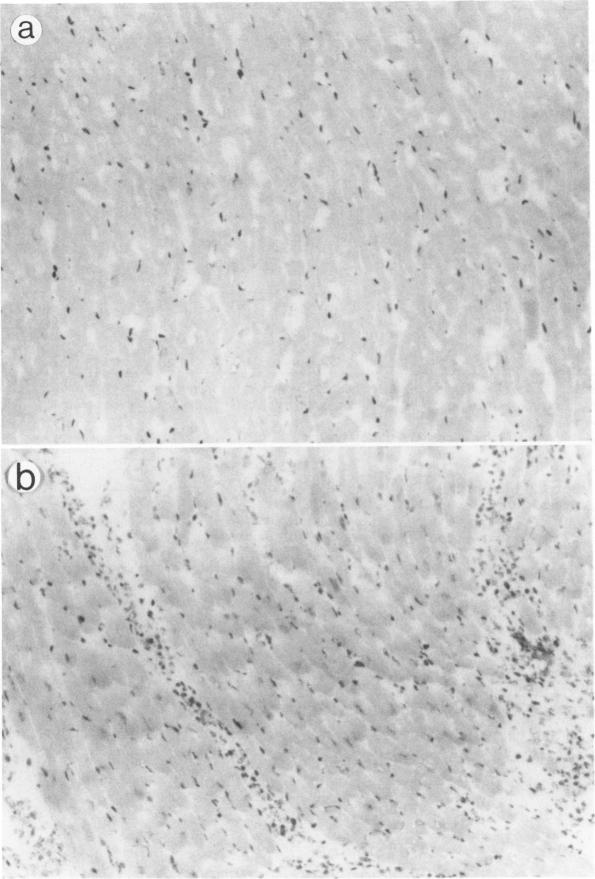
Enteroviruses are implicated as etiologic agents in the inflammatory diseases myocarditis and polymyositis. In this report, we show that a previous enterovirus exposure in mice can influence development of myocardial inflammation with a second enteroviral exposure. Inoculation of 25-day-old male C3H/HeJ mice with 10(3) or 10(5) plaque-forming units (PFU) of infectious or ultra violet (UV)-inactivated coxsackievirus B2 (CVB2), followed by inoculation 28 days later with 10(5) PFU of a myocarditic variant of coxsackievirus B3 (CVB3-m) results in more intense myocardial inflammation and injury than is seen in age-matched mice inoculated with CVB3-m alone. More severe disease occurs with the lower primary dose of CVB2. Neutralizing antibody to CVB2 is detected early after primary inoculation and neutralizing antibody to CVB3 is first detected 5 days after secondary inoculation. In vitro proliferation of splenocytes from mice inoculated with one or both viruses occurs in response to both CVB2 and CVB3 antigens. We recently demonstrated that murine T cells are capable of recognizing an enterovirus group antigen. Thus cell-mediated immune responses to a conserved antigenic epitope(s) among the enteroviruses may be involved in the exacerbation of myocardial inflammatory disease during a second enterovirus infection. The secondary infection model described here may more accurately mirror virus-induced myocarditis in the human population because the majority of adults have been exposed to several enteroviruses before induction of disease.
肠道病毒被认为是心肌炎和多发性肌炎等炎症性疾病的病原体。在本报告中,我们表明,小鼠先前接触过肠道病毒会影响再次接触肠道病毒时心肌炎症的发展。用10³或10⁵个感染性或紫外线(UV)灭活的柯萨奇病毒B2(CVB2)空斑形成单位(PFU)接种25日龄雄性C3H/HeJ小鼠,28天后再用10⁵个PFU的柯萨奇病毒B3心肌炎变种(CVB3-m)接种,与仅接种CVB3-m的年龄匹配小鼠相比,会导致更严重的心肌炎症和损伤。初次接种较低剂量的CVB2会引发更严重的疾病。初次接种后早期可检测到针对CVB2的中和抗体,二次接种后5天首次检测到针对CVB3的中和抗体。接种一种或两种病毒的小鼠脾细胞在体外对CVB2和CVB3抗原均有增殖反应。我们最近证明,小鼠T细胞能够识别肠道病毒群抗原。因此,对肠道病毒中保守抗原表位的细胞介导免疫反应可能参与了第二次肠道病毒感染期间心肌炎症性疾病的加重。这里描述的二次感染模型可能更准确地反映了人群中病毒诱导的心肌炎,因为大多数成年人在疾病诱发前已接触过多种肠道病毒。