Department of Biological Sciences, Brock University, St. Catharines, Ontario, Canada.
BMC Genomics. 2011 May 11;12(1):231. doi: 10.1186/1471-2164-12-231.
Changes in DNA methylation in the mammalian genome during development are frequent events and play major roles regulating gene expression and other developmental processes. It is necessary to identify these events so that we may understand how these changes affect normal development and how aberrant changes may impact disease.
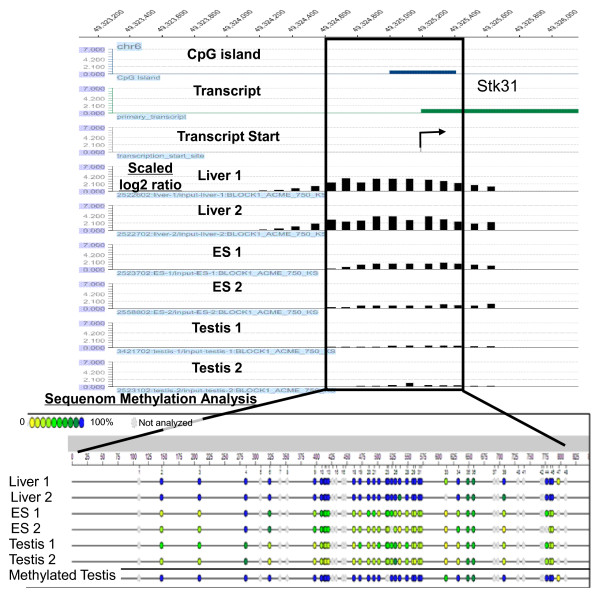
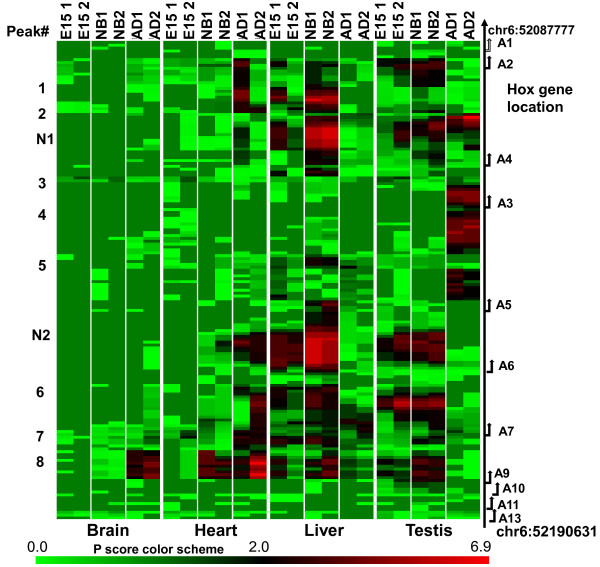
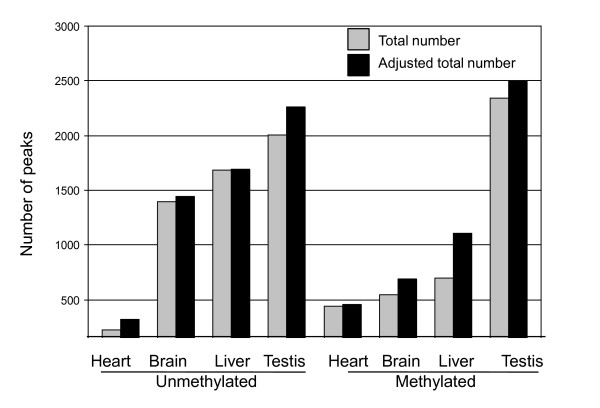
In this study Methylated DNA ImmunoPrecipitation (MeDIP) was used in conjunction with a NimbleGen promoter plus CpG island (CpGi) array to identify Tissue and Developmental Stage specific Differentially Methylated DNA Regions (T-DMRs and DS-DMRs) on a genome-wide basis. Four tissues (brain, heart, liver, and testis) from C57BL/6J mice were analyzed at three developmental stages (15 day embryo, E15; new born, NB; 12 week adult, AD). Almost 5,000 adult T-DMRs and 10,000 DS-DMRs were identified. Surprisingly, almost all DS-DMRs were tissue specific (i.e. methylated in at least one tissue and unmethylated in one or more tissues). In addition our results indicate that many DS-DMRs are methylated at early development stages (E15 and NB) but are unmethylated in adult. There is a very strong bias for testis specific methylation in non-CpGi promoter regions (94%). Although the majority of T-DMRs and DS-DMRs tended to be in non-CpGi promoter regions, a relatively large number were also located in CpGi in promoter, intragenic and intergenic regions (>15% of the 15,979 CpGi on the array).
Our data suggests the vast majority of unique sequence DNA methylation has tissue specificity, that demethylation has a prominent role in tissue differentiation, and that DNA methylation has regulatory roles in alternative promoter selection and in non-promoter regions. Overall, our studies indicate changes in DNA methylation during development are a dynamic, widespread, and tissue-specific process involving both DNA methylation and demethylation.
在哺乳动物基因组的发育过程中,DNA 甲基化的变化是频繁发生的事件,在调节基因表达和其他发育过程中起着重要作用。有必要识别这些事件,以便我们了解这些变化如何影响正常发育,以及异常变化如何影响疾病。
在这项研究中,我们使用甲基化 DNA 免疫沉淀(MeDIP)与 NimbleGen 启动子加 CpG 岛(CpGi)阵列相结合,在全基因组范围内鉴定组织和发育阶段特异性差异甲基化 DNA 区域(T-DMRs 和 DS-DMRs)。我们分析了来自 C57BL/6J 小鼠的四个组织(脑、心、肝和睾丸)在三个发育阶段(15 天胚胎、E15;新生、NB;12 周成年、AD)的情况。鉴定出近 5000 个成人 T-DMRs 和 10000 个 DS-DMRs。令人惊讶的是,几乎所有的 DS-DMRs 都是组织特异性的(即在至少一种组织中甲基化,而在一种或多种组织中未甲基化)。此外,我们的结果表明,许多 DS-DMRs 在早期发育阶段(E15 和 NB)被甲基化,但在成年时未被甲基化。非 CpGi 启动子区域的睾丸特异性甲基化具有很强的偏向性(94%)。尽管大多数 T-DMRs 和 DS-DMRs 倾向于位于非 CpGi 启动子区域,但在启动子、基因内和基因间区域也有相对大量的 T-DMRs 和 DS-DMRs 位于 CpGi(阵列上 15979 个 CpGi 中超过 15%)。
我们的数据表明,绝大多数独特序列 DNA 甲基化具有组织特异性,去甲基化在组织分化中起着重要作用,DNA 甲基化在选择替代启动子和非启动子区域方面具有调节作用。总的来说,我们的研究表明,发育过程中的 DNA 甲基化变化是一个动态的、广泛的、组织特异性的过程,涉及 DNA 甲基化和去甲基化。