Department of Infection and Virology, University of Gothenburg, Gothenburg, Sweden.
BMC Infect Dis. 2011 May 12;11:124. doi: 10.1186/1471-2334-11-124.
Patients infected with hepatitis C virus (HCV) genotype 1 respond poorly to standard treatment with 50% or less achieving sustained virologic response. Predicting outcome is essential and could help avoid unnecessary treatment and reduce health cost. Recently, an association of amino acid substitutions in the core region and treatment outcome was observed in Japanese patients. In the present study, the impact of these mutations on response kinetics and treatment outcome was explored in Caucasian patients.
The core region of HCV pre-treatment samples obtained from 50 patients treated with peginterferon/ribavirin in a previous Swedish clinical trial with genotype 1 infection were sequenced. The alleles at rs12979860, a single nucleotide polymorphism (SNP), were assessed in order to identify any co-association with this strong response predictor.
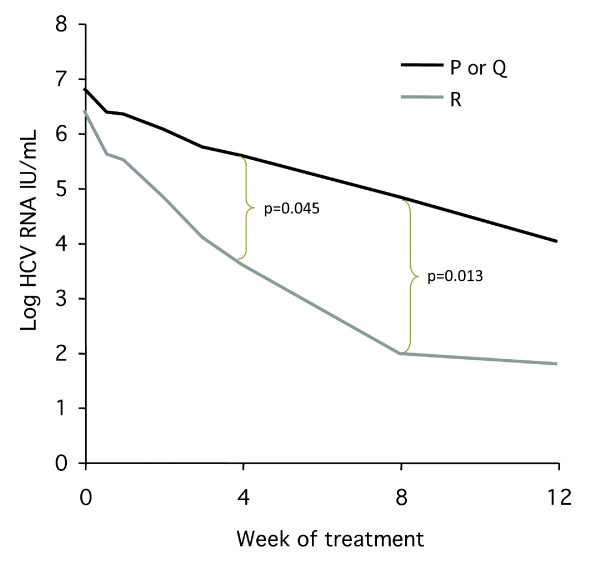
No association between treatment response and substitutions of core residue 91 was found. In contrast, substitutions of core residue 70 were observed in 6/21 (29%) non-responders, but only in one of 29 responders (p = 0.03), and were more common in subgenotype 1b (R70Q in 6 of 13 strains) than in 1a (R70P in 1 of 37 strains, p = 0.004). The rs12979860 SNP upstream of the IL28B gene was overall the strongest response predictor (p = 0.0001). Core 70 substitutions were associated with poorer response kinetics in patients carrying the CT genotype at rs12979860.
The results indicate that substitutions of core residue 70 are related to treatment response in Caucasian patients with HCV-1b infection, but are of less importance than IL28B polymorphism.
丙型肝炎病毒(HCV)基因型 1 感染患者对标准治疗的反应较差,只有 50%或更少的患者能达到持续病毒学应答。预测治疗结果至关重要,可以避免不必要的治疗并降低医疗成本。最近,在日本患者中观察到核心区域的氨基酸取代与治疗结果之间存在关联。在本研究中,探讨了这些突变对高加索患者的反应动力学和治疗结果的影响。
对 50 例在以前的瑞典临床试验中接受聚乙二醇干扰素/利巴韦林治疗的基因型 1 感染患者的治疗前样本进行了 HCV 核心区测序。为了鉴定与这一强反应预测因子的任何共同关联,评估了 rs12979860 单核苷酸多态性(SNP)的等位基因。
未发现治疗反应与核心残基 91 的取代之间存在关联。相反,在 21 例无应答者中观察到核心残基 70 的取代,而在 29 例应答者中仅观察到 1 例(p = 0.03),在亚基因型 1b 中更为常见(13 株中有 6 株为 R70Q),而在 1a 中则较少见(37 株中有 1 株为 R70P,p = 0.004)。IL28B 基因上游的 rs12979860 SNP 是总体上最强的反应预测因子(p = 0.0001)。在携带 rs12979860 CT 基因型的患者中,核心 70 取代与较差的反应动力学相关。
结果表明,在感染 HCV-1b 的高加索患者中,核心残基 70 的取代与治疗反应有关,但不如 IL28B 多态性重要。