Mitchell Center Alzheimer's Disease and Related Brain Disorders, Department of Neurology, University of Texas Houston Medical School, 6431 Fannin St, Houston, TX 77030, USA.
Semin Cell Dev Biol. 2011 Jul;22(5):482-7. doi: 10.1016/j.semcdb.2011.04.002. Epub 2011 May 5.
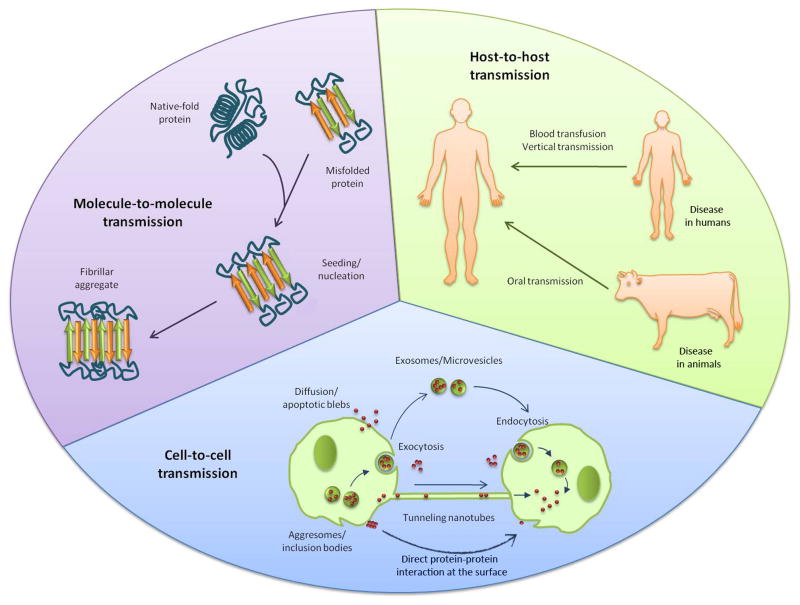
Some of the most prevalent human degenerative diseases appear as a result of the misfolding and aggregation of proteins. Compelling evidence suggest that misfolded protein aggregates play an important role in cell dysfunction and tissue damage, leading to the disease. Prion protein (Prion diseases), amyloid-beta (Alzheimer's disease), alpha-synuclein (Parkinson's disease), Huntingtin (Huntington's disease), serum amyloid A (AA amyloidosis) and islet amyloid polypeptide (type 2 diabetes) are some of the proteins that trigger disease when they get misfolded. The recent understanding of the crucial role of misfolded proteins as well as the structural requirements and mechanism of protein misfolding have raised the possibility that these diseases may be transmissible by self-propagation of the protein misfolding process in a similar way as the infamous prions transmit prion diseases. Future research in this field should aim to clarify this possibility and translate the knowledge of the basic disease mechanisms into development of novel strategies for early diagnosis and efficient treatment.
一些最常见的人类退行性疾病是由于蛋白质错误折叠和聚集引起的。有确凿的证据表明,错误折叠的蛋白质聚集体在细胞功能障碍和组织损伤中发挥重要作用,导致疾病的发生。朊病毒蛋白(朊病毒病)、β-淀粉样蛋白(阿尔茨海默病)、α-突触核蛋白(帕金森病)、亨廷顿蛋白(亨廷顿病)、血清淀粉样蛋白 A(AA 淀粉样变性)和胰岛淀粉样多肽(2 型糖尿病)是一些在错误折叠时引发疾病的蛋白质。最近对错误折叠蛋白质作为关键因素的理解,以及蛋白质错误折叠的结构要求和机制,提出了这样一种可能性,即这些疾病可能通过蛋白质错误折叠过程的自我传播而具有传染性,类似于臭名昭著的朊病毒传播朊病毒病。该领域的未来研究应旨在澄清这种可能性,并将疾病基本机制的知识转化为开发用于早期诊断和有效治疗的新策略。