Department of Biology, University of North Carolina at Chapel Hill, Chapel Hill, North Carolina 27599, USA.
Nat Cell Biol. 2011 Jun;13(6):686-92. doi: 10.1038/ncb2232. Epub 2011 May 15.
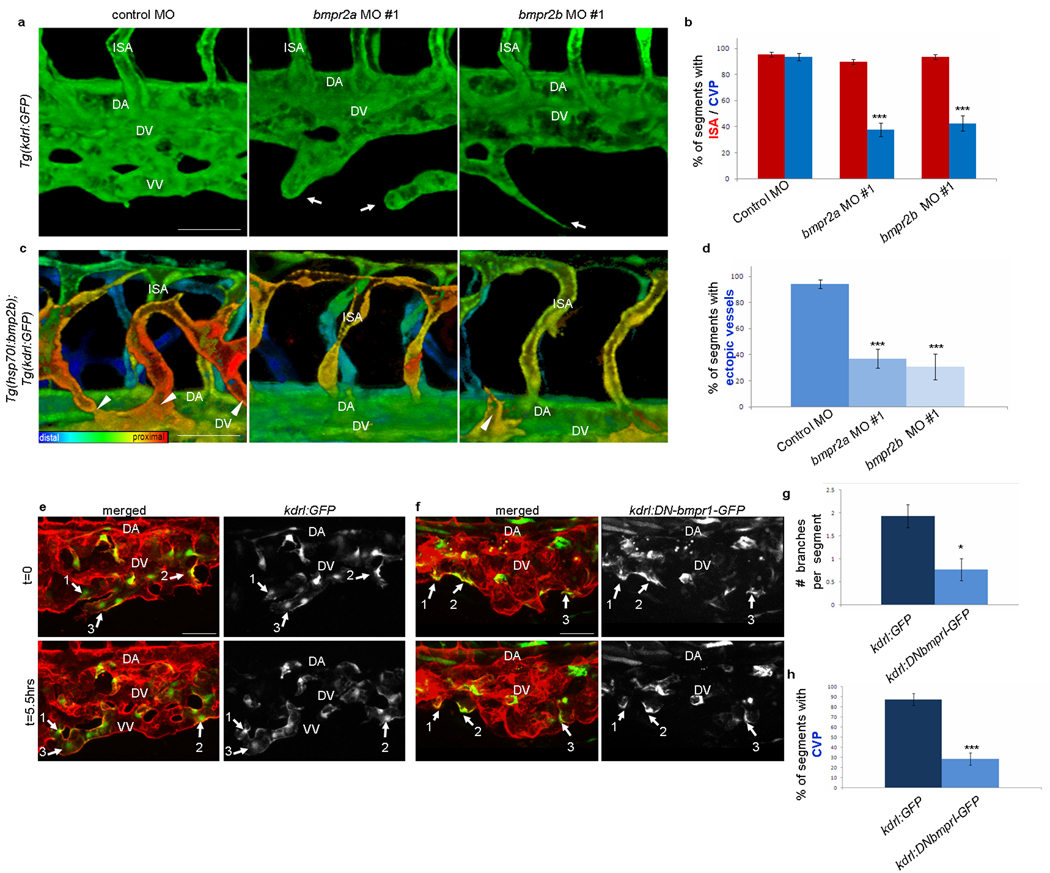
Angiogenesis, the formation of new blood vessels from pre-existing vessels, is critical to most physiological processes and many pathological conditions. During zebrafish development, angiogenesis expands the axial vessels into a complex vascular network that is necessary for efficient oxygen delivery. Although the dorsal aorta and the axial vein are spatially juxtaposed, the initial angiogenic sprouts from these vessels extend in opposite directions, indicating that distinct cues may regulate angiogenesis of the axial vessels. We found that angiogenic sprouts from the dorsal aorta are dependent on vascular endothelial growth factor A (Vegf-A) signalling, and do not respond to bone morphogenetic protein (Bmp) signals. In contrast, sprouts from the axial vein are regulated by Bmp signalling independently of Vegf-A signals, indicating that Bmp is a vein-specific angiogenic cue during early vascular development. Our results support a paradigm whereby different signals regulate distinct programmes of sprouting angiogenesis from the axial vein and dorsal aorta, and indicate that signalling heterogeneity contributes to the complexity of vascular networks.
血管生成,即从预先存在的血管中形成新的血管,对大多数生理过程和许多病理状况都至关重要。在斑马鱼发育过程中,血管生成将轴向血管扩展为复杂的血管网络,这对于有效输送氧气是必需的。尽管背主动脉和轴向静脉在空间上相邻,但这些血管的初始血管生成芽向相反的方向延伸,表明可能存在不同的信号来调节轴向血管的血管生成。我们发现,背主动脉的血管生成芽依赖于血管内皮生长因子 A(Vegf-A)信号,而不响应骨形态发生蛋白(Bmp)信号。相比之下,轴向静脉的芽受 Bmp 信号调节,而不依赖于 Vegf-A 信号,表明 Bmp 是早期血管发育过程中静脉特异性的血管生成信号。我们的结果支持了这样一种模式,即不同的信号调节来自轴向静脉和背主动脉的不同的芽生血管生成程序,并表明信号异质性有助于血管网络的复杂性。