Tulane Cancer Center, Department of Epidemiology, Tulane University Health Sciences Center, New Orleans, Louisiana, United States of America.
PLoS One. 2011 May 10;6(5):e19672. doi: 10.1371/journal.pone.0019672.
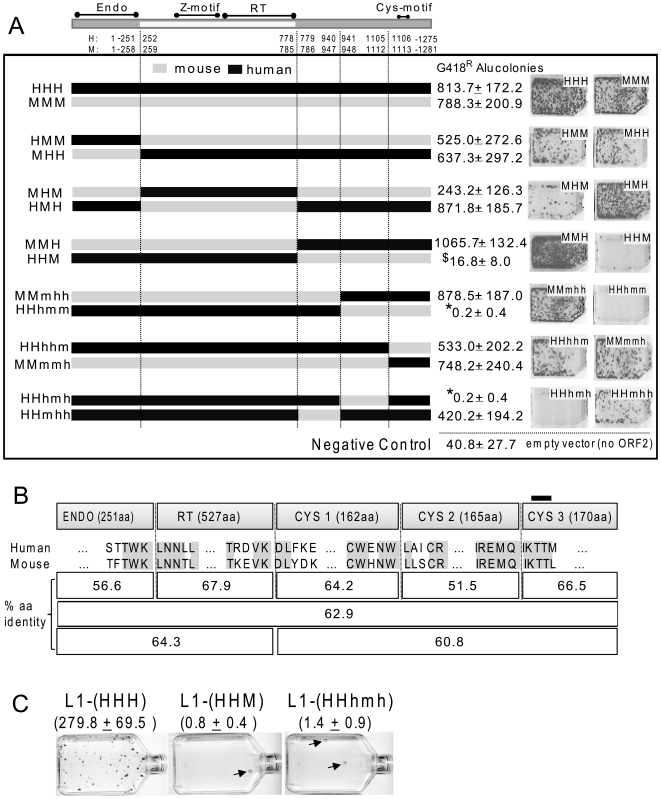
LINE-1 (L1) retroelements emerged in mammalian genomes over 80 million years ago with a few dominant subfamilies amplifying over discrete time periods that led to distinct human and mouse L1 lineages. We evaluated the functional conservation of L1 sequences by comparing retrotransposition rates of chimeric human-rodent L1 constructs to their parental L1 counterparts. Although amino acid conservation varies from ∼35% to 63% for the L1 ORF1p and ORF2p, most human and mouse L1 sequences can be functionally exchanged. Replacing either ORF1 or ORF2 to create chimeric human-mouse L1 elements did not adversely affect retrotransposition. The mouse ORF2p retains retrotransposition-competency to support both Alu and L1 mobilization when any of the domain sequences we evaluated were substituted with human counterparts. However, the substitution of portions of the mouse cys-domain into the human ORF2p reduces both L1 retrotransposition and Alu trans-mobilization by 200-1000 fold. The observed loss of ORF2p function is independent of the endonuclease or reverse transcriptase activities of ORF2p and RNA interaction required for reverse transcription. In addition, the loss of function is physically separate from the cysteine-rich motif sequence previously shown to be required for RNP formation. Our data suggest an additional role of the less characterized carboxy-terminus of the L1 ORF2 protein by demonstrating that this domain, in addition to mediating RNP interaction(s), provides an independent and required function for the retroelement amplification process. Our experiments show a functional modularity of most of the LINE sequences. However, divergent evolution of interactions within L1 has led to non-reciprocal incompatibilities between human and mouse ORF2 cys-domain sequences.
LINE-1(L1)逆转录元件在 8000 多万年前出现在哺乳动物基因组中,少数主要亚家族在不同的时间点扩增,导致了独特的人类和小鼠 L1 谱系。我们通过比较嵌合人-鼠 L1 构建体的逆转座率与其亲本 L1 对应物,评估了 L1 序列的功能保守性。尽管 L1 ORF1p 和 ORF2p 的氨基酸保守性从约 35%到 63%不等,但大多数人类和小鼠 L1 序列可以在功能上互换。用人类对应物替换任一个 ORF1 或 ORF2 来创建嵌合人-鼠 L1 元件,不会对逆转座产生不利影响。当我们评估的任何结构域序列被人源序列取代时,鼠 ORF2p 仍然保留了逆转座能力,以支持 Alu 和 L1 的动员。然而,将鼠 cys 结构域的部分序列替换成人 ORF2p,会使 L1 逆转座和 Alu 转座分别减少 200-1000 倍。观察到的 ORF2p 功能丧失与 ORF2p 的内切酶或逆转录酶活性以及逆转录所需的 RNA 相互作用无关。此外,这种功能丧失与先前显示为 RNP 形成所必需的富含半胱氨酸的基序序列在物理上是分开的。我们的数据表明,L1 ORF2 蛋白的羧基末端具有额外的作用,除了介导 RNP 相互作用外,该结构域还为逆转录元件的扩增过程提供了独立和必需的功能。我们的实验表明,大多数 LINE 序列具有功能模块化。然而,L1 内部相互作用的趋异进化导致了人类和小鼠 ORF2 cys 结构域序列之间的非互惠不兼容。