The First Affiliated Hospital of Chongqing Medical University, Chongqing Key Laboratory of Ophthalmology and Chongqing Eye Institute, Chongqing, People's Republic of China.
PLoS One. 2011 May 6;6(5):e19870. doi: 10.1371/journal.pone.0019870.
Experimental autoimmune uveoretinitis (EAU) serves as a model for human intraocular inflammation. IFN-β has been used in the treatment of certain autoimmune diseases. Earlier studies showed that it ameliorated EAU; however, the mechanisms involved in this inhibition are still largely unknown.
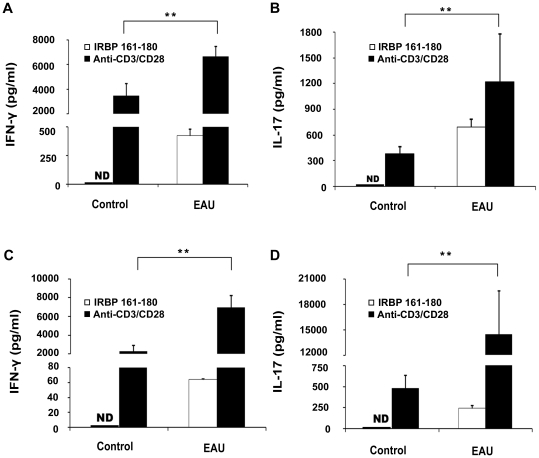
METHODOLOGY/PRINCIPAL FINDINGS: B10RIII mice were immunized with interphotoreceptor retinoid-binding protein (IRBP) peptide 161-180 in Complete Freund's adjuvant. Splenocytes from different time points after immunization were used to evaluate the expression of IFN-β. An increased expression of IFN-β was observed during EAU and its highest expression was observed on day 16, 3 days after the peak of intraocular inflammation. Splenocytes and draining lymph node cells from mice immunized with IRBP(161-180) on day 13 and control mice were activated with anti-CD3/anti-CD28 antibodies or IRBP(161-180) to evaluate the production of IFN-γ and IL-17. The results showed that IFN-γ and IL-17 were significantly higher in immunized mice as compared to the control mice when exposed to anti-CD3/anti-CD28 antibodies. However, the production of IFN-γ and IL-17 was detected only in immunized mice, but not in the control mice when stimulated with IRBP(161-180). Multiple subcutaneous injections of IFN-β significantly inhibited EAU activity in association with a down-regulated expression of IFN-γ, IL-17 and an enhanced IL-10 production. In an in vitro system using cells from mice, IFN-β suppressed IFN-γ production by CD4(+)CD62L(-) T cells, IL-17 production by CD4(+)CD62L(+/-) T cells and proliferation of CD4(+)CD62L(+/-) T cells. IFN-β inhibited the secretion of IL-6, but promoted the secretion of IL-10 by monocytes. IFN-β-treated monocytes inhibited IL-17 secretion by CD4(+)CD62L(+/-) T cells, but did not influence IFN-γ expression and T cell proliferation.
CONCLUSIONS/SIGNIFICANCE: IFN-β may exert its inhibitory effect on EAU by inhibiting Th1, Th17 cells and modulating relevant cytokines. IFN-β may provide a potential treatment for diseases mediated by Th1 and Th17 cells.
实验性自身免疫性葡萄膜炎(EAU)是一种人类眼内炎症的模型。IFN-β 已被用于治疗某些自身免疫性疾病。早期研究表明,它可以改善 EAU,但涉及这种抑制的机制在很大程度上仍不清楚。
方法/主要发现:B10RIII 小鼠用全氟化碳佐剂中的间视网膜视黄醇结合蛋白(IRBP)肽 161-180 免疫。在免疫后不同时间点的脾细胞用于评估 IFN-β 的表达。在 EAU 期间观察到 IFN-β 的表达增加,其最高表达在眼内炎症高峰后第 3 天,即第 16 天。用 IRBP(161-180)在第 13 天免疫的小鼠和对照小鼠的脾细胞和引流淋巴结细胞用抗 CD3/抗 CD28 抗体或 IRBP(161-180)激活,以评估 IFN-γ 和 IL-17 的产生。结果表明,与对照小鼠相比,用抗 CD3/抗 CD28 抗体刺激时,免疫小鼠的 IFN-γ 和 IL-17 明显升高。然而,只有在免疫小鼠中检测到 IFN-γ 和 IL-17 的产生,而在对照小鼠中未检测到。IFN-β 的多次皮下注射可显著抑制 EAU 活性,并伴有 IFN-γ、IL-17 表达下调和 IL-10 产生增强。在使用来自小鼠的细胞的体外系统中,IFN-β 抑制 CD4(+)CD62L(-)T 细胞产生 IFN-γ、CD4(+)CD62L(+/-)T 细胞产生 IL-17 和 CD4(+)CD62L(+/-)T 细胞增殖。IFN-β 抑制 IL-6 的分泌,但促进单核细胞分泌 IL-10。IFN-β 处理的单核细胞抑制 CD4(+)CD62L(+/-)T 细胞分泌 IL-17,但不影响 IFN-γ 表达和 T 细胞增殖。
结论/意义:IFN-β 通过抑制 Th1、Th17 细胞并调节相关细胞因子,可能对 EAU 发挥抑制作用。IFN-β 可能为 Th1 和 Th17 细胞介导的疾病提供一种潜在的治疗方法。