School of Social and Community Medicine, University of Bristol, Bristol, UK.
Matern Child Health J. 2012 May;16(4):909-20. doi: 10.1007/s10995-011-0818-5.
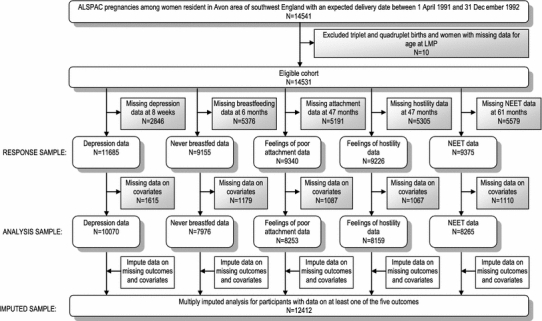
This study examined the predictive ability of mother's age, antenatal depression, education, financial difficulties, partner status, and smoking for a range of poor maternal and offspring outcomes assessed up to 61 months postnatally. Outcomes obtained from the Avon Longitudinal Study of Parents and Children (ALSPAC) were maternal postnatal depression at 8 weeks (n = 10,070), never breastfeeding (n = 7,976), feelings of poor attachment (n = 8,253) and hostility (n = 8,159) at 47 months, and not in employment, education or training (NEET, n = 8,265) at 61 months. Only a small proportion of women with each outcome were aged less than 20 years when they were pregnant. At least half of the women experiencing these outcomes, and up to 74.7% of women with postnatal depression, could be identified if they had at least one of the predictors measured during pregnancy (age < 20, depression, education less than O level, financial difficulties, no partner, or smoking). Model discrimination was poor using maternal age only (area under the receiver operator characteristic (AUROC) curve approximately 0.52), except for never breastfeeding (0.63). Discrimination improved (AUROC: 0.80, 0.69, 0.62, 0.60, 0.66 for depression, never breastfeeding, poor attachment, hostility and NEET, respectively) when all six predictors were included in the model. Calibration improved for all outcomes with the model including all six predictors, except never breastfeeding where even age alone demonstrated good calibration. Factors other than young maternal age, including education, smoking and depression during pregnancy should be considered in identifying women and their offspring likely to benefit from parenting support interventions.
本研究考察了母亲年龄、产前抑郁、教育程度、经济困难、伴侣状况和吸烟等因素对一系列产后母亲和后代不良结局的预测能力,这些结局是在产后 61 个月内评估的。该研究的数据来自阿冯纵向父母与子女研究(Avon Longitudinal Study of Parents and Children,ALSPAC),包括母亲产后 8 周的抑郁情况(n=10070)、从未母乳喂养(n=7976)、47 个月时的母子依恋不良(n=8253)和敌对情绪(n=8159),以及 61 个月时未就业、未接受教育或培训(not in employment, education or training,NEET,n=8265)。只有一小部分有这些结果的女性在怀孕时年龄小于 20 岁。如果在怀孕期间测量了至少一个预测因素(年龄<20 岁、抑郁、教育程度低于 O 级、经济困难、没有伴侣或吸烟),那么至少一半经历这些结果的女性,甚至多达 74.7%的产后抑郁女性,都可以被识别出来。仅使用母亲年龄进行模型区分的效果较差(接收者操作特征曲线下面积(area under the receiver operator characteristic,AUROC)约为 0.52),但从未母乳喂养的情况除外(0.63)。当模型中包含所有六个预测因素时,模型的区分度有所提高(AUROC:抑郁、从未母乳喂养、母子依恋不良、敌对情绪和 NEET 分别为 0.80、0.69、0.62、0.60 和 0.66)。除了从未母乳喂养外,即使仅使用年龄进行预测,模型对所有结局的校准也有所提高。在识别可能受益于育儿支持干预的妇女及其后代时,应考虑母亲年龄以外的因素,包括教育、吸烟和怀孕期间的抑郁。