Department of Biostatistics, University of Washington, Seattle, Washington, United States of America.
PLoS One. 2011 May 12;6(5):e19416. doi: 10.1371/journal.pone.0019416.
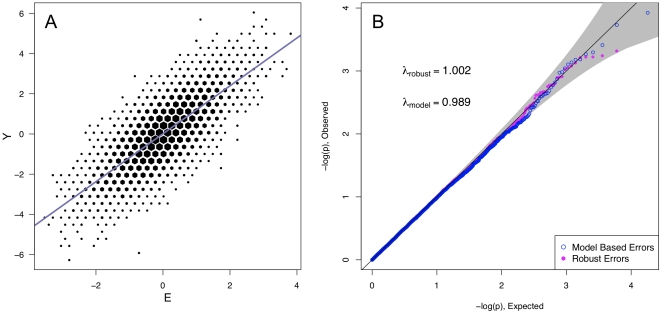
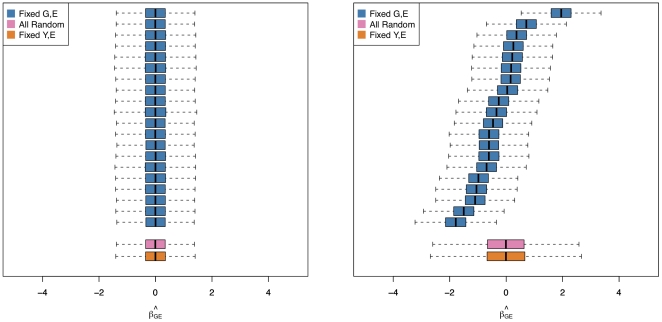
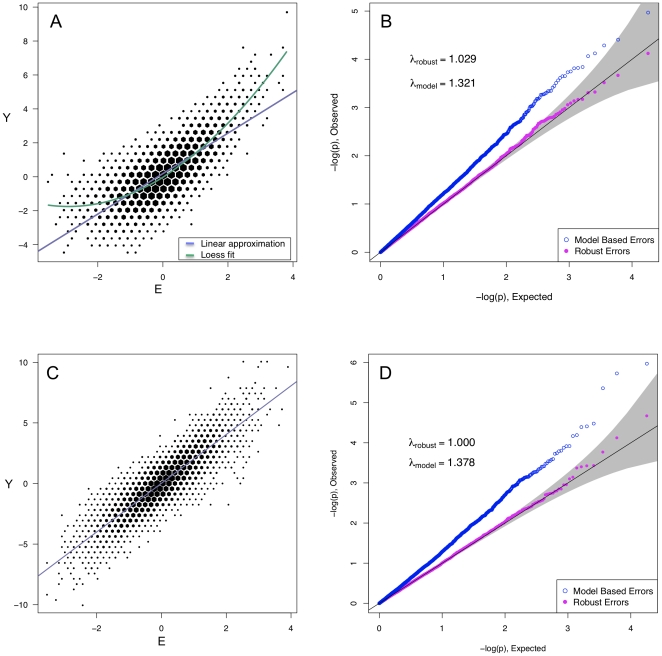
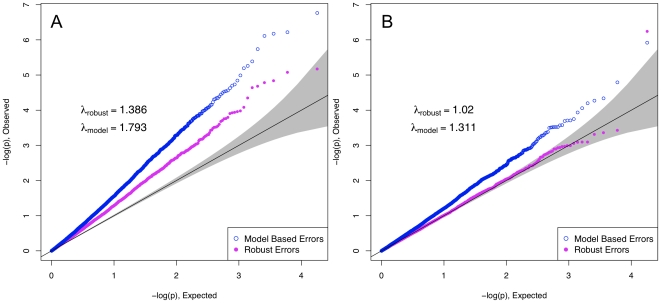
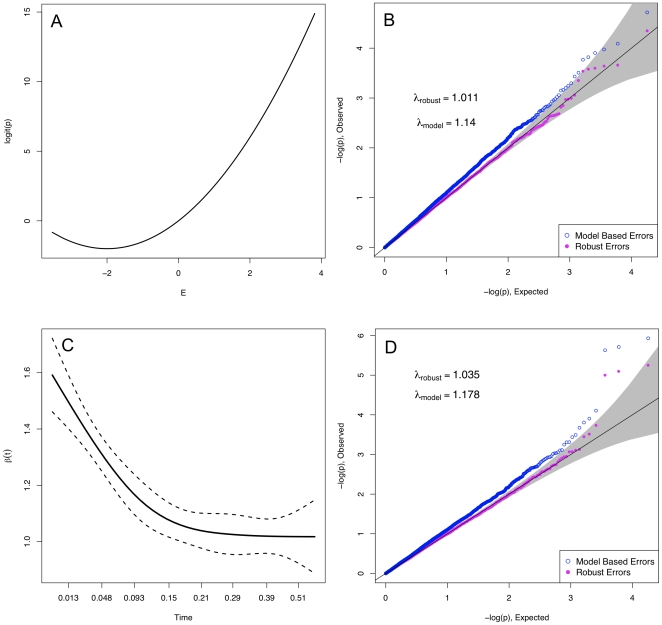
Genome-wide association studies of gene-environment interaction (GxE GWAS) are becoming popular. As with main effects GWAS, quantile-quantile plots (QQ-plots) and Genomic Control are being used to assess and correct for population substructure. However, in G x E work these approaches can be seriously misleading, as we illustrate; QQ-plots may give strong indications of substructure when absolutely none is present. Using simulation and theory, we show how and why spurious QQ-plot inflation occurs in G x E GWAS, and how this differs from main-effects analyses. We also explain how simple adjustments to standard regression-based methods used in G x E GWAS can alleviate this problem.
全基因组关联研究中的基因-环境相互作用 (GxE GWAS) 正变得越来越流行。与主要效应 GWAS 一样,分位数-分位数图 (QQ-plot) 和基因组控制 (Genomic Control) 也被用于评估和纠正群体亚结构。然而,在 GxE 研究中,这些方法可能会产生严重的误导,正如我们所说明的;QQ-plot 可能会在绝对不存在亚结构的情况下给出强烈的亚结构迹象。我们通过模拟和理论展示了在 GxE GWAS 中虚假的 QQ-plot 膨胀是如何以及为什么发生的,以及这与主要效应分析有何不同。我们还解释了如何对用于 GxE GWAS 的基于标准回归的简单调整方法进行调整,以缓解这个问题。