Department of Molecular Physiology and Biophysics, Center for Human Genetics Research, Vanderbilt University School of Medicine, Nashville, Tennessee, United States of America.
PLoS One. 2011 May 11;6(5):e19586. doi: 10.1371/journal.pone.0019586.
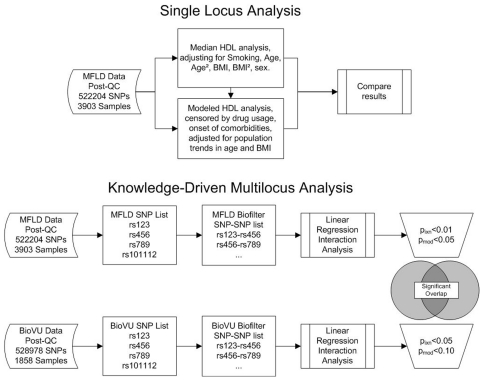
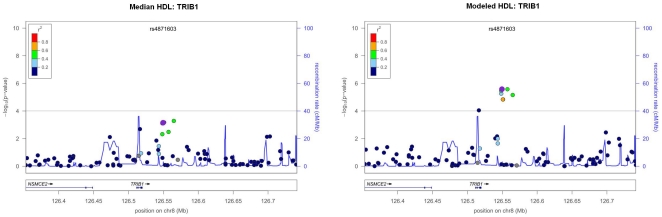
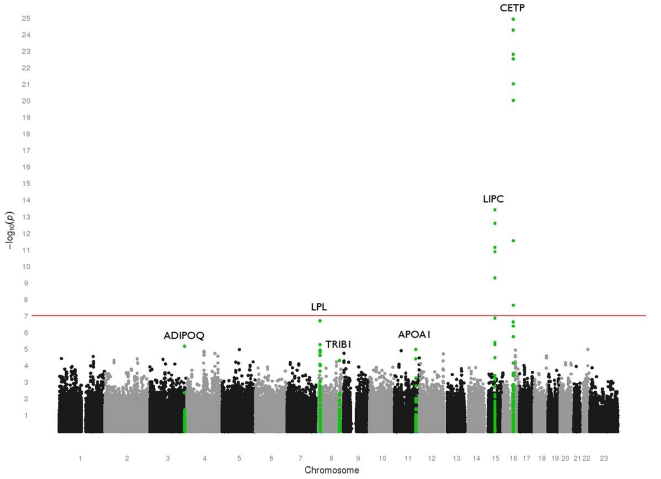
Genome-wide association studies (GWAS) are routinely being used to examine the genetic contribution to complex human traits, such as high-density lipoprotein cholesterol (HDL-C). Although HDL-C levels are highly heritable (h(2)∼0.7), the genetic determinants identified through GWAS contribute to a small fraction of the variance in this trait. Reasons for this discrepancy may include rare variants, structural variants, gene-environment (GxE) interactions, and gene-gene (GxG) interactions. Clinical practice-based biobanks now allow investigators to address these challenges by conducting GWAS in the context of comprehensive electronic medical records (EMRs). Here we apply an EMR-based phenotyping approach, within the context of routine care, to replicate several known associations between HDL-C and previously characterized genetic variants: CETP (rs3764261, p = 1.22e-25), LIPC (rs11855284, p = 3.92e-14), LPL (rs12678919, p = 1.99e-7), and the APOA1/C3/A4/A5 locus (rs964184, p = 1.06e-5), all adjusted for age, gender, body mass index (BMI), and smoking status. By using a novel approach which censors data based on relevant co-morbidities and lipid modifying medications to construct a more rigorous HDL-C phenotype, we identified an association between HDL-C and TRIB1, a gene which previously resisted identification in studies with larger sample sizes. Through the application of additional analytical strategies incorporating biological knowledge, we further identified 11 significant GxG interaction models in our discovery cohort, 8 of which show evidence of replication in a second biobank cohort. The strongest predictive model included a pairwise interaction between LPL (which modulates the incorporation of triglyceride into HDL) and ABCA1 (which modulates the incorporation of free cholesterol into HDL). These results demonstrate that gene-gene interactions modulate complex human traits, including HDL cholesterol.
全基因组关联研究(GWAS)常用于研究遗传因素对复杂人类特征(如高密度脂蛋白胆固醇(HDL-C))的贡献。尽管 HDL-C 水平具有高度遗传性(h(2)∼0.7),但通过 GWAS 鉴定的遗传决定因素仅对该特征的一小部分变异有贡献。造成这种差异的原因可能包括罕见变异、结构变异、基因-环境(GxE)相互作用和基因-基因(GxG)相互作用。临床实践为基础的生物库现在允许研究人员通过在全面的电子病历(EMR)背景下进行 GWAS 来解决这些挑战。在这里,我们应用基于 EMR 的表型分析方法,在常规护理的背景下,复制了几个先前已知的 HDL-C 与先前表征的遗传变异之间的关联:CETP(rs3764261,p=1.22e-25),LIPC(rs11855284,p=3.92e-14),LPL(rs12678919,p=1.99e-7)和 APOA1/C3/A4/A5 基因座(rs964184,p=1.06e-5),所有这些都针对年龄、性别、体重指数(BMI)和吸烟状况进行了调整。通过使用一种新的方法,根据相关合并症和脂质调节药物对数据进行 censoring,构建更严格的 HDL-C 表型,我们鉴定出 HDL-C 与 TRIB1 之间存在关联,TRIB1 是一个先前在更大样本量研究中难以识别的基因。通过应用纳入生物学知识的额外分析策略,我们在发现队列中进一步鉴定了 11 个显著的 GxG 相互作用模型,其中 8 个在第二个生物库队列中显示出复制的证据。最强的预测模型包括 LPL(调节甘油三酯向 HDL 的掺入)和 ABCA1(调节游离胆固醇向 HDL 的掺入)之间的成对相互作用。这些结果表明,基因-基因相互作用调节复杂的人类特征,包括高密度脂蛋白胆固醇。