1 Montreal Heart Institute Montréal Québec Canada.
2 Department of Biochemistry Robarts Research Institute Western University London Ontario Canada.
J Am Heart Assoc. 2018 Aug 21;7(16):e009545. doi: 10.1161/JAHA.118.009545.
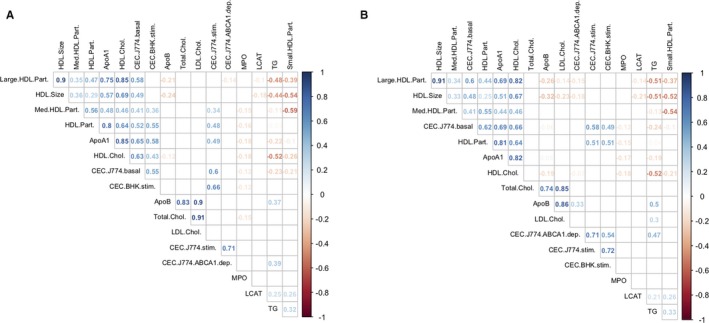
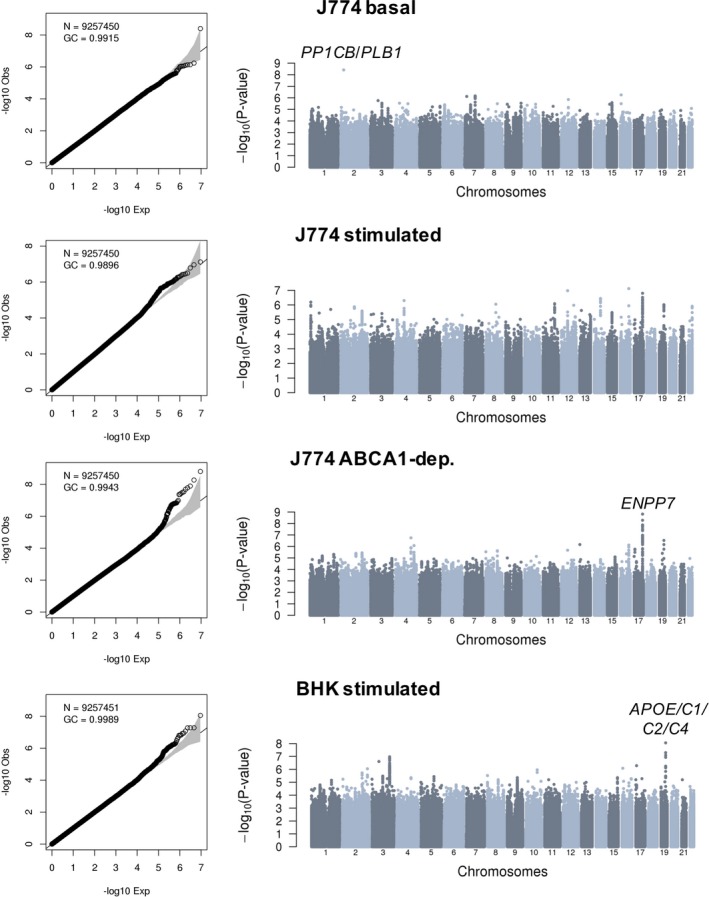
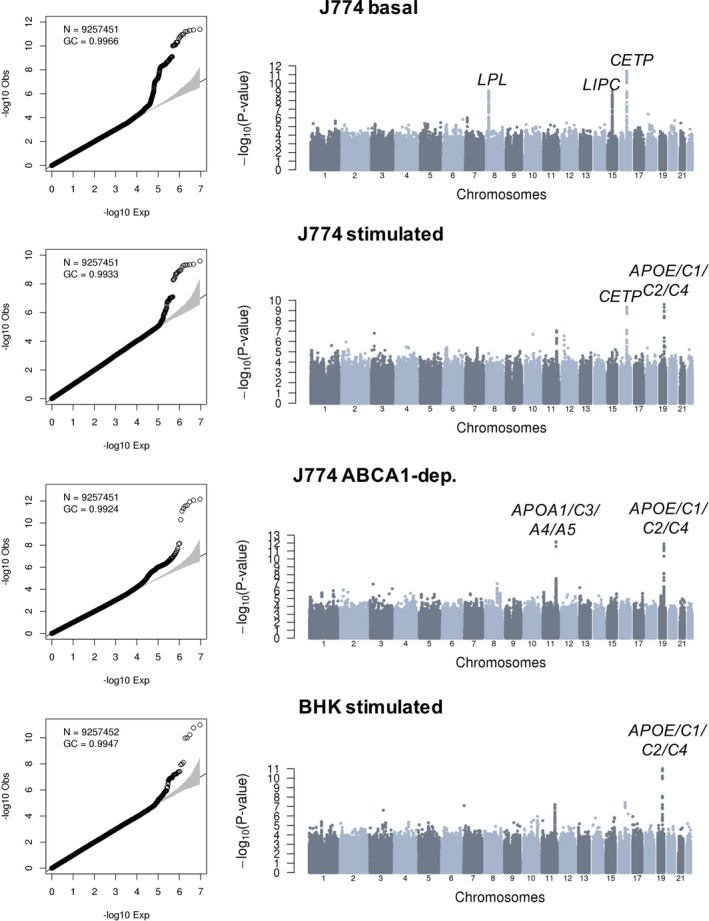
Background Macrophage cholesterol efflux to high-density lipoproteins ( HDLs ) is the first step of reverse cholesterol transport. The cholesterol efflux capacity ( CEC ) of HDL particles is a protective risk factor for coronary artery disease independent of HDL cholesterol levels. Using a genome-wide association study approach, we aimed to identify pathways that regulate CEC in humans. Methods and Results We measured CEC in 5293 French Canadians. We tested the genetic association between 4 CEC measures and genotypes at >9 million common autosomal DNA sequence variants. These analyses yielded 10 genome-wide significant signals ( P<6.25×10) representing 7 loci. Five of these loci harbor genes with important roles in lipid biology ( CETP , LIPC , LPL , APOA 1/C3/A4/A5, and APOE /C1/C2/C4). Except for the APOE /C1/C2/C4 variant ( rs141622900, P =1.0×10; P =8.8×10), the association signals disappear when correcting for HDL cholesterol and triglyceride levels. The additional 2 significant signals were near the PPP 1 CB / PLB 1 and RBFOX 3/ ENPP 7 genes. In secondary analyses, we considered candidate functional variants for 58 genes implicated in HDL biology, as well as 239 variants associated with blood lipid levels and/or coronary artery disease risk by genome-wide association study . These analyses identified 27 significant CEC associations, implicating 5 additional loci ( GCKR , LIPG , PLTP , PPARA , and TRIB 1). Conclusions Our genome-wide association study identified common genetic variation at the APOE /C1/C2/C4 locus as a major determinant of CEC that acts largely independently of HDL cholesterol. We predict that HDL -based therapies aiming at increasing CEC will be modulated by changes in the expression of apolipoproteins in this gene cluster.
巨噬细胞胆固醇向高密度脂蛋白(HDL)的外流是胆固醇逆转运的第一步。HDL 颗粒的胆固醇外排能力(CEC)是独立于 HDL 胆固醇水平的冠心病保护风险因素。本研究采用全基因组关联研究方法,旨在确定调控人类 CEC 的途径。
我们测量了 5293 名法裔加拿大人的 CEC。我们测试了 4 种 CEC 测量方法与>900 万个常见常染色体 DNA 序列变异的基因型之间的遗传关联。这些分析产生了 10 个全基因组显著信号(P<6.25×10),代表 7 个位点。其中 5 个位点含有脂质生物学中具有重要作用的基因(CETP、LIPC、LPL、APOA1/C3/A4/A5 和 APOE/C1/C2/C4)。除了 APOE/C1/C2/C4 变异(rs141622900,P=1.0×10;P=8.8×10)外,当校正 HDL 胆固醇和甘油三酯水平时,关联信号消失。另外 2 个显著信号位于 PPP1CB/PLB1 和 RBFOX3/ENPP7 基因附近。在二次分析中,我们考虑了与 HDL 生物学相关的 58 个基因的候选功能变异,以及通过全基因组关联研究与血脂水平和/或冠心病风险相关的 239 个变异。这些分析确定了 27 个与 CEC 显著相关的变异,涉及 5 个额外的位点(GCKR、LIPG、PLTP、PPARA 和 TRIB1)。
我们的全基因组关联研究发现,APOE/C1/C2/C4 基因座的常见遗传变异是 CEC 的主要决定因素,其作用主要独立于 HDL 胆固醇。我们预测,旨在增加 CEC 的基于 HDL 的治疗方法将受到该基因簇中载脂蛋白表达变化的调节。