
尿酸氧化酶的盐析结晶纯化:寻求替代色谱法的方法。
Urate oxidase purification by salting-in crystallization: towards an alternative to chromatography.
机构信息
Centre Interdisciplinaire de Nanoscience de Marseille, UPR3118 CNRS, Aix-Marseille Université, Marseille, France.
出版信息
PLoS One. 2011 May 11;6(5):e19013. doi: 10.1371/journal.pone.0019013.
BACKGROUND
Rasburicase (Fasturtec® or Elitek®, Sanofi-Aventis), the recombinant form of urate oxidase from Aspergillus flavus, is a therapeutic enzyme used to prevent or decrease the high levels of uric acid in blood that can occur as a result of chemotherapy. It is produced by Sanofi-Aventis and currently purified via several standard steps of chromatography. This work explores the feasibility of replacing one or more chromatography steps in the downstream process by a crystallization step. It compares the efficacy of two crystallization techniques that have proven successful on pure urate oxidase, testing them on impure urate oxidase solutions.
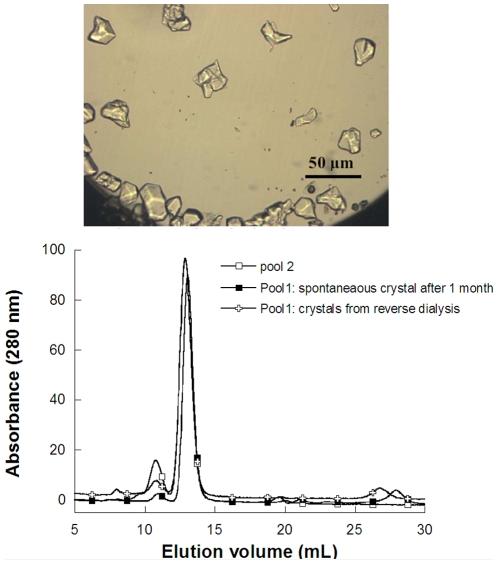
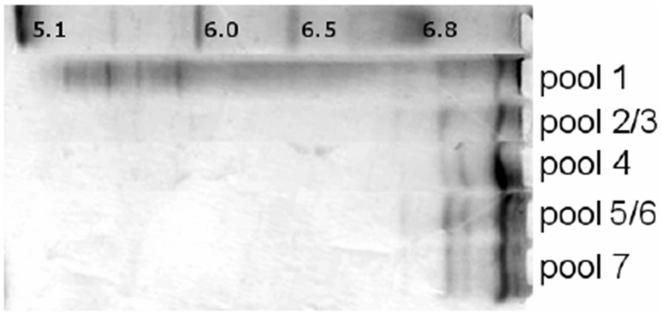
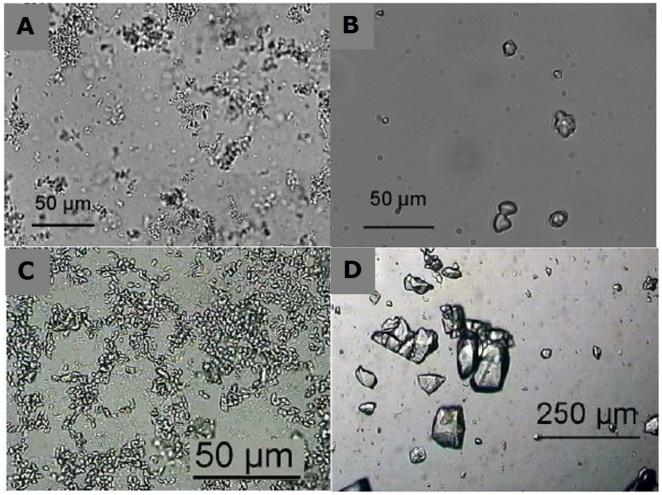
METHODOLOGY/PRINCIPAL FINDINGS: Here we investigate the possibility of purifying urate oxidase directly by crystallization from the fermentation broth. Based on attractive interaction potentials which are known to drive urate oxidase crystallization, two crystallization routes are compared: a) by increased polymer concentration, which induces a depletion attraction and b) by decreased salt concentration, which induces attractive interactions via a salting-in effect. We observe that adding polymer, a very efficient way to crystallize pure urate oxidase through the depletion effect, is not an efficient way to grow crystals from impure solution. On the other hand, we show that dialysis, which decreases salt concentration through its strong salting-in effect, makes purification of urate oxidase from the fermentation broth possible.
CONCLUSIONS
The aim of this study is to compare purification efficacy of two crystallization methods. Our findings show that crystallization of urate oxidase from the fermentation broth provides purity comparable to what can be achieved with one chromatography step. This suggests that, in the case of urate oxidase, crystallization could be implemented not only for polishing or concentration during the last steps of purification, but also as an initial capture step, with minimal changes to the current process.
背景
重组黄曲尿酸氧化酶(拉布立酶,法玛西亚普强公司,Sanofi-Aventis)是一种治疗酶,用于预防或降低因化疗而导致的血液中尿酸水平升高。它由法玛西亚普强公司生产,目前通过几个标准的色谱步骤来纯化。这项工作探讨了通过结晶步骤替代下游工艺中一个或多个色谱步骤的可行性。它比较了两种结晶技术的功效,这两种技术已在纯尿酸氧化酶上取得成功,并在不纯的尿酸氧化酶溶液上进行了测试。
方法/主要发现:在这里,我们研究了直接从发酵液中通过结晶来纯化尿酸氧化酶的可能性。基于已知可驱动尿酸氧化酶结晶的吸引力相互作用势,比较了两种结晶途径:a)通过增加聚合物浓度,诱导耗尽吸引;b)通过降低盐浓度,通过盐析效应诱导吸引力。我们观察到,添加聚合物,通过耗尽效应使纯尿酸氧化酶结晶的非常有效方法,对于从不纯溶液中生长晶体不是一种有效方法。另一方面,我们表明,通过透析降低盐浓度,通过其强烈的盐析效应,可以从发酵液中纯化尿酸氧化酶。
结论
本研究的目的是比较两种结晶方法的纯化效果。我们的发现表明,从发酵液中结晶尿酸氧化酶可以提供与一个色谱步骤相当的纯度。这表明,在尿酸氧化酶的情况下,结晶不仅可以在纯化的最后步骤中进行抛光或浓缩,而且可以作为初始捕获步骤,对当前工艺的改动最小。




 Zotero 插件