University Medical Centre Utrecht, Utrecht, The Netherlands.
Ann Surg Oncol. 2011 Dec;18(13):3702-10. doi: 10.1245/s10434-011-1762-8. Epub 2011 May 18.
Local tumor progression (LTP) is a serious complication after local ablation of malignant liver tumors, negatively influencing patient survival. LTP may be the result of incomplete ablation of the treated tumor. In this study, we determined whether viable tumor cells attached to the needle applicator after ablation was associated with LTP and disease-free survival.
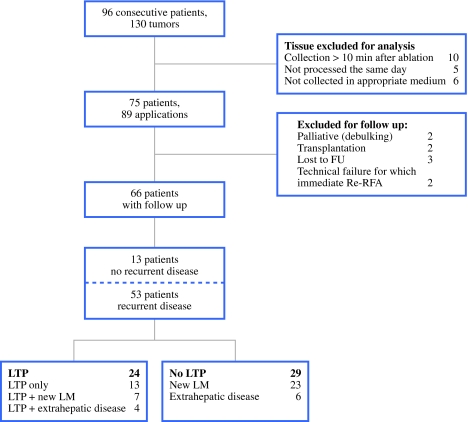
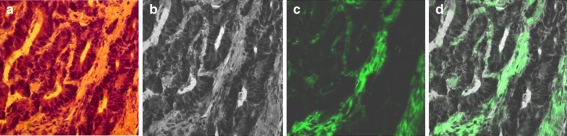
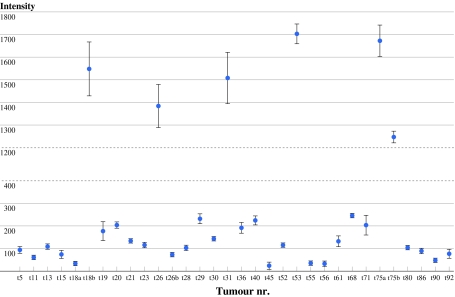
In this prospective study, tissue was collected of 96 consecutive patients who underwent local liver ablations for 130 liver malignancies. Cells and tissue attached to the needle applicators were analyzed for viability using glucose-6-phosphate-dehydrogenase staining and autofluorescence intensity levels of H&E stained sections. Patients were followed-up until disease progression.
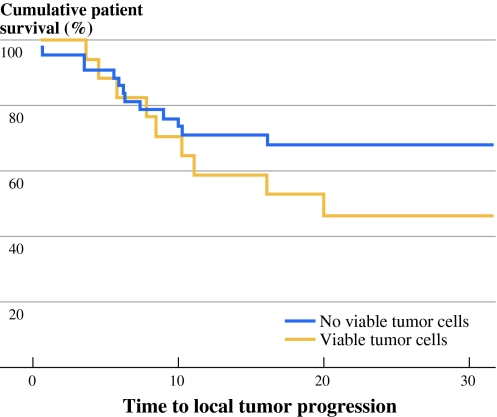
Viable tumor cells were found on the needle applicators after local ablation in 26.7% of patients. The type of needle applicator used, an open approach, and the omission of track ablation were significantly correlated with viable tumor tissue adherent to the needle applicator. The presence of viable cells was an independent predictor of LTP. The attachment of viable cells to the needle applicators was associated with a shorter time to LTP.
Viable tumor cells adherent to the needle applicators were found after ablation of 26.7% of patients. An independent risk factor for viable cells adherent to the needle applicators is the omission of track ablation. We recommend using only RFA devices that have track ablation functionality. Adherence of viable tumor cells to the needle applicator after local ablation was an independent risk factor for LTP.
局部肿瘤进展(LTP)是恶性肝肿瘤局部消融后的严重并发症,对患者的生存产生负面影响。LTP 可能是治疗肿瘤不完全消融的结果。在这项研究中,我们确定消融后附着在针状施源器上的存活肿瘤细胞是否与 LTP 和无病生存有关。
在这项前瞻性研究中,对 96 例连续接受局部肝脏消融治疗的 130 例肝脏恶性肿瘤患者的组织进行了收集。使用葡萄糖-6-磷酸脱氢酶染色和 H&E 染色切片的自发荧光强度水平分析附着在针状施源器上的细胞和组织的活力。对患者进行随访直至疾病进展。
在 26.7%的患者中,在局部消融后发现针状施源器上有存活的肿瘤细胞。使用的针状施源器类型、开放式方法和省略轨道消融与针状施源器上附着的存活肿瘤组织显著相关。存活细胞的存在是 LTP 的独立预测因子。存活细胞附着在针状施源器上与 LTP 时间缩短有关。
在 26.7%的患者中,在消融后发现有存活的肿瘤细胞附着在针状施源器上。存活细胞附着在针状施源器上的独立危险因素是省略轨道消融。我们建议仅使用具有轨道消融功能的 RFA 设备。局部消融后存活肿瘤细胞附着在针状施源器上是 LTP 的独立危险因素。