Avail Biomedical Research Institute, Basel, Switzerland.
J Cell Mol Med. 2012 Mar;16(3):483-95. doi: 10.1111/j.1582-4934.2011.01344.x.
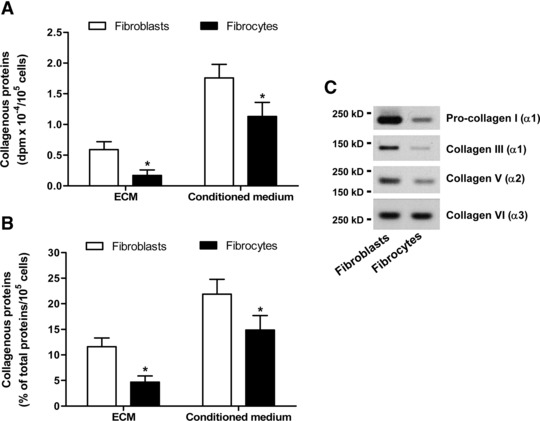
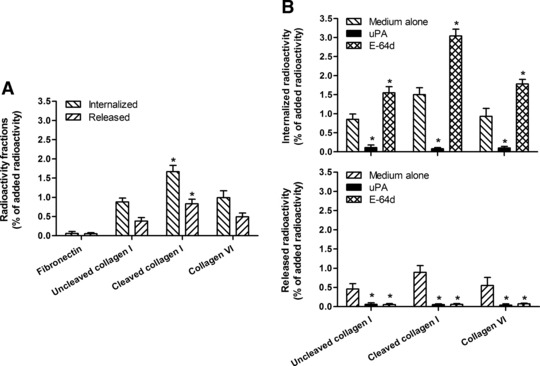
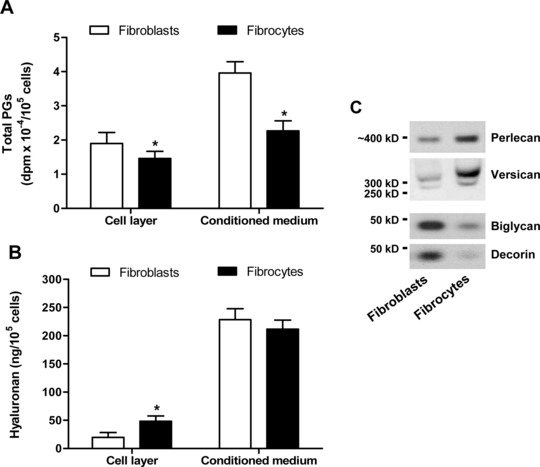
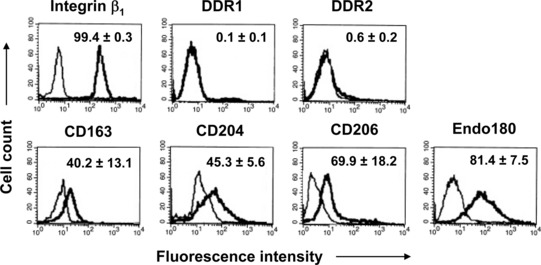
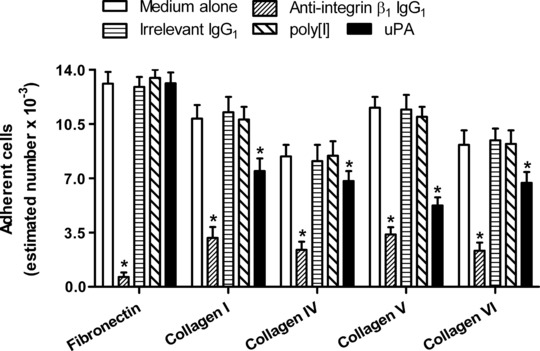
The fibrocytes are thought to serve as a source of newly deposited collagens I and III during reparative processes and in certain fibrotic disorders, but their matrix remodelling properties are incompletely understood. We evaluated their ability to produce several extracellular matrix (ECM) components, in comparison with fibroblasts, and to participate in collagen turnover. The collagen gene expression profile of fibrocytes differed from that of fibroblasts because fibrocytes constitutively expressed relatively high levels of the mRNA encoding collagen VI and significantly lower levels of the mRNA encoding collagens I, III and V. The proteoglycan (PG) gene expression profile was also different in fibrocytes and fibroblasts because fibrocytes constitutively expressed the mRNA encoding perlecan and versican at relatively high levels and the mRNA encoding biglycan and decorin at low and very low levels, respectively. Moreover, fibrocytes expressed the mRNA for hyaluronan synthase 2 at higher level than fibroblasts. Significant differences between the two cell populations were also demonstrated by metabolic labelling and analysis of the secreted collagenous proteins, PGs and hyaluronan. Fibrocytes constitutively expressed the scavenger receptors CD163 and CD204 as well as the mannose receptors CD206 and Endo180, and internalized and degraded collagen fragments through an Endo180-mediated mechanism. The results of this study demonstrate that human fibrocytes exhibit ECM remodelling properties previously unexplored, including the ability to participate in collagen turnover. The observed differences in collagen and PG expression profile between fibrocytes and fibroblasts suggest that fibrocytes may predominantly have a matrix-stabilizing function.
成纤维细胞被认为是修复过程中和某些纤维化疾病中新沉积的 I 型和 III 型胶原的来源,但它们的基质重塑特性尚未完全了解。我们评估了它们产生几种细胞外基质 (ECM) 成分的能力,与成纤维细胞进行比较,并参与胶原蛋白的周转。成纤维细胞和成纤维细胞的胶原基因表达谱不同,因为成纤维细胞持续表达相对高水平的编码胶原 VI 的 mRNA,而编码 I 型、III 型和 V 型胶原的 mRNA 水平显著降低。成纤维细胞和成纤维细胞的蛋白聚糖 (PG) 基因表达谱也不同,因为成纤维细胞持续表达高水平的编码 PG 核心蛋白聚糖和 versican 的 mRNA,而编码 biglycan 和 decorin 的 mRNA 水平分别较低和极低。此外,成纤维细胞表达的透明质酸合酶 2 mRNA 水平高于成纤维细胞。通过代谢标记和分析分泌的胶原蛋白、PG 和透明质酸,也证明了这两种细胞群之间存在显著差异。成纤维细胞持续表达清道夫受体 CD163 和 CD204 以及甘露糖受体 CD206 和 Endo180,并通过 Endo180 介导的机制内化和降解胶原蛋白片段。这项研究的结果表明,人成纤维细胞表现出以前未探索过的 ECM 重塑特性,包括参与胶原蛋白周转的能力。成纤维细胞和成纤维细胞之间胶原和 PG 表达谱的观察差异表明,成纤维细胞可能主要具有基质稳定功能。