Clinical Brain Disorder Branch, Gene Cognition and Psychosis program, NIH/NIMH Bethesda, MD 20892, USA.
Neuroimage. 2011 Aug 1;57(3):1264-72. doi: 10.1016/j.neuroimage.2011.05.006. Epub 2011 May 7.
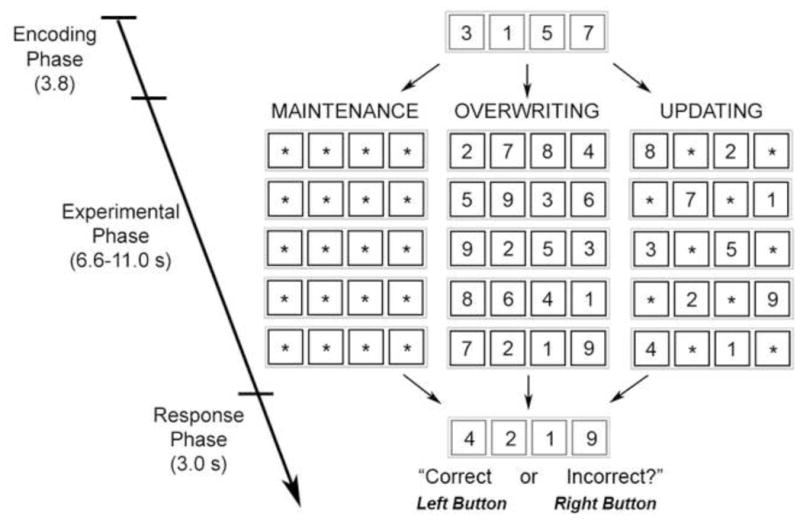
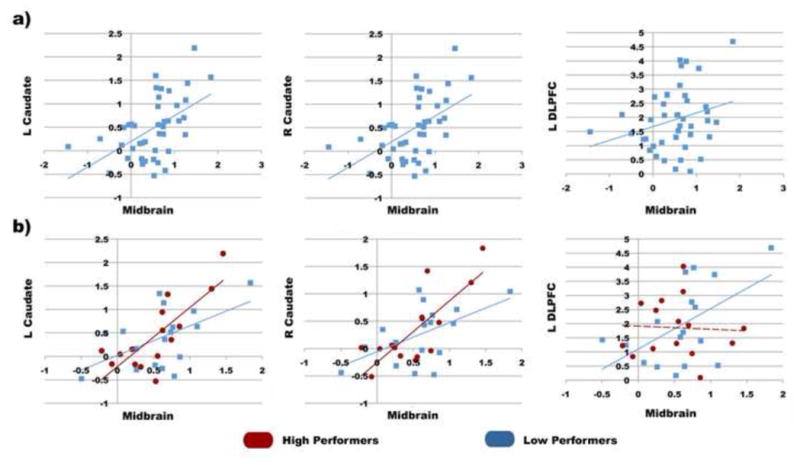
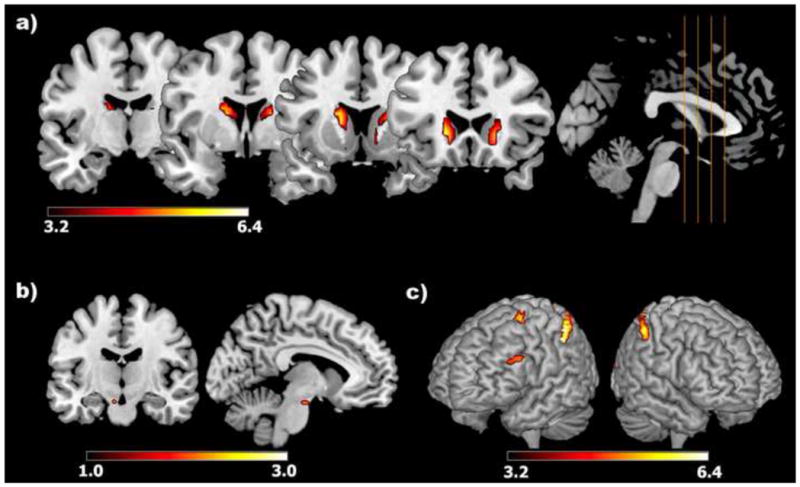
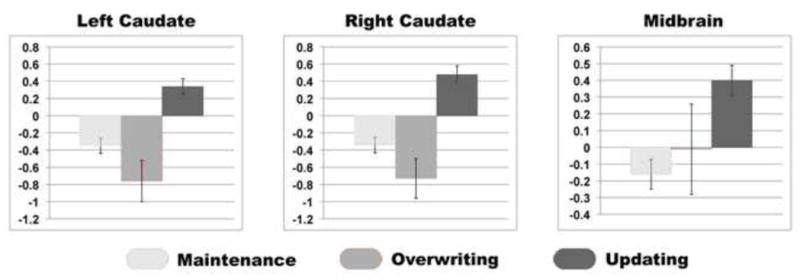
Accumulating evidence from non-human primates and computational modeling suggests that dopaminergic signals arising from the midbrain (substantia nigra/ventral tegmental area) mediate striatal gating of the prefrontal cortex during the selective updating of working memory. Using event-related functional magnetic resonance imaging, we explored the neural mechanisms underlying the selective updating of information stored in working memory. Participants were scanned during a novel working memory task that parses the neurophysiology underlying working memory maintenance, overwriting, and selective updating. Analyses revealed a functionally coupled network consisting of a midbrain region encompassing the substantia nigra/ventral tegmental area, caudate, and dorsolateral prefrontal cortex that was selectively engaged during working memory updating compared to the overwriting and maintenance of working memory content. Further analysis revealed differential midbrain-dorsolateral prefrontal interactions during selective updating between low-performing and high-performing individuals. These findings highlight the role of this meso-cortico-striatal circuitry during the selective updating of working memory in humans, which complements previous research in behavioral neuroscience and computational modeling.
越来越多来自非人类灵长类动物和计算模型的证据表明,中脑(黑质/腹侧被盖区)中的多巴胺信号介导了前额叶皮层在工作记忆选择性更新期间对纹状体的门控。使用事件相关功能磁共振成像,我们探讨了工作记忆中存储信息选择性更新的神经机制。在一项新的工作记忆任务中对参与者进行了扫描,该任务解析了工作记忆维持、覆盖和选择性更新的神经生理学基础。分析显示,一个由中脑区域(包括黑质/腹侧被盖区、尾状核和背外侧前额叶皮层)组成的功能耦合网络在工作记忆更新期间被选择性地激活,而不是在工作记忆内容的覆盖和维持期间被激活。进一步的分析揭示了在低表现和高表现个体之间选择性更新期间中脑-背外侧前额叶的差异相互作用。这些发现强调了该中脑-皮质-纹状体电路在人类工作记忆选择性更新中的作用,这补充了行为神经科学和计算模型的先前研究。