Department of Biochemistry, Schulich School of Medicine & Dentistry, University of Western Ontario, London, ON, Canada, N6A 5C1.
Nucleic Acids Res. 2011 Sep 1;39(16):6998-7008. doi: 10.1093/nar/gkr371. Epub 2011 May 19.
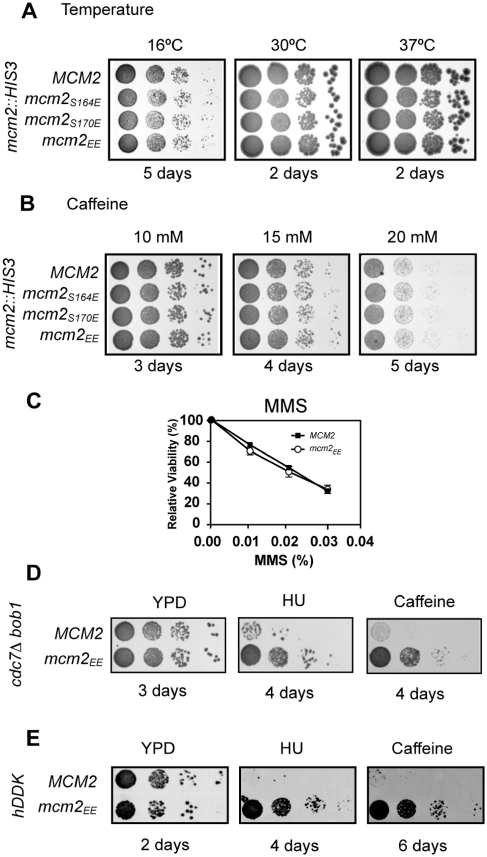
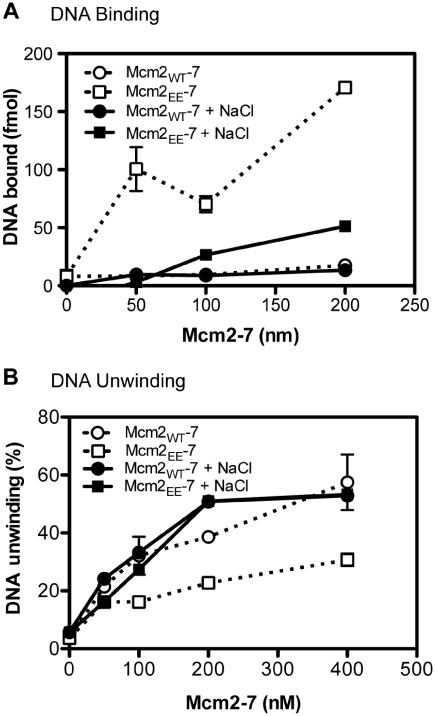
The S-phase kinase, DDK controls DNA replication through phosphorylation of the replicative helicase, Mcm2-7. We show that phosphorylation of Mcm2 at S164 and S170 is not essential for viability. However, the relevance of Mcm2 phosphorylation is demonstrated by the sensitivity of a strain containing alanine at these positions (mcm2(AA)) to methyl methanesulfonate (MMS) and caffeine. Consistent with a role for Mcm2 phosphorylation in response to DNA damage, the mcm2(AA) strain accumulates more RPA foci than wild type. An allele with the phosphomimetic mutations S164E and S170E (mcm2(EE)) suppresses the MMS and caffeine sensitivity caused by deficiencies in DDK function. In vitro, phosphorylation of Mcm2 or Mcm2(EE) reduces the helicase activity of Mcm2-7 while increasing DNA binding. The reduced helicase activity likely results from the increased DNA binding since relaxing DNA binding with salt restores helicase activity. The finding that the ATP site mutant mcm2(K549R) has higher DNA binding and less ATPase than mcm2(EE), but like mcm2(AA) results in drug sensitivity, supports a model whereby a specific range of Mcm2-7 activity is required in response to MMS and caffeine. We propose that phosphorylation of Mcm2 fine-tunes the activity of Mcm2-7, which in turn modulates DNA replication in response to DNA damage.
S 期激酶 DDK 通过磷酸化复制解旋酶 Mcm2-7 来控制 DNA 复制。我们发现,Mcm2 在 S164 和 S170 位点的磷酸化对于细胞活力并非必需。然而,在含有这些位置的丙氨酸突变体(mcm2(AA))对甲基甲磺酸(MMS)和咖啡因敏感的情况下,Mcm2 磷酸化的相关性得到了证明。与 Mcm2 磷酸化在响应 DNA 损伤中的作用一致,mcm2(AA) 菌株比野生型积累更多的 RPA 焦点。具有磷酸化模拟突变 S164E 和 S170E(mcm2(EE))的等位基因可以抑制 DDK 功能缺陷引起的 MMS 和咖啡因敏感性。在体外,Mcm2 或 Mcm2(EE) 的磷酸化降低了 Mcm2-7 的解旋酶活性,同时增加了 DNA 结合。由于通过盐松弛 DNA 结合可以恢复解旋酶活性,因此这种降低的解旋酶活性可能是由于 DNA 结合增加所致。发现 ATP 位点突变体 mcm2(K549R)比 mcm2(EE)具有更高的 DNA 结合能力和更低的 ATP 酶活性,但与 mcm2(AA)一样导致药物敏感性,这支持了一种模型,即在 MMS 和咖啡因的响应中,需要特定范围的 Mcm2-7 活性。我们提出,Mcm2 的磷酸化微调了 Mcm2-7 的活性,从而反过来调节 DNA 复制以响应 DNA 损伤。