INSERM U847, Institut de Recherche en Biothérapie, CHRU de Montpellier, France.
J Transl Med. 2011 May 21;9:72. doi: 10.1186/1479-5876-9-72.
The sulfation pattern of heparan sulfate chains influences signaling events mediated by heparan sulfate proteoglycans located on cell surface. SULF1 and SULF2 are two endosulfatases able to cleave specific 6-O sulfate groups within the heparan chains. Their action can modulate signaling processes, many of which with key relevance for cancer development and expansion. SULF1 has been associated with tumor suppressor effects in various models of cancer, whereas SULF2 dysregulation was in relation with protumorigenic actions. However, other observations argue for contradictory effects of these sulfatases in cancer, suggesting the complexity of their action in the tumor microenvironment.
We compared the expression of the genes encoding SULF1, SULF2 and heparan sulfate proteoglycans in a large panel of cancer samples to their normal tissue counterparts using publicly available gene expression data, including the data obtained from two cohorts of newly-diagnosed multiple myeloma patients, the Oncomine Cancer Microarray database, the Amazonia data base and the ITTACA database. We also analysed prognosis data in relation with these databases.
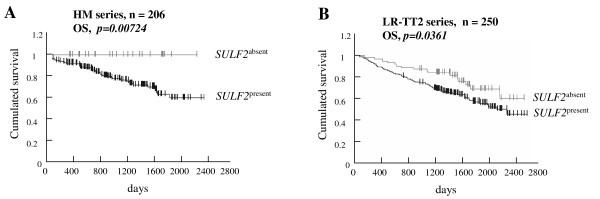
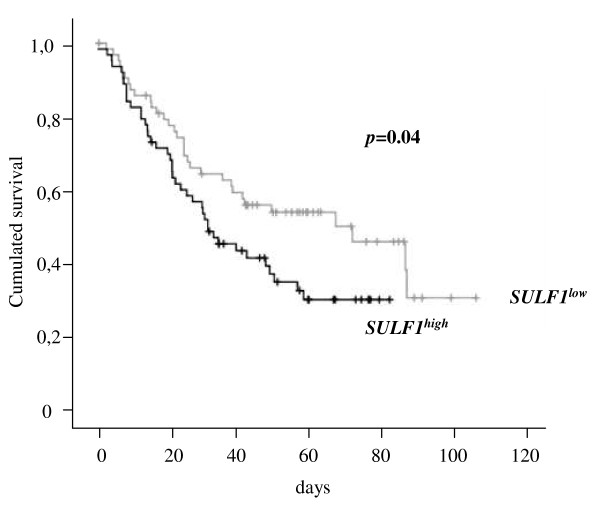
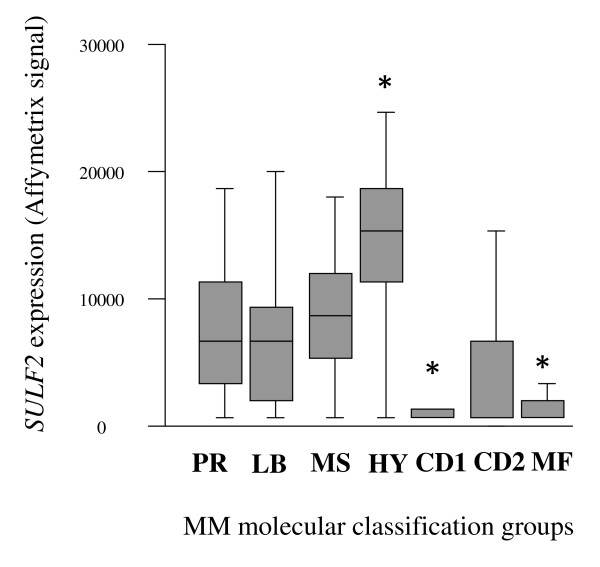
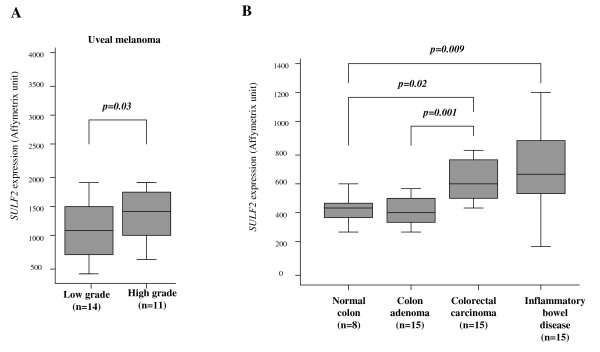
We demonstrated that SULF2 expression in primary multiple myeloma cells was associated with a poor prognosis in two independent large cohorts of patients. It remained an independent predictor when considered together with conventional multiple myeloma prognosis factors. Besides, we observed an over-representation of SULF2 gene expression in skin cancer, colorectal carcinoma, testicular teratoma and liver cancer compared to their normal tissue counterpart. We found that SULF2 was significantly over-expressed in high grade uveal melanoma compared to low grade and in patients presenting colorectal carcinoma compared to benign colon adenoma.We observed that, in addition to previous observations, SULF1 gene expression was increased in T prolymphocytic leukemia, acute myeloid leukemia and in renal carcinoma compared to corresponding normal tissues. Furthermore, we found that high SULF1 expression was associated with a poor prognosis in lung adenocarcinoma.Finally, SULF1 and SULF2 were simultaneously overexpressed in 6 cancer types: brain, breast, head and neck, renal, skin and testicular cancers.
SULF1 and SULF2 are overexpressed in various human cancer types and can be associated to progression and prognosis. Targeting SULF1 and/or SULF2 could be interesting strategies to develop novel cancer therapies.
肝素硫酸链的硫酸化模式会影响位于细胞表面的肝素硫酸蛋白聚糖所介导的信号事件。SULF1 和 SULF2 是两种能够在肝素链中特异性切割 6-O 硫酸基团的内切硫酸酯酶。它们的作用可以调节信号转导过程,其中许多过程对癌症的发生和发展至关重要。SULF1 已与多种癌症模型中的肿瘤抑制作用相关,而 SULF2 的失调与促肿瘤作用有关。然而,其他观察结果表明这些硫酸酯酶在癌症中的作用具有矛盾性,这表明它们在肿瘤微环境中的作用复杂性。
我们使用公开的基因表达数据,包括从两个新诊断多发性骨髓瘤患者队列中获得的数据、Oncomine Cancer Microarray 数据库、Amazonia 数据库和 ITTACA 数据库,比较了大量癌症样本中编码 SULF1、SULF2 和肝素硫酸蛋白聚糖的基因的表达与其正常组织对应物的表达。我们还分析了这些数据库中的预后数据。
我们证明了原发性多发性骨髓瘤细胞中的 SULF2 表达与两个独立的大型患者队列中的不良预后相关。当与传统多发性骨髓瘤预后因素一起考虑时,它仍然是一个独立的预测因子。此外,我们观察到与正常组织相比,皮肤癌、结直肠癌、睾丸畸胎瘤和肝癌中 SULF2 基因表达过度。我们发现,与低级别相比,高级别的葡萄膜黑色素瘤和与良性结肠腺瘤相比,结直肠癌患者中 SULF2 的表达明显更高。我们观察到,除了以前的观察结果外,SULF1 基因在 T 前淋巴细胞白血病、急性髓细胞白血病和肾细胞癌中的表达也高于相应的正常组织。此外,我们发现肺腺癌中高 SULF1 表达与不良预后相关。最后,SULF1 和 SULF2 在 6 种癌症类型中同时过表达:脑、乳腺、头颈部、肾、皮肤和睾丸癌。
SULF1 和 SULF2 在各种人类癌症类型中过度表达,可与进展和预后相关。靶向 SULF1 和/或 SULF2 可能是开发新型癌症疗法的有趣策略。