Dipartimento di Scienze Biomolecolari e Biotecnologie, Università degli Studi di Milano. Via Celoria 26, 20133 Milano, Italy.
DNA Repair (Amst). 2011 Jul 15;10(7):751-9. doi: 10.1016/j.dnarep.2011.04.030. Epub 2011 May 23.
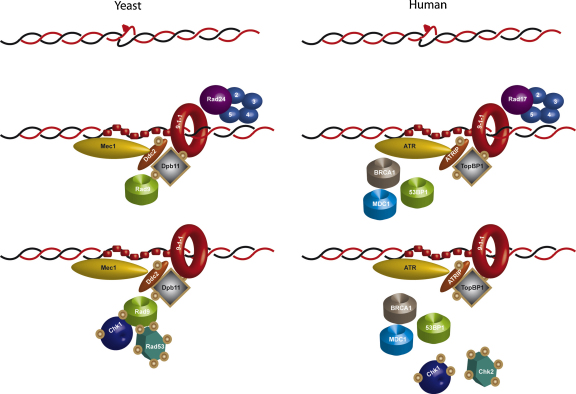
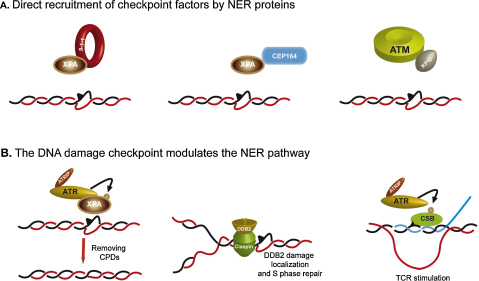
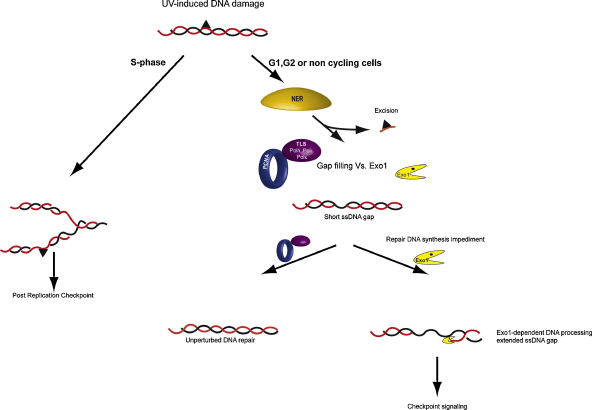
Cells respond to genotoxic insults by triggering a DNA damage checkpoint surveillance mechanism and by activating repair pathways. Recent findings indicate that the two processes are more related than originally thought. Here we discuss the mechanisms involved in responding to UV-induced lesions in different phases of the cell cycle and summarize the most recent data in a model where Nucleotide Excision Repair (NER) and exonucleolytic activities act in sequence leading to checkpoint activation in non replicating cells. The critical trigger is likely represented by problematic intermediates that cannot be completely or efficiently repaired by NER. In S phase cells, on the other hand, the replicative polymerases, blocked by bulky UV lesions, re-initiate DNA synthesis downstream of the lesions, leaving behind a ssDNA tract. If these gaps are not rapidly refilled, checkpoint kinases will be activated.
细胞通过触发 DNA 损伤检查点监控机制和激活修复途径来响应遗传毒性损伤。最近的发现表明,这两个过程比最初想象的更为相关。在这里,我们讨论了在细胞周期的不同阶段对 UV 诱导损伤的反应机制,并在一个模型中总结了最近的数据,在该模型中核苷酸切除修复 (NER) 和外切核酸酶活性依次作用,导致非复制细胞中的检查点激活。关键的触发因素可能是无法被 NER 完全或有效修复的有问题的中间产物。另一方面,在 S 期细胞中,被大体积 UV 损伤阻断的复制聚合酶在损伤下游重新启动 DNA 合成,留下一条单链 DNA 片段。如果这些缺口不能迅速填补,检查点激酶将被激活。