Docherty Paul D, Chase J Geoffrey, Hann Christopher E, Lotz Thomas F, Lin J, McAuley Kirsten A, Shaw Geoffrey M
Centre for Bio-Engineering, University of Canterbury, Christchurch, New Zealand.
Open Med Inform J. 2010;4:141-8. doi: 10.2174/1874431101004010141. Epub 2010 Jul 27.
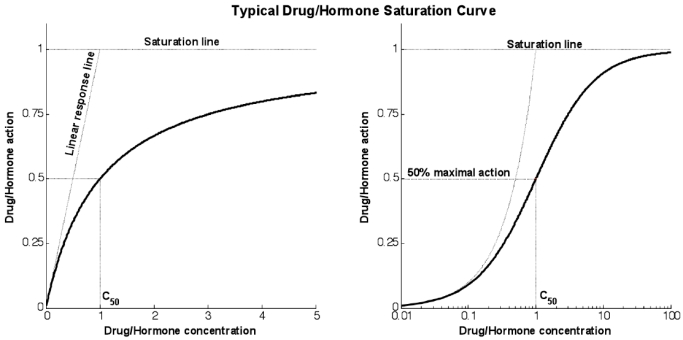
Many insulin sensitivity (SI) tests identify a sensitivity metric that is proportional to the total available insulin and measured glucose disposal despite general acceptance that insulin action is saturable. Accounting for insulin action saturation may aid inter-participant and/or inter-test comparisons of insulin efficiency, and model-based glycaemic regulation.
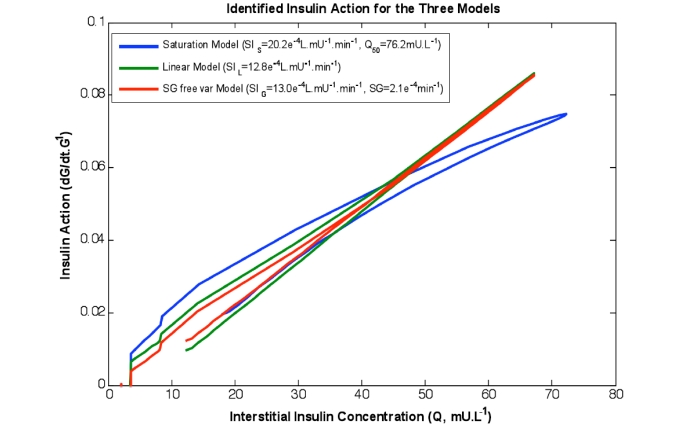
Eighteen subjects participated in 46 dynamic insulin sensitivity tests (DIST, low-dose 40-50 minute insulin-modified IVGTT). The data was used to identify and compare SI metrics from three models: a proportional model (SI(L)), a saturable model (SI(S )and Q₅₀) and a model similar to the Minimal Model (SG and SI(G)). The three models are compared using inter-trial parameter repeatability, and fit to data.
The single variable proportional model produced the metric with least intra-subject variation: 13.8% vs 40.1%/55.6%, (SI(S)/I₅₀) for the saturable model and 15.8%/88.2% (SI(G)/SG) for the third model. The average plasma insulin concentration at half maximum action (I₅₀) was 139.3 mU·L⁻¹, which is comparable to studies which use more robust stepped EIC protocols.
The saturation model and method presented enables a reasonable estimation of an overall patient-specific saturation threshold, which is a unique result for a test of such low dose and duration. The detection of previously published population trends and significant bias above noise suggests that the model and method successfully detects actual saturation signals. Furthermore, the saturation model allowed closer fits to the clinical data than the other models, and the saturation parameter showed a moderate distinction between NGT and IFG-T2DM subgroups. However, the proposed model did not provide metrics of sufficient resolution to enable confidence in the method for either SI metric comparisons across dynamic tests or for glycamic control.
尽管人们普遍认为胰岛素作用是可饱和的,但许多胰岛素敏感性(SI)测试所确定的敏感性指标与总可用胰岛素和所测葡萄糖处置量成正比。考虑胰岛素作用的饱和性可能有助于进行参与者间和/或测试间胰岛素效率的比较,以及基于模型的血糖调节。
18名受试者参与了46次动态胰岛素敏感性测试(DIST,低剂量40 - 50分钟胰岛素改良静脉葡萄糖耐量试验)。数据用于识别和比较来自三个模型的SI指标:比例模型(SI(L))、饱和模型(SI(S)和Q₅₀)以及一个类似于最小模型的模型(SG和SI(G))。使用试验间参数重复性对这三个模型进行比较,并使其拟合数据。
单变量比例模型产生的指标在受试者内变异最小:饱和模型为13.8%,而(SI(S)/I₅₀)为40.1%/55.6%,第三个模型为15.8%/88.2%(SI(G)/SG)。最大作用一半时的平均血浆胰岛素浓度(I₅₀)为139.3 mU·L⁻¹,这与使用更稳健的阶梯式EIC方案的研究结果相当。
所提出的饱和模型和方法能够合理估计个体特异性的总体饱和阈值,这对于如此低剂量和持续时间的测试来说是一个独特的结果。对先前发表的总体趋势的检测以及高于噪声的显著偏差表明该模型和方法成功检测到了实际的饱和信号。此外,与其他模型相比,饱和模型与临床数据的拟合度更高,并且饱和参数在正常血糖组和空腹血糖受损 - 2型糖尿病亚组之间显示出适度差异。然而,所提出的模型没有提供足够分辨率的指标,无法对动态测试中的SI指标比较方法或血糖控制方法产生信心。