Docherty Paul D, Chase J Geoffrey, Lotz Thomas, Hann Christopher E, Shaw Geoffrey M, Berkeley Juliet E, Mann J I, McAuley Kirsten
Department of Mechanical Engineering, University of Canterbury, New Zealand.
Open Med Inform J. 2009 Dec 2;3:65-76. doi: 10.2174/1874431100903010065.
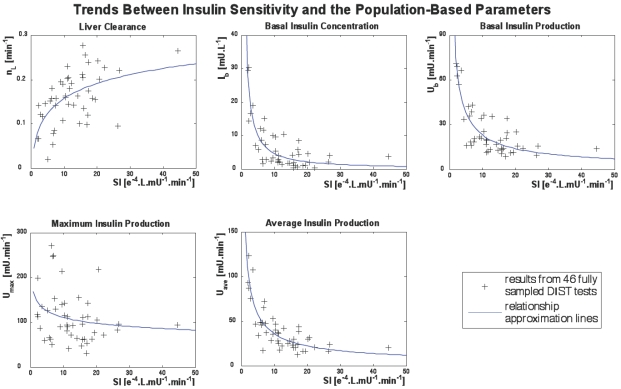
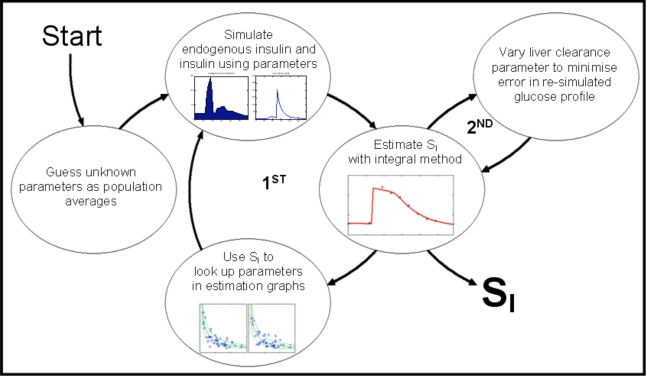
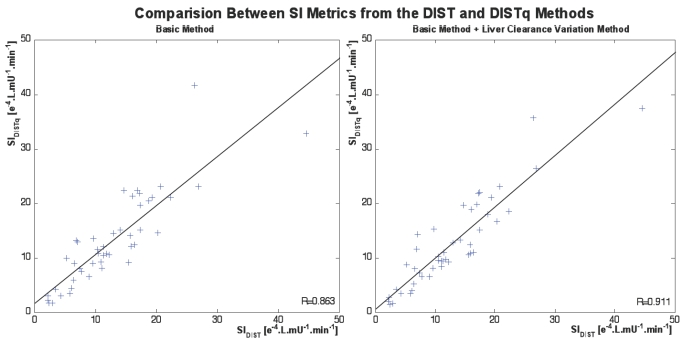
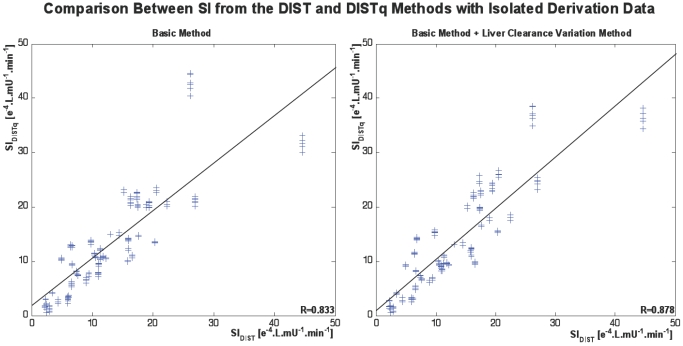
Insulin sensitivity (SI) estimation has numerous uses in medical and clinical situations. However, highresolution tests that are useful for clinical diagnosis and monitoring are often too intensive, long and costly for regular use. Simpler tests that mitigate these issues are not accurate enough for many clinical diagnostic or monitoring scenarios. The gap between these tests presents an opportunity for new approaches. The quick dynamic insulin sensitivity test (DISTq) utilises the model-based DIST test protocol and a series of population estimates to eliminate the need for insulin or C-peptide assays to enable a high resolution, low-intensity, real-time evaluation of SI. The method predicts patient specific insulin responses to the DIST test protocol with enough accuracy to yield a useful clinical insulin sensitivity metric for monitoring of diabetes therapy. The DISTq method replicated the findings of the fully sampled DIST test without the use of insulin or C-peptide assays. Correlations of the resulting SI values was R=0.91. The method was also compared to the euglycaemic hyperinsulinaemic clamp (EIC) in an in-silico Monte-Carlo analysis and showed a good ability to re-evaluate SI(EIC) (R=0.89), compared to the fully sampled DIST (R=0.98) Population-derived parameter estimates using a-posteriori population-based functions derived from DIST test data enables the simulation of insulin profiles that are sufficiently accurate to estimate SI to a relatively high precision. Thus, costly insulin and C-peptide assays are not necessary to obtain an accurate, but inexpensive, real-time estimate of insulin sensitivity. This estimate has enough resolution for SI prediction and monitoring of response to therapy. In borderline cases, re-evaluation of stored (frozen) blood samples for insulin and C-peptide would enable greater accuracy where necessary, enabling a hierarchy of tests in an economical fashion.
胰岛素敏感性(SI)评估在医学和临床场景中有多种用途。然而,对临床诊断和监测有用的高分辨率测试通常过于繁琐、耗时且成本高昂,不适合常规使用。能够缓解这些问题的更简单测试在许多临床诊断或监测场景中不够准确。这些测试之间的差距为新方法提供了机会。快速动态胰岛素敏感性测试(DISTq)利用基于模型的DIST测试方案和一系列总体估计,无需进行胰岛素或C肽检测,即可对SI进行高分辨率、低强度的实时评估。该方法能够足够准确地预测患者对DIST测试方案的特定胰岛素反应,从而得出用于监测糖尿病治疗的有用临床胰岛素敏感性指标。DISTq方法在不使用胰岛素或C肽检测的情况下重现了完全采样的DIST测试结果。所得SI值的相关性为R = 0.91。在计算机模拟的蒙特卡洛分析中,该方法还与正常血糖高胰岛素钳夹试验(EIC)进行了比较,结果表明与完全采样的DIST(R = 0.98)相比,该方法具有良好的重新评估SI(EIC)的能力(R = 0.89)。使用从DIST测试数据中得出的基于后验总体的函数进行总体参数估计,能够模拟出足够准确的胰岛素曲线,以相对较高的精度估计SI。因此,无需进行昂贵的胰岛素和C肽检测即可获得准确但成本低廉的胰岛素敏感性实时估计值。该估计值对于SI预测和治疗反应监测具有足够的分辨率。在临界情况下,必要时对储存(冷冻)的血样进行胰岛素和C肽的重新评估可提高准确性,从而以经济的方式实现分级测试。