National Metrology Institute of Japan, National Institute of Advanced Industrial Science and Technology, Tsukuba, Ibaraki, Japan.
PLoS One. 2011;6(5):e19761. doi: 10.1371/journal.pone.0019761. Epub 2011 May 13.
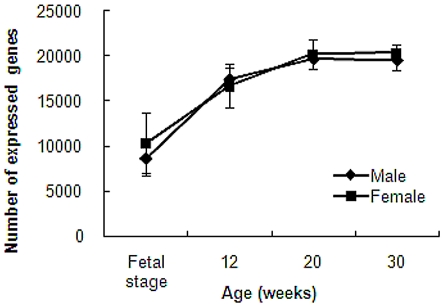
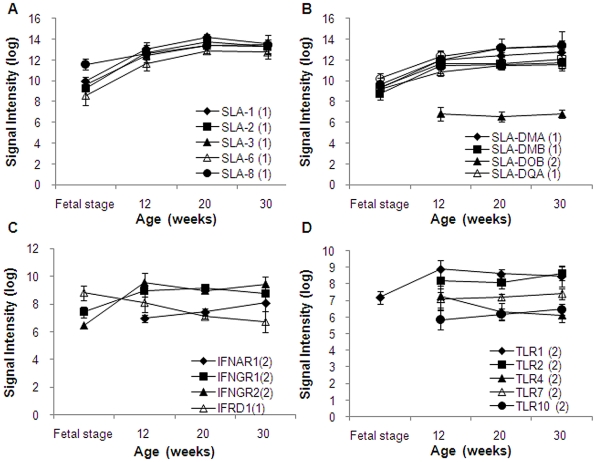
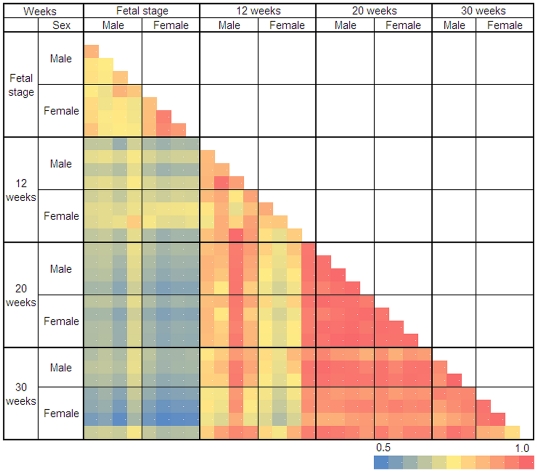
Miniature pigs are useful model animals for humans because they have similar anatomy and digestive physiology to humans and are easy to breed and handle. In this study, whole blood microarray analyses were conducted to evaluate variations of correlation among individuals and ages using specific pathogen-free (SPF) Clawn miniature pigs. Whole blood RNA is easy to handle compared to isolated white blood cell RNA and can be used for health and disease monitoring and animal control. In addition, whole blood is a heterogeneous mixture of subpopulation cells. Once a great change occurs in composition and expressing condition of subpopulations, their associated change will be reflected on whole blood RNA. From 12 to 30 weeks of age, fractions of lymphocytes, monocytes, neutrophils, eosinophils, and basophils in white blood cells showed insignificant differences with age as a result of ANOVA analysis. This study attempted to identify characteristics of age-related gene expression by taking into account the change in the number of expressed genes by age and similarities of gene expression intensity between individuals. As a result, the number of expressed genes was less in fetal stage and infancy period but increased with age, reaching a steady state of gene expression after 20 weeks of age. Variation in gene expression intensity within the same age was great in fetal stage and infancy period, but converged with age. The variation between 20 and 30 weeks of age was comparable to that among 30 weeks individuals. These results indicate that uniformity of laboratory animals is expected for miniature pigs after 20 weeks of age. Furthermore, a possibility was shown that whole blood RNA analysis is applicable to evaluation of physiological state.
小型猪是一种有用的人类模型动物,因为它们在解剖结构和消化生理学上与人类相似,并且易于繁殖和处理。在这项研究中,使用无特定病原体(SPF)克劳恩小型猪进行全血微阵列分析,以评估个体和年龄之间相关性的变化。与分离的白细胞 RNA 相比,全血 RNA 更容易处理,可用于健康和疾病监测以及动物控制。此外,全血是亚群细胞的异质混合物。一旦亚群的组成和表达状态发生重大变化,它们的相关变化将反映在全血 RNA 上。从 12 周到 30 周龄,白细胞中淋巴细胞、单核细胞、中性粒细胞、嗜酸性粒细胞和嗜碱性粒细胞的分数与年龄无关,这是由于 ANOVA 分析的结果。本研究试图通过考虑年龄引起的表达基因数量的变化以及个体之间基因表达强度的相似性来确定与年龄相关的基因表达特征。结果表明,胎儿期和婴儿期的表达基因数量较少,但随着年龄的增长而增加,在 20 周龄后达到基因表达的稳定状态。同一年龄内基因表达强度的变化在胎儿期和婴儿期较大,但随年龄而收敛。20 至 30 周龄之间的变化与 30 周龄个体之间的变化相当。这些结果表明,20 周龄后小型猪的实验室动物均匀性有望得到保证。此外,还表明全血 RNA 分析可适用于评估生理状态。