Gene Expression Unit, Department of Molecular Cell Biology, Katholieke Universiteit Leuven.
BMC Genomics. 2011 May 23;12:257. doi: 10.1186/1471-2164-12-257.
The total number of miRNA genes in a genome, expression of which is responsible for the miRNA repertoire of an organism, is not precisely known. Moreover, the question of how new miRNA genes arise during evolution is incompletely understood. Recent data in humans and opossum indicate that retrotranspons of the class of short interspersed nuclear elements have contributed to the growth of microRNA gene clusters.
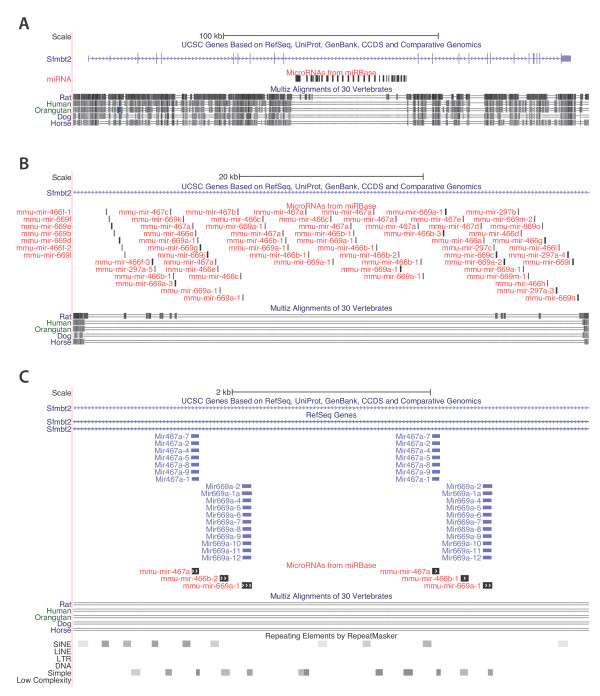
We studied a large miRNA gene cluster in intron 10 of the mouse Sfmbt2 gene using bioinformatic tools.
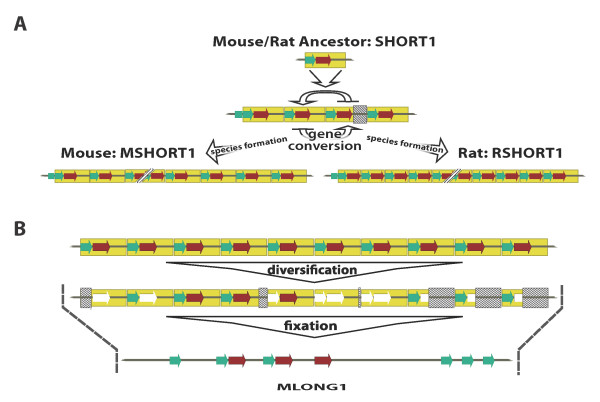
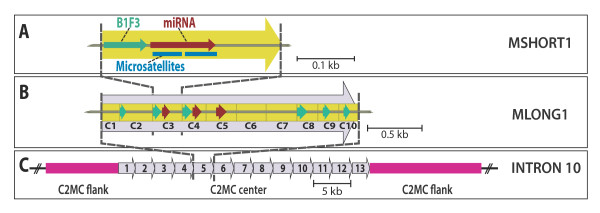
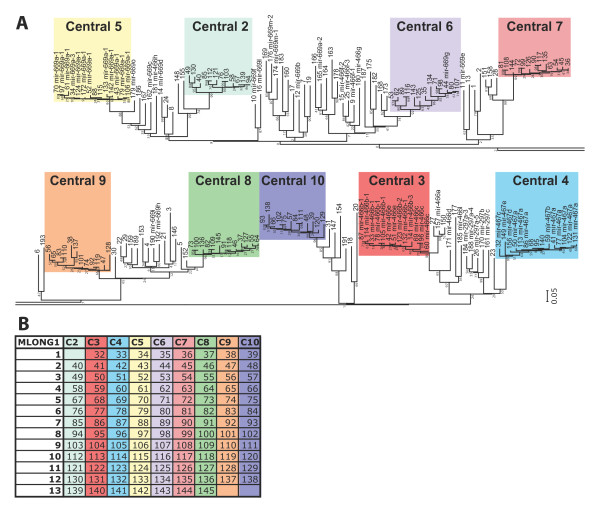
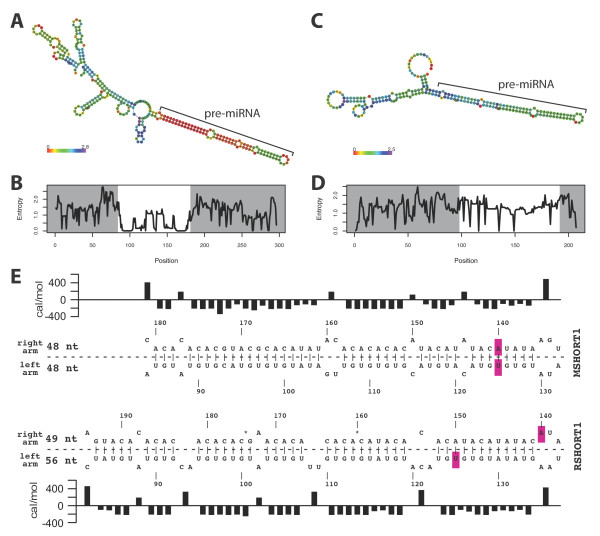
Mice and rats are unique to harbor a 55-65 Kb DNA sequence in intron 10 of the Sfmbt2 gene. This intronic region is rich in regularly repeated B1 retrotransposons together with inverted self-complementary CA/TG microsatellites. The smallest repeats unit, called MSHORT1 in the mouse, was duplicated 9 times in a tandem head-to-tail array to form 2.5 Kb MLONG1 units. The center of the mouse miRNA gene cluster consists of 13 copies of MLONG1. BLAST analysis of MSHORT1 in the mouse shows that the repeat unit is unique for intron 10 of the Sfmbt2 gene and suggest a dual phase model for growth of the miRNA gene cluster:arrangement [corrected] of 10 MSHORT1 units into MLONG1 and further duplication of 13 head-to-tail MLONG1 units in the center of the miRNA gene cluster. Rats have a similar arrangement [corrected] of repeat units in intron 10 of the Sfmbt2 gene. The discrepancy between 65 miRNA genes in the mouse cluster as compared to only 1 miRNA gene in the corresponding rat repeat cluster is ascribed to sequence differences between MSHORT1 and RSHORT1 that result in lateral-shifted, less-stable miRNA precursor hairpins for RSHORT1.
Our data provides new evidence for the emerging concept that lineage-specific retroposons have played an important role in the birth of new miRNA genes during evolution. The large difference in the number of miRNA genes in two closely related species (65 versus 1, mice versus rats) indicates that this species-specific evolution can be a rapid process.
负责生物体 miRNA 库的基因组中 miRNA 基因的总数并不确切知晓。此外,新的 miRNA 基因在进化过程中是如何产生的问题也不完全清楚。最近在人类和负鼠中的数据表明,短散在核元件类的逆转座子有助于 miRNA 基因簇的生长。
我们使用生物信息学工具研究了小鼠 Sfmbt2 基因 10 号内含子中的一个大型 miRNA 基因簇。
小鼠和大鼠是唯一在 Sfmbt2 基因 10 号内含子中拥有 55-65kb 大小 DNA 序列的物种。该内含子区域富含规则重复的 B1 逆转座子,以及反向互补的 CA/TG 微卫星。最小的重复单元在小鼠中被称为 MSHORT1,以串联头对头的方式重复 9 次形成 2.5kb 的 MLONG1 单元。小鼠 miRNA 基因簇的中心由 13 个 MLONG1 组成。对小鼠 MSHORT1 的 BLAST 分析表明,重复单元是 Sfmbt2 基因 10 号内含子所特有的,并提出了 miRNA 基因簇生长的双相模型:10 个 MSHORT1 单元排列成 MLONG1,然后在 miRNA 基因簇的中心进一步重复 13 个头对头的 MLONG1 单元。大鼠的 Sfmbt2 基因 10 号内含子也有类似的重复单元排列。小鼠簇中 65 个 miRNA 基因与大鼠对应重复簇中仅 1 个 miRNA 基因之间的差异归因于 MSHORT1 和 RSHORT1 之间的序列差异,导致 RSHORT1 的 miRNA 前体发夹侧向移位,稳定性降低。
我们的数据为新兴概念提供了新的证据,即谱系特异性逆转座子在进化过程中对新 miRNA 基因的产生起到了重要作用。两个密切相关物种(小鼠与大鼠)中 miRNA 基因数量的巨大差异表明,这种物种特异性进化可以是一个快速的过程。