Center for Observational Research, Amgen Inc., Thousand Oaks, CA, USA;
Clin Epidemiol. 2011;3:139-48. doi: 10.2147/CLEP.S17191. Epub 2011 Apr 28.
The role of histology in the targeted management of nonsmall cell lung cancer (NSCLC) has garnered renewed attention in recent years. We provide contemporary population-based estimates of survival and an assessment of important prognostic factors in stage IV NSCLC by major histologic subtype.
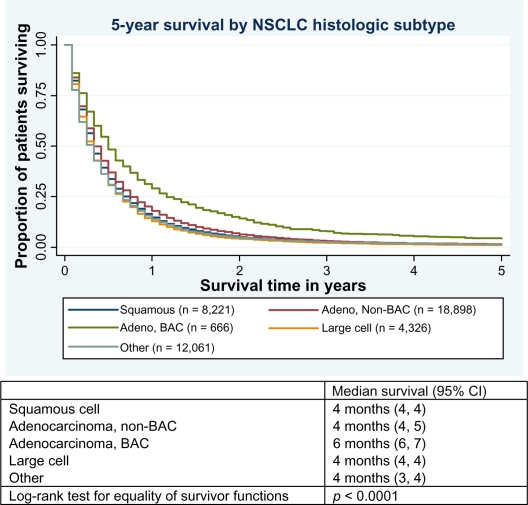
Using data from the Surveillance, Epidemiology and End Results (SEER) Program, we stratified 51,749 incident stage IV NSCLC patients (1988-2003 with follow-up through 2006) by major histologic subtype. We used Kaplan-Meier and Cox proportional hazards methods to describe overall survival and the prognostic influence of select patient, tumor, and treatment characteristics for each histologic subgroup.
Survival was highest in patients with bronchioloalveolar adenocarcinoma (1-year survival: 29.1%) and lowest in those with large cell tumors (1-year survival: 12.8%). Diagnosis in later years, female gender, younger age, either Asian/Pacific Islander or Hispanic race/ethnicity, lower tumor grade, and surgery or beam radiation as part of first-line treatment were generally independently associated with a decreased risk of death, but the prognostic significance of some of these factors (age, ethnicity, tumor grade) varied according to histologic subtype.
Findings demonstrate a poor prognosis across histologic subtypes in stage IV NSCLC patients but highlight differences in both absolute survival and the relative importance of select prognostic factors by histologic subclassification. More research using other sources of population-based data could help clarify the role of histology in the presentation, management, and prognosis of late-stage NSCLC.
近年来,组织学在非小细胞肺癌(NSCLC)的靶向治疗中的作用重新引起了关注。我们提供了当代基于人群的 IV 期 NSCLC 生存估计值,并按主要组织学亚型评估了 IV 期 NSCLC 的重要预后因素。
使用来自监测、流行病学和最终结果(SEER)计划的数据,我们按主要组织学亚型对 51749 例新发 IV 期 NSCLC 患者(1988-2003 年,随访至 2006 年)进行分层。我们使用 Kaplan-Meier 和 Cox 比例风险方法描述了每个组织学亚组的总体生存率以及选择的患者、肿瘤和治疗特征对预后的影响。
细支气管肺泡腺癌患者的生存率最高(1 年生存率:29.1%),大细胞肿瘤患者的生存率最低(1 年生存率:12.8%)。较晚的诊断年份、女性、年轻、亚裔/太平洋岛民或西班牙裔种族/民族、较低的肿瘤分级、以及手术或射线治疗作为一线治疗的一部分,通常与死亡风险降低独立相关,但这些因素中的一些(年龄、种族、肿瘤分级)的预后意义因组织学亚型而异。
这些发现表明,IV 期 NSCLC 患者的所有组织学亚型预后均较差,但强调了通过组织学亚分类,在绝对生存率和某些选择预后因素的相对重要性方面存在差异。使用其他人群来源的数据进行更多研究可以帮助阐明组织学在晚期 NSCLC 的表现、治疗和预后中的作用。