Aga Khan University Medical College, Karachi, Pakistan.
BMC Public Health. 2011 May 24;11:379. doi: 10.1186/1471-2458-11-379.
Living in a world greatly controlled by mass media makes it impossible to escape its pervading influence. As media in Pakistan has been free in the true sense of the word for only a few years, its impact on individuals is yet to be assessed. Our study aims to be the first to look at the effect media has on the body image of university students in a conservative, developing country like Pakistan. Also, we introduced the novel concept of body image dissatisfaction as being both negative and positive.
A cross-sectional study was conducted among 7 private universities over a period of two weeks in the city of Karachi, Pakistan's largest and most populous city. Convenience sampling was used to select both male and female undergraduate students aged between 18 and 25 and a sample size of 783 was calculated.
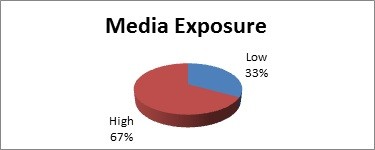
Of the 784 final respondents, 376 (48%) were males and 408 (52%) females. The mean age of males was 20.77 (+/- 1.85) years and females was 20.38 (+/- 1.63) years. Out of these, 358 (45.6%) respondents had a positive BID (body image dissatisfaction) score while 426 (54.4%) had a negative BID score. Of the respondents who had positive BID scores, 93 (24.7%) were male and 265 (65.0%) were female. Of the respondents with a negative BID score, 283 (75.3%) were male and 143 (35.0%) were female. The results for BID vs. media exposure were similar in both high and low peer pressure groups. Low media exposure meant positive BID scores and vice versa in both groups (p < 0.0001) showing a statistically significant association between high media exposure and negative body image dissatisfaction. Finally, we looked at the association between gender and image dissatisfaction. Again a statistically significant association was found between positive body image dissatisfaction and female gender and negative body image dissatisfaction and male gender (p < 0.0001).
Our study confirmed the tendency of the media to have an overall negative effect on individuals' body image. A striking feature of our study, however, was the finding that negative body image dissatisfaction was found to be more prevalent in males as compared to females. Likewise, positive BID scores were more prevalent amongst females.
生活在一个被大众媒体高度控制的世界里,人们不可能逃避其无处不在的影响。由于巴基斯坦的媒体只有几年才真正实现了自由,因此其对个人的影响尚未得到评估。我们的研究旨在首次观察媒体对巴基斯坦这样一个保守的发展中国家大学生的身体形象的影响。此外,我们引入了身体形象不满既是消极的也是积极的新概念。
在巴基斯坦最大和人口最多的城市卡拉奇的 7 所私立大学进行了一项横断面研究。采用便利抽样法选择年龄在 18 至 25 岁之间的男女本科生,计算样本量为 783 人。
在 784 名最终回答者中,男性 376 人(48%),女性 408 人(52%)。男性的平均年龄为 20.77(+/-1.85)岁,女性为 20.38(+/-1.63)岁。其中,358 名(45.6%)受访者的 BID(身体形象不满)评分呈阳性,426 名(54.4%)呈阴性。在 BID 评分呈阳性的受访者中,男性 93 人(24.7%),女性 265 人(65.0%)。BID 评分呈阴性的受访者中,男性 283 人(75.3%),女性 143 人(35.0%)。高朋辈压力组和低朋辈压力组的 BID 与媒体暴露结果相似。两组中,低媒体暴露均与 BID 评分呈阳性相关,反之亦然(p<0.0001),表明高媒体暴露与负面身体形象不满之间存在统计学显著关联。最后,我们观察了性别与形象不满之间的关系。再次发现,女性的积极身体形象不满与女性之间存在统计学显著关联,而男性的消极身体形象不满与男性之间存在统计学显著关联(p<0.0001)。
我们的研究证实了媒体对个人身体形象的整体负面影响。然而,我们研究的一个显著特点是,与女性相比,男性的负面身体形象不满更为普遍。同样,女性的积极 BID 评分更为普遍。