Department of Medicine, University of British Columbia, Vancouver, BC, Canada.
BMC Med Educ. 2011 May 24;11:23. doi: 10.1186/1472-6920-11-23.
Traditional Objective Structured Clinical Examinations (OSCEs) are psychometrically sound but have the limitation of fragmenting complex clinical cases into brief stations. We describe a pilot study of a modified OSCE that attempts to balance a typical OSCE format with a semblance of a continuous, complex, patient case.
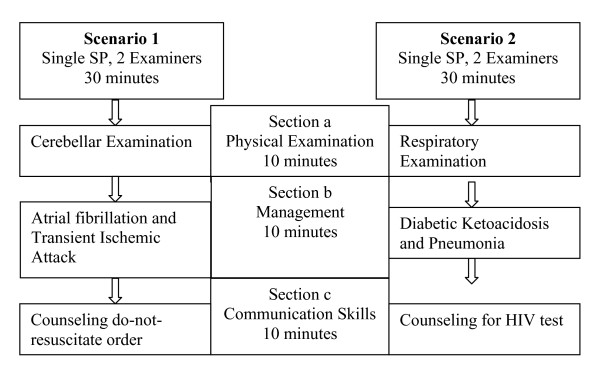
Two OSCE scenarios were developed. Each scenario involved a single standardized patient and was subdivided into three sequential 10 minute sections that assessed separate content areas and competencies. Twenty Canadian PGY-4 internal medicine trainees were assessed by trained examiner pairs during each OSCE scenario. Paired examiners rated participant performance independent of each other, on each section of each scenario using a validated global rating scale. Inter-rater reliabilities and Pearson correlations between ratings of the 3 sections of each scenario were calculated. A generalizability study was conducted. Participant and examiner satisfaction was surveyed.
There was no main effect of section or scenario. Inter-rater reliability was acceptable. The g-coefficient was 0.68; four scenarios would achieve 0.80. Moderate correlations between sections of a scenario suggest a possible halo effect. The majority of examiners and participants felt that the modified OSCE provided a sense of patient continuity.
The modified OSCE provides another approach to the assessment of clinical performance. It attempts to balance the advantages of a traditional OSCE with a sense of patient continuity.
传统的客观结构化临床考试(OSCE)具有心理测量学上的优势,但存在将复杂的临床病例分解为简短站点的局限性。我们描述了一项试点研究,该研究对修改后的 OSCE 进行了尝试,旨在平衡典型的 OSCE 格式与类似连续、复杂的患者病例。
开发了两个 OSCE 场景。每个场景都涉及一个单一的标准化患者,并细分为三个连续的 10 分钟部分,评估单独的内容领域和能力。在每个 OSCE 场景中,由经过培训的考官对 20 名加拿大 PGY-4 内科住院医师进行评估。考官对每个场景的每个部分独立于彼此进行评估,使用经过验证的综合评分量表进行评估。计算了每个场景的 3 个部分的评分之间的组内相关性和 Pearson 相关性。进行了可推广性研究。对参与者和考官的满意度进行了调查。
没有部分或场景的主要影响。组内相关性可接受。g 系数为 0.68;四个场景将达到 0.80。场景的各部分之间存在中等相关性,这表明可能存在晕轮效应。大多数考官和参与者认为修改后的 OSCE 提供了一种患者连续性的感觉。
修改后的 OSCE 提供了评估临床绩效的另一种方法。它试图平衡传统 OSCE 的优势与患者连续性的感觉。